City Guide
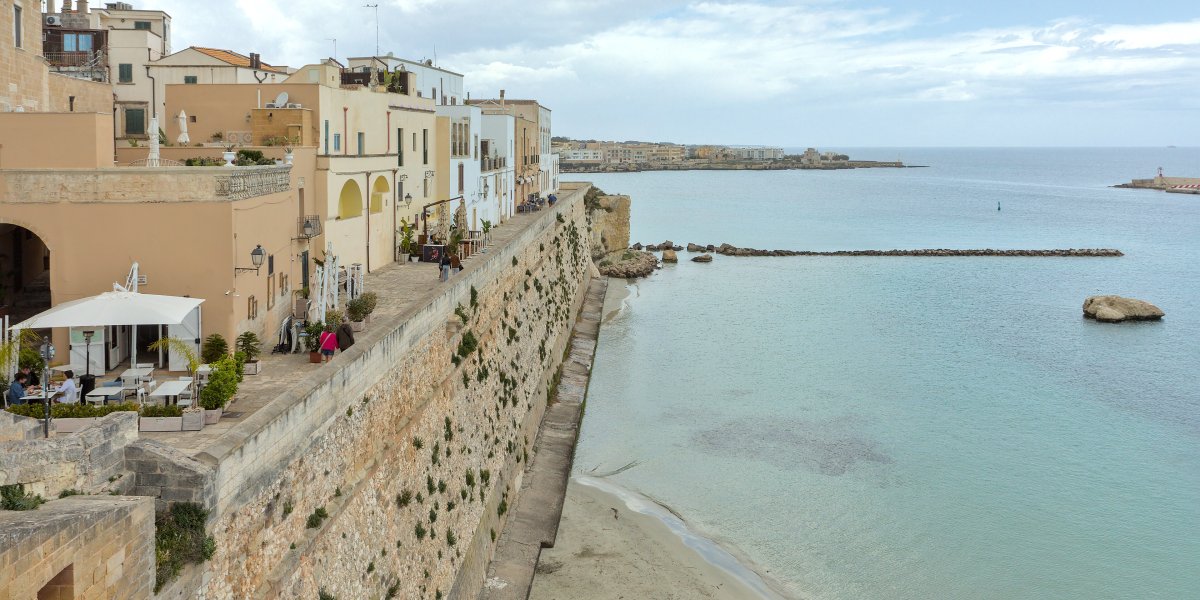
Otranto
Italy · Best time to visit: May-Sep.
Day-by-day plan
Choose your pace
Trip length
08:30
Landmark
Begin at the harbor and walk two minutes along the marina — the moat opens in front of you like a stage set. This pentagonal 15th-century fortress is the castle Horace Walpole never visited but borrowed for the very first Gothic novel; standing under its scarred sandstone walls at this hour, with the sun still low behind you, you understand why the imagination ran wild. Skip buying a ticket — the exterior ramparts and the moat walk give you everything you came for.
Tip: Walk the moat path counter-clockwise to reach the south-east bastion overlooking the sea — at 08:30 the rising sun lights the cream walls golden while the harbor is still in shadow, the only window for this contrast all day.
Open in Google Maps →10:00
Religious
Leave the castle through the small Porta Alfonsina, climb the narrow stepped lane of Via Basiliani for four minutes through whitewashed houses, and the unassuming Romanesque facade appears almost without warning. Inside lies the reason every traveler in Salento eventually comes to Otranto: 16,000 square feet of 12th-century mosaic floor — the Tree of Life by the monk Pantaleone — covering the entire nave like a frozen tapestry. Walk the wooden planks slowly; this is one of the largest medieval mosaics in Europe and it is entirely free.
Tip: Step into the right transept to find the Chapel of the Martyrs — the glass cases hold the actual skulls of the 813 citizens beheaded by the Ottomans in 1480. Most tour groups miss it because it is unmarked on the floor plan; arrive before 10:30 and you will have it to yourself.
Open in Google Maps →11:30
Landmark
Exit the cathedral, turn right onto Via Duca degli Abruzzi and follow it east for six minutes until the alleys spill abruptly onto the city walls. The Pelasgian Bastion is the north-east corner of the old town — a flat stone terrace dropping straight into water so clear you can see the rocks twenty feet down. This is the first place on the route where you face directly toward Albania; on a clear morning you can pick out the Karaburun peninsula on the horizon, 80 km away.
Tip: The flat stone slabs to the left of the bastion are where locals jump in for a swim — if you brought swimwear under your clothes, this is your one chance today, and the water is calmer here than at any beach because the bastion blocks the swell.
Open in Google Maps →12:45
Food
Walk back into the old town along Corso Garibaldi for four minutes — the Salento sun is now overhead and the lane smells of almond. Martinucci is the Salentine pastry institution, and their Otranto counter does the regional specialty fast: a puccia (a soft round bread split open and stuffed) with capocollo, mozzarella and grilled vegetables for around €7, and a pasticciotto leccese — warm shortcrust filled with custard — for €1.80. Eat standing at the counter; this is exactly how locals do lunch in summer.
Tip: Order the pasticciotto al pistacchio, not the classic one — the pistachio version is what residents from Lecce drive down specifically for. Ask for it 'caldo' (warm) and they will pull one from the oven tray; never accept a refrigerated pasticciotto, the custard turns gummy.
Open in Google Maps →14:00
Landmark
From the pastry shop, walk south along the Lungomare degli Eroi past the small Byzantine church of San Pietro, follow the coastal road as it curves past Baia dell'Orte, then pick up the cliff trail at Torre del Serpe — about 5 km one-way along bare limestone cliffs the color of bone, with the Adriatic 50 m below. Punta Palascia is the easternmost point of Italy; the small black-and-white lighthouse marks the exact line where the Adriatic ends and the Ionian begins, and on a clear afternoon you genuinely see the two seas meet in a long ripple. You came to Otranto to say you'd been; this is the photograph that proves it.
Tip: Wear real shoes, not sandals — the trail is sharp karst rock and there is zero shade for the full distance. Carry 1.5L of water from town; the only fountain on the route is at Torre del Serpe and it is sometimes dry in August. Turn back by 17:30 or you will be walking the cliff edge in fading light.
Open in Google Maps →19:30
Food
Walk back into the old town through Porta Terra — eight minutes from the harbor along Via Cenobio Basiliano. After 15 km on your legs you have earned a proper sit-down, and L'Altro Baffo is where chef Christian Cosi reinterprets Salento seafood with the restraint of a fine-dining kitchen. Order the raw red prawns of Gallipoli (€22) — sweeter than any langoustine you have eaten — and the spaghetto with sea urchin and lemon zest (€26). The wine list leans hard on Salentine Negroamaro; ask the sommelier for a glass of Calafuria rosé from Tormaresca.
Tip: Reserve before 18:00 the same day or you will not get a table — the dining room is small and books out from June onward. Avoid the restaurants on Lungomare degli Eroi with the printed photo menus and English-only barkers; they are the classic Salento tourist trap, charging €30 for frozen fritto misto that costs €12 inland.
Open in Google Maps →Jump to day
09:00
Religious
Walk three minutes uphill from the centro storico — at 9 sharp the cathedral opens and the 12th-century Tree of Life floor mosaic is essentially yours, before any cruise group arrives. Spanning all 16,000 sq ft of the nave, the mosaic maps a complete medieval cosmology underfoot: Adam, Eve, the months, biblical kings, even Alexander the Great riding griffins. End in the side chapel of the Martyrs, where 813 skulls from the 1480 Ottoman sack stare from glass reliquaries — the most haunting room in Salento.
Tip: Buy the €1 mosaic ticket at the entrance — without it the verger keeps you behind a low rope and you cannot walk the central nave. Wear soft soles; locals genuinely walk on the mosaic every Sunday, but heels will get a stern look.
Open in Google Maps →11:00
Religious
Exit the cathedral, turn left into Via Duca degli Abruzzi, and walk five minutes through whitewashed alleys hung with laundry and bougainvillea to reach this tiny 10th-century Byzantine church. Built on a Greek cross plan, it still holds faded frescoes of the Last Supper on its central dome; fifteen minutes inside is enough. Afterwards, lose yourself in the labyrinth around Via Pretoria and Via Cattedrale — every wall lime-washed white, every door Greek-island blue, every corner a photograph.
Tip: San Pietro closes at 12:00 for the long lunch break and does not reopen until 16:00 — be inside by 11:45 at the latest. The dome frescoes are clearest standing directly under the centre looking up at a 45-degree angle; flash is forbidden but a steady phone at 1/15s works.
Open in Google Maps →12:30
Food
Two minutes from San Pietro on Via Rondachi — a noisy family trattoria where the lunch crowd is fishermen, masons, and off-duty carabinieri from the station up the road. Order the puccia salentina al tonno e capperi (€8, a round flatbread split open and stuffed with tuna, capers, and Pachino tomato) and a half-portion of orecchiette con cime di rapa (€9). A glass of Negroamaro is €4 — this is what locals eat on a Tuesday.
Tip: Arrive by 12:30 or expect a 20-minute wait — they do not take lunch reservations. Skip dessert here and walk five minutes back to Pasticceria Martinucci on Corso Garibaldi for a pasticciotto leccese (€1.80), the warm custard tart Salentini have for elevenses.
Open in Google Maps →15:00
Landmark
Walk south down Corso Garibaldi for three minutes — the castle's pentagonal bulk grows out of the harbour cliffs ahead. Built in 1485 on Ferdinand of Aragon's orders to harden the town against another Ottoman raid, this fortress so haunted English diplomat Horace Walpole that in 1764 he wrote the first Gothic novel and named it The Castle of Otranto. Walk the ramparts first, then descend into the dry moat and dungeons; the upper rooms host rotating contemporary-art shows.
Tip: Go straight to the eastern seaward rampart first — by 16:00 it fills with cruise-ship day-trippers bussed in from Brindisi. From that bastion the view stretches all the way south to Punta Palascìa, a useful preview of tomorrow's walk.
Open in Google Maps →17:30
Neighborhood
Exit the castle by the western gate, drop down to the Lungomare degli Eroi, and walk twenty minutes north along the seafront — the curve of the bay opens up with the cathedral campanile floating above the white roofs. At the far end, climb up onto Porta Alfonsina (the 1481 town gate rebuilt after the Ottoman siege), then on into the Bastione dei Pelasgi: cyclopean stones believed to predate Greek Otranto by a thousand years. The setting sun is behind the town, so the white facades burn honey gold from the west while the Adriatic behind you darkens to ink.
Tip: Position yourself on top of Porta Alfonsina at 18:30 facing east — at exactly that hour the cathedral campanile catches the last warm light against a deep blue dusk sky. The benches along the inland side of the bastion are the only ones in town that face the actual sunset; everyone else is staring at the sea in the wrong direction.
Open in Google Maps →19:30
Food
Five minutes back through the old town on Via Cenobio Basiliano — a small modern dining room with eight tables, run by chef Cristina Conte who refined her family trattoria into Salento's most quietly exciting kitchen. Order the crudo di gambero rosso di Gallipoli (€22, raw red prawns from the Ionian, dressed with citrus and Salina capers) and the spaghetto ai ricci di mare (€26, with sea urchin pulled that morning). Pair with a Susumaniello rosato from Brindisi (€8 a glass); the seven-course dégustation is €70.
Tip: Reserve at least three days ahead in summer, a week in August — booking via Instagram DM gets faster replies than the phone. Pitfall warning: most of the lungomare restaurants with photo menus and English-speaking touts at the door are tourist traps charging €30 for frozen calamari; the rule is simple — no chalkboard menu in Italian, no real meal.
Open in Google Maps →08:30
Park
Walk south from the centro storico along Via Vittorio Emanuele II for 30 minutes — the road climbs past Otranto's last houses, then opens onto pale limestone cliffs above a turquoise sea. The bauxite quarry, abandoned in the 1970s, has filled with rainwater to form a small emerald-green lake ringed by walls of fierce iron-red ore — Mars colliding with the Caribbean. At 9 am the low eastern sun saturates the red without burning out the green; by noon the contrast flattens completely.
Tip: Approach from the upper rim first — the unmarked dirt path on your left as you reach the quarry leads to a flat shelf 8 metres above the water, the only spot where both the entire red wall and the full green lake fit into a single frame. Do not swim or wade: the water is iron-rich and your swimsuit will stain orange permanently.
Open in Google Maps →10:30
Landmark
Follow the coastal track south from the quarry for 45 minutes — past the broken 13th-century Torre del Serpe (the legend has a thirsty serpent draining its oil at night and dooming the watchmen) and down the headland to the lighthouse. This is the easternmost point of the Italian peninsula: every dawn the sunrise touches Italy here first, and on a clear morning the white cliffs of Albania, 80 km away, lift visibly above the Strait. The 1869 lighthouse is now a UNESCO Mediterranean ecosystems centre; the small museum inside takes twenty minutes.
Tip: Walk down the white-stone path on the south side of the lighthouse to a low rock platform at sea level — at 11:30 the light hits the cliff face full-on and the Albanian coast is at its sharpest. Bring at least 1.5 litres of water per person: there is no fountain, no café, nothing between the quarry and here for the entire stretch.
Open in Google Maps →13:30
Food
Take a 15-minute taxi back to town (€18, call AutoBlu on +39 0836 801120 from the lighthouse) and walk one block off Corso Garibaldi. Sergio has run this room since 1979 and still writes the menu by hand each morning; order the linguine alle vongole veraci (€16, true Adriatic clams that snap open at the table) and a small portion of polpo arrosto (€14, octopus slow-roasted with potato and capers). A half-litre of house Verdeca is €6.
Tip: Ask Sergio's son Marco about la pescata del giorno — whatever he gestures to first is what came off the Otranto boats at dawn. Decline politely if he offers the live lobster: it is excellent but priced for cruise passengers at €80 per kilo.
Open in Google Maps →16:00
Park
Take a 10-minute taxi north on SP366 to the parking lot, then walk fifteen minutes through a fragrant Aleppo pine wood — the trees suddenly open onto a long curve of fine white sand and water of unbelievable transparent turquoise. This is the bay where the Ottoman fleet is said to have landed in 1480 before sacking Otranto. The shore is a protected reserve — no concessions, no umbrellas, no music — so the only sound is wind in the pines and small surf; from 16:00 the families pack up and the bay slowly empties.
Tip: Walk 200 m to the right (north) along the sand to where the cliff steps down — the rocks shelter a smaller cove most day-trippers miss, the water is mirror-still, and it is the best place to swim 30 m offshore and look back at the white cliff and pines. There is no kiosk on the beach: buy water and fruit at the small Coop on Via Alimini before you leave town.
Open in Google Maps →19:00
Neighborhood
Taxi back to town and walk five minutes from the harbour up to the southern town walls. The Pelasgian bastion sits on a layer of cyclopean stones — uncut boulders so old that the medieval and Aragonese walls above rest on them like later sentences on the same page. Otranto faces east into the Adriatic, so the sun sets behind the town: the last light burns the white facades into gold while the sea below you turns matte slate-blue.
Tip: Sit on the inland-facing parapet just west of the castle — there is a single bench under a fig tree that perfectly frames the cathedral campanile against the setting sun. Locals begin the evening passeggiata here between 19:15 and 19:45; arrive a few minutes before to claim the bench.
Open in Google Maps →20:30
Food
Three minutes' walk into the centro storico on Via Rondachi — a candlelit wine bar with eighteen seats, vaulted stone ceilings, and a wall of small-producer Salento bottles (Cantele, Apollonio, Garofano) you will not see in any export catalogue. Order the tartare di tonno con burrata e pistacchio di Bronte (€18) and the bombette di Cisternino (€16, small pork rolls stuffed with caciocavallo and wild herbs). A glass of well-aged Primitivo di Manduria from owner Gianni's personal selection is €9.
Tip: Reserve the small interior alcove (table 7) when you book — it has its own arched ceiling and is the most romantic seat in town. Pitfall warning: avoid the late-night gelato carts along Corso Garibaldi charging €5 for an industrial scoop; the only true artisanal gelato in Otranto is Pasticceria Martinucci on the same street, which closes at 22:30 sharp.
Open in Google Maps →
Trip builder
Plan this trip around Otranto
Turn this guide into a bookable rail itinerary with FlipEarth.
Keep exploring
Related cities
More in the same country
FAQ
Frequently asked questions
How many days do you need in Otranto?
Most travelers enjoy Otranto in 1 days, with enough time for headline sights and a slower meal or museum stop.
What's the best time to visit Otranto?
The easiest season for most travelers is May-Sep, especially if you want good weather and manageable crowds.
What's the daily budget for Otranto?
A practical starting point is about €110 per person per day before hotels, then adjust based on museums, dining, and transport.
What are the must-see attractions in Otranto?
A good first shortlist for Otranto includes Aragonese Castle of Otranto, Bastione dei Pelasgi, Punta Palascia Lighthouse.