City Guide
Merano
Italy · Best time to visit: Apr-Oct.
Day-by-day plan
Choose your pace
Trip length
09:00
Park
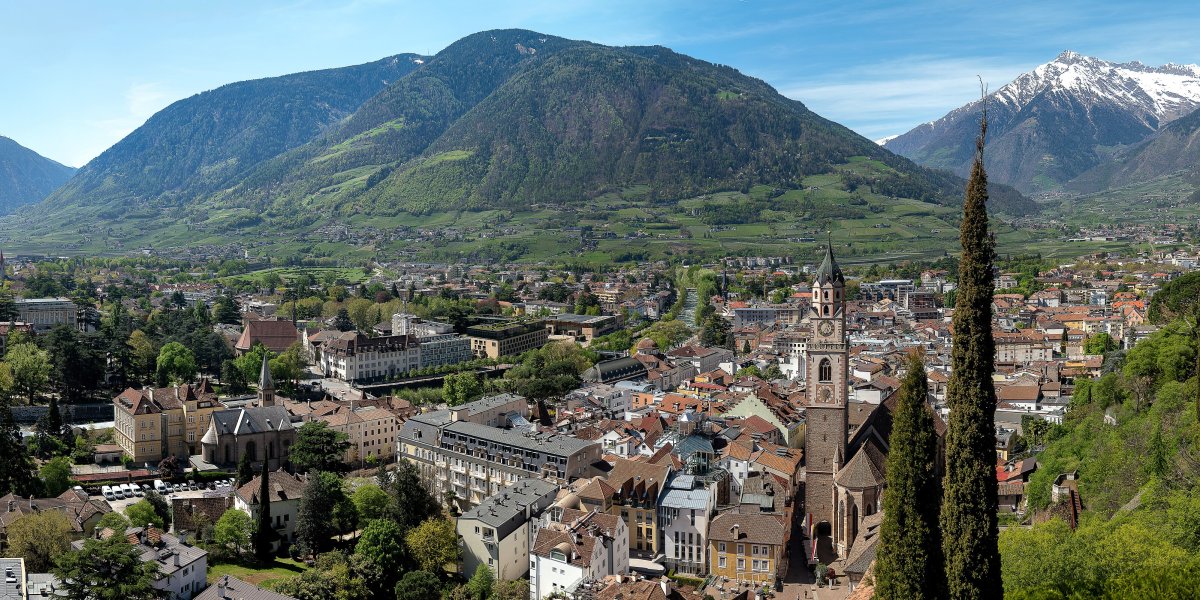
From Merano train station, take bus 1A directly to 'Trauttmansdorff' (10 min) and arrive at 9:00 sharp when the gates open — the south-facing amphitheatre of gardens belongs to about thirty people for the first hour instead of three thousand by midday. Spiral downward through Mediterranean palms, rice paddies, lotus ponds and the famous Lily Pond toward the Matteo-Thun viewing platform that juts over the valley. Skip Sisi's Touriseum inside the castle; the outdoor terraces, the Tuscan cypresses and the snow-streaked Texelgruppe peaks behind the castle are the entire point of coming.
Tip: The Matteo-Thun platform is the only angle where castle + cypresses + alpine peaks stack into one frame — shoot before 10:30 while the light is still sidelit and the haze hasn't risen off the Adige valley. Tickets are €2 cheaper if you buy online the night before via trauttmansdorff.it.
Open in Google Maps →12:00
Food
Exit the gardens by the lower (south) gate and follow the brown 'Sissi-Weg' signs westward — a 35-minute downhill stroll along the Passer river past chestnut groves drops you straight into Laubengasse. Slip into Pur Südtirol at Portici 44, a wood-lined emporium where every speck, cheese and apple carries the name of its South Tyrolean farmer. Order the Speck & Vinschgerl tasting board (€14) with a glass of Lagrein Kretzer rosé; the standing counter clears in 40 minutes and keeps you sharp for the afternoon.
Tip: Ask specifically for Recla speck from Lana — smoke-cured only, no liquid smoke — and Graukäse from the Ahrntal as a side. Ignore every 'Speckstube' along the arcades with photo menus; they cure nothing themselves and are double the price.
Open in Google Maps →13:15
Neighborhood
Step out of Pur and the entire 800-year-old arcaded street is at your feet — kinked deliberately so the winter wind from the Vinschgau can't run its full length. Walk it slowly westward beneath the painted 15th-century house fronts, duck into the hidden courtyard at number 192 for its forgotten fountain, then emerge at the late-Gothic Cathedral of St. Nicholas whose 83-metre spire is the tallest in all of Tyrol. The Gothic 'Judgment Doors' on the south façade and the tiny Romanesque chapel of St. Barbara hiding behind the apse are the photographs locals never tell you about.
Tip: The arcade has two halves: 'Wasserlauben' on the river (north) side is shaded and where locals actually shop for groceries; 'Berglauben' on the mountain (south) side is sunnier and full of tourist boutiques. Stay on the north arcade for honest bakeries — Erb at number 360 has the only proper Vinschgerl bread left in town.
Open in Google Maps →14:45
Landmark
From the cathedral square walk 4 minutes south to the Theatre Bridge — the Belle Époque Kurhaus appears across the river like a wedding cake of butter-yellow stucco and copper domes. Walk the south-bank Passerpromenade westward beneath the original 1914 Art Nouveau iron railings and palm-lined benches where Sisi's court strolled, then loop back over the Steinerner Steg (Stone Bridge) for the canonical postcard shot — Kurhaus, palms and snowy peaks stacked in three layers. The afternoon backlight at 15:00 lights the rotunda's gold lettering exactly.
Tip: The 'Pavillon des Fleurs' wing of the Kurhaus has Merano's finest ceiling fresco — push through the lobby door (free, no concert ticket needed) and look up for thirty seconds. Refuse the staged horse-and-carriage tours out front: they trot the same 400-metre loop and charge €60.
Open in Google Maps →15:45
Park
Cross back over the Stone Bridge and climb 200 m up Galileo-Galilei-Straße to the medieval Powder Tower — the stone steps behind it deliver you onto the Tappeiner Promenade, a 4-km level path carved into the hillside in 1893 and planted with 400 species that survive only here because of Merano's freak microclimate. Walk westward through agaves, fan palms, cork oaks and olive trees with the old town glowing below and the Vinschgau vineyards turning copper. The window from 16:00 to 18:30 is the entire reason you came: south-facing sun lights the valley directly, and the Texelgruppe peaks pink at golden hour.
Tip: Don't try to walk the full 4 km to Quarazze — instead exit at the 'St. Peter' marker (about halfway, 35 min in), descend the 300-step staircase down to the riverside and you land 5 minutes from dinner. Signage is German-only; the German word is 'Abstieg.' This is the locals' shortcut.
Open in Google Maps →19:00
Food
From the foot of the Tappeiner staircase, walk 5 minutes south along Corso Libertà to the brewery's century-old Stube under coffered larchwood ceilings — this is where Merano's lawyers, mountain guides and grocers genuinely eat dinner. Order Specknödel in clear beef broth (€11) followed by the Wiener Schnitzel with parsley potatoes and lingonberry (€22), washed down with an unfiltered Forst Felsenkeller pulled from the tank room next door. Arrive at 19:00 to claim a corner Stube without a reservation; after 19:45 only the noisy hall is left.
Tip: Final pitfall warning for Merano: along the Passer river and around Theaterplatz, avoid any 'Tirolese' place with English-only menus, plasticised photo dishes, or staff outside touting passers-by — these are €30 frozen-schnitzel traps built for one-day visitors who'll never return. The three honest sit-downs locals will name are Forst, Kallmünz on Sandplatz, and Sissi (Michelin); everything else around the bridges is theatre.
Open in Google Maps →Jump to day
09:00
Park
Take Bus 4 from Theaterplatz to the garden's lower gate — €2, twelve minutes, leaves every half hour from 08:30. Spread across 12 hectares of hillside, these 80 themed gardens encircle the small castle where Empress Elisabeth of Austria came to recover her health in 1870. The ticket also covers the Touriseum inside the castle, a quietly brilliant museum that retells 200 years of Alpine tourism through life-size dioramas.
Tip: Climb straight to the top tier 'Sunny Gardens' first — by 10:30 tour buses arrive and the panoramic viewing platform jutting over the valley becomes a queue. The lily pond at the lowest terrace photographs best around 10:00, when the sun strikes the lotus heads from the east. Skip the Touriseum audioguide; the visual installations carry themselves.
Open in Google Maps →13:00
Food
Exit the gardens at the lower gate and pick up the Sissi Path (Sissi Weg) — the empress's own daily walking trail along the Passer River, shaded by 150-year-old plane and chestnut trees for thirty flat minutes back into town. Forsterbräu sits at the western end of Freiheitsstraße in a wood-paneled brewery hall pouring its own beer made 4 km up the valley. Order the Speckknödelsuppe (speck dumplings in beef broth, €11) and the Schlutzkrapfen (spinach-ricotta ravioli with brown butter, €14) — both are South Tyrolean canon. Budget €25-35.
Tip: No reservation needed at lunch — walk-ins seated within ten minutes. Take the back garden if the sun is out; the front terrace faces a noisy street. Order the Forst Felsenkeller (dark lager) rather than the pilsner most tourists default to — it pairs properly with smoked speck and is what locals at the next table will be drinking.
Open in Google Maps →14:45
Neighborhood
Walk six minutes east along Freiheitsstraße and slip into the medieval old town. The Laubengasse is a 400-meter covered arcade laid out in 1290 — two parallel rows of merchants' houses with vaulted passageways that have sheltered shoppers from sun and snow for seven centuries. The Wasserlauben (water arcades) face the river; the Berglauben (mountain arcades) face the peaks, and their facades still carry original medieval guild signs above the doorways.
Tip: Step into Pur Südtirol at No. 35 even if you don't intend to shop — it's a curated farmer cooperative where you can sample real apple varieties and aged speck. The narrowest hidden passages branch off near No. 118 (the Steinerner Steg alley) where locals actually walk; the central straight stretch is the tourist lane.
Open in Google Maps →16:00
Religious
Walk two minutes north from the Laubengasse — the 83-meter Gothic spire is already overhead. Built between 1302 and 1465, this is Merano's mother church, marked by an extraordinary 12-meter external fresco of Saint Christopher painted on the south wall in 1450 and a star-vaulted choir with original 14th-century stained glass. The bell tower's perforated stone openwork is unique to Tyrolean Gothic and was once the model for half a dozen valley churches.
Tip: Enter from the south door under the Christopher fresco rather than the main west portal — at 16:00 light through the original choir glass turns the apse cobalt and gold. The small St. Barbara Chapel to the right of the altar holds a 1450 fresco cycle that most visitors walk past entirely.
Open in Google Maps →16:45
Park
Five minutes uphill from the church on Galileistraße you reach the Pulverturm (Powder Tower), the official trailhead. Carved into the southern slope of Küchelberg in 1893 by the physician Franz Tappeiner, this terrace promenade hangs a hundred meters above town and runs four kilometers through a microclimate band where palms, agaves, olive trees and Mediterranean cypress grow against snow-capped Alpine peaks. Walk to the Pulverturm platform and continue west as far as the Gratsch terraces.
Tip: Time it to stand on the Pulverturm platform between 17:30 and 18:30 — the sun drops behind Mount Ifinger and the Texel Alps to the north catch pink alpenglow while the town below falls into shadow. Café Saxifraga, 600 meters in, is the real local pause for a glass of Vernatsch (€4.50) — not a tourist trap, just a quiet bench in the trees.
Open in Google Maps →19:45
Food
Descend the promenade via the Gilf Bridge stairs and walk seven minutes south to Galileistraße 44. Chef Andrea Fenoglio holds one Michelin star in a quietly elegant townhouse that takes its name from the empress herself. The menu reads as modern Italian threaded with Tyrolean memory — order the river trout with horseradish and pickled mountain herbs (€32) and the venison ravioli with Lagrein reduction (€34). Tasting menus run €110-145; à la carte around €85-100 per person.
Tip: Reserve at least three days ahead — only thirty seats and the Michelin listing fills weekends solid. Ask specifically for the small back room overlooking the inner courtyard, not the front salon facing the street. Avoid every restaurant on Corso Libertà between the Kurhaus and the river for dinner — they look romantic from outside but reheat industrial polenta at tourist prices; no local eats there, ever.
Open in Google Maps →09:30
Park
Start at Theaterplatz on the right bank of the Passer and follow the Summer Promenade west along the river. Laid out in 1854 specifically so Habsburg spa guests could take a shaded morning walk, it is lined with monumental Lebanese cedars, ginkgos and magnolias that close overhead into a green nave. At this hour the path belongs to local dog-walkers and joggers, and the only sound is glacial water running over the river stones.
Tip: Cross the iron Steinerner Steg footbridge halfway along and switch to the opposite bank — you'll then be on the Winterpromenade, engineered a century ago to catch the southern winter sun. The two-bank loop is how locals do it; tourists walk one side and miss the temperature and shade contrast that defines the design.
Open in Google Maps →10:45
Museum
Walk four minutes south from the riverside into the old town to Galileistraße. This compact 15th-century residence was built by Archduke Sigismund of Austria in 1470 — not a fortress but a small urban hunting lodge. Six furnished rooms preserve the original armor, painted chests, ceramic stoves and a tiny private chapel, all left essentially untouched. The whole circuit takes under an hour and is one of the very few late-medieval interiors in northern Italy that has never been redecorated.
Tip: Closed Mondays — if today is Monday, swap this stop with Day 1's St. Nicholas slot. Buy the ticket at the desk inside, never online; there is no queue. The wooden ceiling in the Princess's Chamber is the highlight; ask the guard to point out the carved monogram of Eleanor of Scotland (Sigismund's wife) hidden in the corner beam.
Open in Google Maps →12:00
Landmark
Three minutes east along Sparkassenstraße brings you back to the riverside Corso Libertà. The Kurhaus is Merano's Art Nouveau cathedral — built 1874 and extended in 1914 by Friedrich Ohmann, a 90-meter cream-stucco facade with wrought-iron balconies where Habsburg society took the waters and waltzed through every spa season. The Wandelhalle (concert pavilion) is free to walk through; the domed Kursaal inside is open when no event is scheduled.
Tip: Weekday late mornings are the most reliable time to find the Kursaal doors open — peek in even if no concert is on; ask the porter politely and most will let you stand in the doorway for a photo. The eight allegorical statues on the river facade represent the four seasons twice over; the easternmost figure ('Autumn') is the only one to have survived a 1945 bomb strike intact.
Open in Google Maps →13:00
Food
Walk two minutes west along the Corso to Freiheitsstraße 35. This is the producer cooperative for the entire South Tyrolean Alps — a deli, wine bar and lunch counter under one vaulted ceiling that sells only goods from named local farms. Order the Speckbrettl (a wooden board of speck, Graukäse mountain cheese, and Schüttelbrot rye crispbread, €16) with a glass of Vernatsch (€5), or the Knödeltrio (three dumplings — speck, spinach, cheese — with melted butter, €14). Budget €18-25.
Tip: Sit at the high counter facing the wine wall — staff will explain which valley each cheese is from and pour small tastings free. The speck here comes from Recla in Vallelunga, the only producer in town not industrially smoked; once you taste it, supermarket speck is finished for you.
Open in Google Maps →14:30
Entertainment
Walk eight minutes south along the river to Piazza Terme — the glass cube designed by Matteo Thun in 2005, built where the original Habsburg-era bath stood. Inside: 25 pools (12 indoor, 13 outdoor), a separate sauna world with eight saunas, and an 8-hectare landscaped park of century-old trees facing the mountains. The thermal water rises from the radon-rich Vigiljoch spring above town. Three hours covers the pools and a relaxed lap of the park; the full sauna circuit needs its own ticket and another two hours.
Tip: Buy the 'Pool & Park' 3-hour ticket (€27) rather than the more expensive day pass, and arrive at 14:30 sharp — the morning local crowd has just left and the next wave doesn't arrive until 16:30. Claim the outdoor saltwater pool with the Texel Alps view first; the indoor Quellbecken with underwater music is best after 16:00 when low light streams through the west window.
Open in Google Maps →19:45
Food
Walk seven minutes north from the spa, crossing the Theaterplatz to Sandplatz 12. Kallmünz occupies a 16th-century townhouse with a vaulted main dining room, an inner courtyard for warm evenings, and a chef who works regional ingredients with restraint — not fusion, not nostalgia, but a third way locals quietly trust. Order the saddle of Vinschgau lamb with rosemary jus (€34) and the Marillenknödel (apricot dumplings rolled in browned breadcrumbs, €12) for dessert. The wine list goes deep on Lagrein and Vernatsch from neighbors. Budget €55-75.
Tip: Reserve the courtyard between May and September — only 24 seats and they go first. The kitchen stops orders sharp at 21:30, so don't roll in after 20:30. Avoid the cafés crowding the Theaterplatz fountain itself for a nightcap; they mark up Lagrein by 40% after sunset for the view, and the same wine at Vinothek Ungericht around the corner on Steinach is half the price and poured by people who actually know it.
Open in Google Maps →
Trip builder
Plan this trip around Merano
Turn this guide into a bookable rail itinerary with FlipEarth.
Keep exploring
Related cities
More in the same country
FAQ
Frequently asked questions
How many days do you need in Merano?
Most travelers enjoy Merano in 1 days, with enough time for headline sights and a slower meal or museum stop.
What's the best time to visit Merano?
The easiest season for most travelers is Apr-Oct, especially if you want good weather and manageable crowds.
What's the daily budget for Merano?
A practical starting point is about €110 per person per day before hotels, then adjust based on museums, dining, and transport.
What are the must-see attractions in Merano?
A good first shortlist for Merano includes Kurhaus & Passer Promenade.