City Guide
La Rochelle
France · Best time to visit: May-Sep.
Day-by-day plan
Choose your pace
Trip length
09:00
Landmark
Start at the city's western edge where the rampart meets the Atlantic — a 10-minute stroll from any old-town address. This octagonal 15th-century tower served as both lighthouse and prison, and the rampart walk along the sea here is the calmest, most photogenic stretch in La Rochelle before the day crowd arrives. Hug the seaside path eastward to inhale full Atlantic wind before the city wakes up.
Tip: Arrive before 09:30 to have the rampart almost to yourself; the seaside grass strip 50 m west gives the cleanest morning-light shot of the tower silhouetted against open ocean. Skip the interior climb on a one-day visit — the exterior silhouette is what you came for.
Open in Google Maps →11:00
Neighborhood
From the rampart, cut inland along Rue sur les Murs and surface onto Rue du Palais — France's best-preserved medieval arcades, all slate roofs and weathered limestone columns. Follow them east to the Grosse Horloge, the 14th-century clock-gate that has marked the boundary between port and old town for 600 years. Pause for a café crème at Café de la Paix on Place de Verdun, whose gilded Belle Époque salon was a favorite of Georges Simenon.
Tip: Detour onto Rue Chaudrier and Rue des Merciers — quieter than Rue du Palais and the column carvings are noticeably older. The arcades stay dim even at noon, so switch your phone to night mode or open up your aperture for the storefronts.
Open in Google Maps →13:00
Food
Walk 4 minutes north from the Grosse Horloge via Rue du Temple to Place du Marché, where the covered hall hits peak hum at lunch — locals shopping shoulder-to-shoulder with chefs from the harbor restaurants. Eat standing: half a dozen Marennes-Oléron oysters (€9) from the stall in front of the market, then a buckwheat galette with crab (€8), washed down with a glass of chilled Pineau des Charentes. Budget €15-20 for a properly stuffed lunch.
Tip: Skip the photo-menu terraces on Rue Gambetta — the same Marennes oysters cost €15 there instead of €9. The shucker on the east side of the market, where you'll see the longest local queue, is the one to pick.
Open in Google Maps →14:30
Landmark
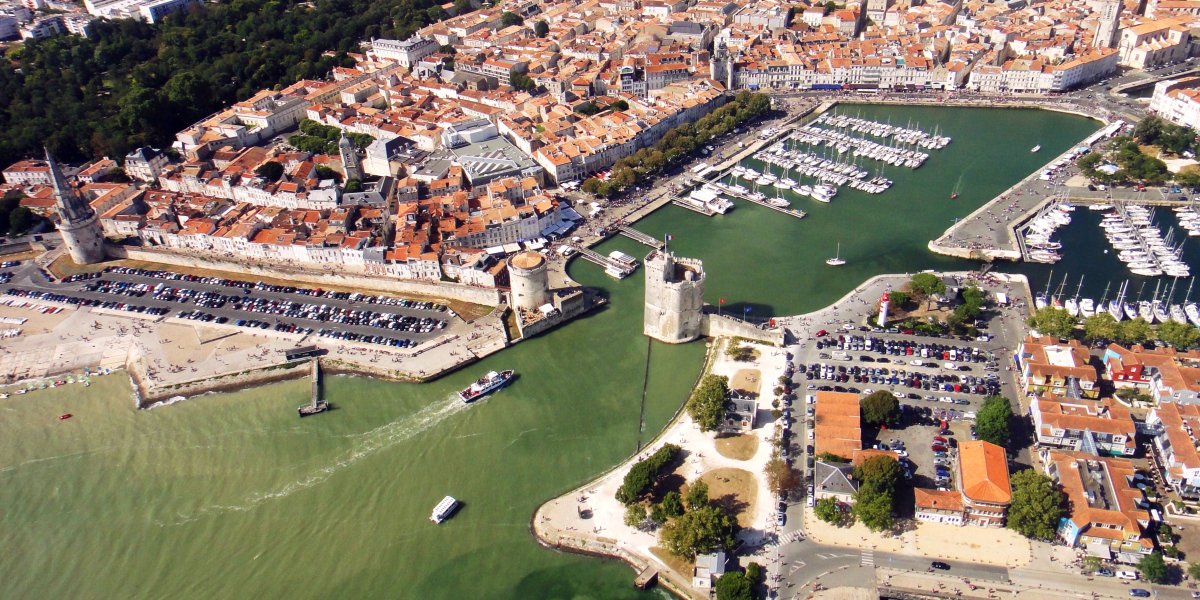
Walk south from the market along Cours des Dames, then east across the lifting footbridge to Quai Louis Prunier — about 12 minutes of pure harbor views. You're not going inside the aquarium today; the prize is the loop walk around the Bassin des Grands Yachts to the Médiathèque jetty, which delivers La Rochelle's magazine-cover shot: three medieval towers framed by mast-forests of moored sailboats. Afternoon sun is now behind you, lighting the limestone towers in full color.
Tip: Walk to the southern tip of the Médiathèque jetty for the cleanest tower panorama with no parked cars in frame. The €19.50 aquarium ticket is poor value on a single-day visit — the exterior walk gives you the postcard for free.
Open in Google Maps →16:30
Landmark
Retrace the lifting bridge and walk west along Cours des Dames to the harbor mouth, arriving just as the light turns gold. A massive iron chain once stretched between Tour Saint-Nicolas and Tour de la Chaîne each night to seal the port; now they frame Atlantic France's most photographed view. Cross between them along the quay to catch both stone faces in honey-colored late-afternoon light.
Tip: Stand on Quai Valin (south side, beside Tour Saint-Nicolas) 30 minutes before sunset — the towers turn honey-orange and small fishing boats slide out for the evening run. The reverse shot from Cours des Dames captures both towers in a single frame around 18:30 in summer.
Open in Google Maps →19:30
Food
Walk 90 seconds from the foot of Tour de la Chaîne to Place de la Chaîne — André has been the harbor's seafood institution since 1947, a labyrinth of fishermen-shack-style rooms hung with nets, oars, and lanterns. Order the plateau de fruits de mer (€52): Marennes oysters, langoustines, whelks, periwinkles, crab claws — paired with a chilled bottle of Muscadet sur Lie (€28). Walk in past 20:00 and you'll face an hour's wait, so phone ahead before 18:00.
Tip: Pitfall warning: the three identical-looking glass-fronted brasseries directly on the quay charge 30% more for frozen Brittany seafood, and the 'fresh local oyster' street carts near the towers fill imported shells with cheaper stock. André, La Cabane des Huîtres, and Les Quatre Sergents are the three names locals actually trust — every other harbor-front sign is a tourist trap.
Open in Google Maps →Jump to day
09:30
Landmark
Begin where the Atlantic begins — at the south side of the harbour mouth, La Rochelle's largest medieval tower stands like a stone giant on the water. Inside, a labyrinth of spiral stairs, chapels and prison cells climbs to a rooftop terrace that opens out over the entire old port, the slate roofs of the old town, and the matching Tour de la Chaîne across the channel. This is the establishing shot of your trip — the photograph you will keep.
Tip: Buy the 'Pass 3 Tours' combo ticket (€13.50) at the first tower — it saves €9 versus single entries and skips the queue at the next two. Climb to the very top terrace, not the intermediate one — most visitors stop too early and miss the open-air view.
Open in Google Maps →11:00
Landmark
Walk back across the harbour drawbridge — five minutes along Quai Valin, with the fishing boats on your right and Saint-Nicolas growing smaller behind you. The Chain Tower is the northern pillar from which, every night until 1858, a giant iron chain was hauled up across the water to seal the port. The interior now houses a beautiful scale model of medieval La Rochelle — go straight to the second floor and study it for ten minutes; it will make everything you see today suddenly make sense.
Tip: The combo ticket from the previous stop covers this entry — no extra cost. The terrace here is lower than Saint-Nicolas but gives the only angle where both towers and the harbour entrance line up in one frame; shoot from the southwest parapet.
Open in Google Maps →12:30
Food
Exit Tour de la Chaîne and walk north up Rue du Port for eight minutes — the cobbles narrow, the arcades begin, and the smell of roasting chickens and butter pulls you in. La Rochelle's covered market is where the city actually eats: a vaulted hall ringed by fishmongers, oyster men shucking Marennes-Oléron straight onto crushed ice, and a handful of bistro counters along the eastern arcade. Order a dozen Fines de Claires Marennes-Oléron (€12) and a glass of Charentes white at the counter of L'Huîtrière de Ré, then a galette saucisse (€4) at the crêpe stand for warmth. Stand-up only, locals shoulder-to-shoulder, no reservations and no chairs needed.
Tip: The market closes at 13:30 sharp — arrive by 12:45 at the latest or the oyster counters start shutting down. The flat-shelled 'huîtres plates' (Belon-style) cost twice as much as Fines de Claires for the same volume — order the Fines unless you specifically want the metallic minerality.
Open in Google Maps →14:30
Neighborhood
From the market, slip down Rue des Merciers — the most photographed street in the city, where every house sits on a granite arcade and no two facades match. Walk slowly: the slate, half-timbered and pink-stone houses lean over you for three blocks until you reach Place de l'Hôtel de Ville. The town hall itself is the only Renaissance flamboyant town hall left in France, and the inner courtyard — free to enter through the side gate — is a hidden jewel of carved stone galleries that almost no day-tripper finds. Continue afterwards along Rue du Palais and Rue Chaudrier to feel the rhythm of arcades that runs almost a kilometre without break.
Tip: The Hôtel de Ville interior is only open for guided tours (€5, Saturdays and Sundays 15:00) — outside those slots, push the small wooden side door on Rue des Gentilshommes; the courtyard stays open until 18:00 and is free.
Open in Google Maps →16:45
Landmark
Walk west along Rue sur les Murs for ten minutes — the path runs on top of the original 14th-century curtain wall, with the harbour on your left and rooftops on your right. The Lantern Tower is the tallest of the three and the most haunting: 162 spiral steps climb past five floors of prisoner graffiti, some carved by English sailors held here in the 1600s, others by Spanish, Dutch and even American captives. The light is best now — late afternoon sun strikes the western parapet and turns the whole limestone tower honey-gold. From the gallery at the top you see the Île de Ré bridge stretching out into the Atlantic.
Tip: Last entry is 45 minutes before closing — in summer (Apr-Sep) that means 17:15 for the 18:00 close. The graffiti is on the third and fourth floors; bring a phone torch — the walls are not lit and most visitors walk past the best ones without noticing them.
Open in Google Maps →19:45
Food
Walk back along the harbour to the corner of Place de la Chaîne and Rue Saint-Jean du Pérot — six minutes east of the Lantern. Café André has been the institution of La Rochelle since 1947, a green-awninged seafood brasserie where retired fishermen still drink at the bar and the dining room is hung with marine memorabilia. Order the Plateau Royal (€58 for two — oysters, langoustines, crab, whelks, prawns, clams) and a bottle of Sauvignon de Touraine (€26). For something lighter, the Moules Marinières (€18) are the city benchmark.
Tip: Reserve by phone (+33 5 46 41 28 24) the morning of — the terrace facing the port is fully booked by 19:00 most nights from June to September. Tourist trap warning for the Vieux Port: every restaurant with a sandwich-board photo of food on the quai between Cours des Dames and Quai Duperré is a tourist pen — same frozen plateau, twice the price; stick to Café André, Les Flots, or anything north of Rue Saint-Jean du Pérot.
Open in Google Maps →09:00
Museum
Cross the small footbridge at the southern end of the Vieux Port — three minutes from any harbour hotel — and you are inside one of Europe's finest aquariums. Twelve thousand creatures from the Atlantic, Mediterranean, tropics and high seas live across 84 tanks, and the route is choreographed like a film: jellyfish in the dark, hammerheads sliding above your head in the shark tunnel, and finally a 50-square-metre coral lagoon that opens out like a cathedral. Allow two and a half hours — anything less and you'll regret rushing the shark tunnel.
Tip: Book online the night before to enter through the priority gate — the on-site queue passes 200 people by 10:30 in July-August. Go straight to the jellyfish room first thing and double back — it's at the end of the route, so it's empty when you arrive but rammed an hour later.
Open in Google Maps →11:45
Museum
Exit the aquarium and walk west along Quai Louis Prunier for five minutes — the masts you can see across the basin are the museum. This is no glass-case museum: you board the boats themselves, including the France 1 weather frigate (the last working French ocean weather ship) and the Angoumois trawler, and walk through engine rooms, captain's quarters and radio rooms exactly as the crews left them. The smell of diesel, rope and salt is the whole point. One hour fifteen is enough to do both ships at a proper pace.
Tip: Go to the France 1 first, not the Angoumois — the lower-deck galley closes for 'cleaning' at 13:00 on weekdays and is the most evocative space in the whole museum. Skip the small exhibit hall on land; it's thin compared to the boats themselves.
Open in Google Maps →13:15
Food
Walk back along the quai toward the colourful wooden houses you can see north of the museum — eight minutes through the Bassin des Chalutiers. The Gabut is the old fishermen's quarter, blue-and-red-and-yellow timber cabins now lined with oyster shacks, and L'Huîtrière is the one locals send their cousins to. Order the 'Assiette du Pêcheur' (€19): half a dozen Marennes-Oléron oysters, four shrimps, two whelks, a slice of rye and salted butter, and a glass of Charentes white. Sit at the outdoor counter facing the boats. No fuss, no menu in five languages.
Tip: Cash and card both fine, but no reservations — arrive by 13:15 to grab one of the six harbour-side counter seats; after 13:30 you'll be inside with no view. Ask for a dash of the house échalote-vinegar mignonette — it's behind the counter, not on the table by default.
Open in Google Maps →14:45
Neighborhood
Step out of lunch and walk five minutes through the Gabut itself — narrow lanes of brightly painted wooden warehouses built by 19th-century fishermen, today repurposed as small ateliers, a bookshop and two galleries. The block is tiny — three streets — but it is the only surviving fishermen's village fabric in the city. Walk a slow loop: Rue Saint-Sauveur, Rue du Brave Rondeau, then along Quai du Gabut. The wood was painted in vivid colours so wives could spot their husbands' boats returning at dawn.
Tip: The best frame for the row of painted houses is from the small drawbridge over the Bassin des Chalutiers, mid-afternoon when the sun lights the eastern faces — not the morning, when they're in shadow. The first-floor balcony of the maritime bookshop 'Librairie Calligrammes' on Rue Saint-Sauveur is open to anyone who buys something and gives a postcard view.
Open in Google Maps →16:15
Park
From the Gabut, walk three minutes back to the Vieux Port and board the Bus de Mer — La Rochelle's electric water shuttle that crosses the harbour mouth to Port des Minimes in seven minutes (€3 one way). On the far side, walk fifteen minutes south along the marina to the Phare du Bout du Monde, the 'Lighthouse at the End of the World' — a faithful replica of the lighthouse built by Argentina at Tierra del Fuego in 1884 and rebuilt here as a monument to that lost original. Continue past it to Plage des Minimes, the city's sandy bay, for a sit, a wade, and a final sunset facing Île de Ré.
Tip: The Bus de Mer runs every 20 minutes April-September until 22:00 — much more pleasant than the 30-minute walk along the marina road. From the lighthouse, walk to the very western tip of the breakwater before sunset: the sun drops directly behind the Île de Ré bridge from late May onwards, a free silhouette photo that hotel rooftops cannot give you.
Open in Google Maps →20:00
Food
Bus de Mer back to the Vieux Port — eight minutes — and walk one minute west along Cours des Dames. Les Flots sits directly under the Tour de la Chaîne in a 17th-century stone house, one Michelin star for Christopher Coutanceau's brother Grégory, and the most graceful place in the city to end a weekend. Order the 'Menu Découverte' (€72, four courses) — almost always opening with the day's raw Marennes oysters, then sole meunière or line-caught bar with samphire and beurre nantais. The wine pairing (€38) leans heavily on small Charentes producers you cannot buy outside the region.
Tip: Reserve at least 48 hours ahead (lesflots.com), and request 'la salle à l'étage' — the upstairs dining room has only six tables and looks directly onto the lit Tour de la Chaîne, a view that the ground-floor terrace does not have. Final pitfall: when leaving, do not walk back along Quai Duperré past midnight on weekends — it is loud, drunk and unrepresentative of the city; cut one block north onto Rue du Port instead, which is quiet, lamplit and the real La Rochelle.
Open in Google Maps →
Trip builder
Plan this trip around La Rochelle
Turn this guide into a bookable rail itinerary with FlipEarth.
Keep exploring
Related cities
More in the same country
FAQ
Frequently asked questions
How many days do you need in La Rochelle?
Most travelers enjoy La Rochelle in 1 days, with enough time for headline sights and a slower meal or museum stop.
What's the best time to visit La Rochelle?
The easiest season for most travelers is May-Sep, especially if you want good weather and manageable crowds.
What's the daily budget for La Rochelle?
A practical starting point is about €100 per person per day before hotels, then adjust based on museums, dining, and transport.
What are the must-see attractions in La Rochelle?
A good first shortlist for La Rochelle includes Tour de la Lanterne & the Sea Rampart, Aquarium Exterior & Bassin des Grands Yachts Loop, Tour Saint-Nicolas & Tour de la Chaîne at Golden Hour.