City Guide
Kutna Hora
Czechia · Best time to visit: Apr-Oct.
Day-by-day plan
Choose your pace
Trip length
09:00
Religious
Exit Kutná Hora hlavní nádraží, turn right and follow Vítězná street for 600 meters — the unassuming chapel sits behind a low cemetery wall, easy to miss. Arrive at the 9:00 opening and you'll have the chandelier strung from 40,000 plague and Hussite-war skulls almost to yourself before the Prague tour buses descend after 10:30. The Schwarzenberg coat of arms in the south corner — a raven made of bones plucking the eye of a Turkish skull — is the single image everyone takes home.
Tip: Tickets have been timed-entry and online-only since 2020 — book the 9:00 slot the night before on sedlec.info or you risk being turned away at the door. Standard tickets do NOT include photography rights; a separate photo permit (around 100 CZK) is sold at the cashier and is enforced strictly. Stand at the back-center underneath the chandelier looking forward for the symmetrical shot — the corner skull-coat-of-arms wants you crouched low, looking up at it.
Open in Google Maps →10:30
Religious
Walk 5 minutes back across the cemetery lawn under the linden trees — you'll spot the bone-white twin spires before you spot the door. This is the masterpiece of Jan Santini's 'Baroque Gothic' style, where ribbed vaults seem to dissolve gravity, and it deliberately answers the chapel of bones you just left: same Cistercian monastery, two visions of death — terror in the crypt, transcendence in the nave. The star-pattern vault over the central nave is unique in European Gothic and worth lying on a pew to study.
Tip: The cathedral closes for liturgy Sunday mornings until 11:00 — a weekday or Saturday visit gives you uninterrupted access. Stand directly under the crossing and look up: the vault's star pattern aligns perfectly only from that single tile. The combined Sedlec ticket sold at the Ossuary covers both this cathedral and the chapel — buy it together, not separately.
Open in Google Maps →12:00
Food
Catch the local bus #1 from the Sedlec stop to Šultysova (8 minutes, 20 CZK from the driver), or walk west along Masarykova for a flat 25-minute approach into the old town. Dačický is the 17th-century beer hall every local in Kutná Hora actually eats at — dark wood paneling, vaulted ceilings, and the only place still pouring the unpasteurized Kutná Hora 12° lager from wooden taps. Order the svíčková (marinated beef sirloin in cream sauce with bread dumplings and a dollop of lingonberry) — this has been the town's plate for four centuries — with a half-liter of the dark Dačický 13°.
Tip: Ask for the denní menu (daily lunch menu, served only 11:00-14:00) — three courses for around 180 CZK, never on the English menu. The summer garden behind the building is shaded and far quieter than the front rooms. No reservation needed before 12:30, but by 13:00 the courtyard fills with regulars.
Open in Google Maps →14:00
Landmark
From Dačický, walk two blocks east down Rakova — the Italian Court rises on the southeast edge of Havlíčkovo náměstí, the medieval royal mint where Bohemia's silver groschen was struck and which financed half the wars of 14th-century Europe. Skip the interior tour and head straight for the courtyard with its delicate chapel oriel window, then through the arch to the lower terrace behind the building, where the Vrchlice valley drops away in the postcard view nobody takes from inside. Walk back up through Havlíčkovo náměstí past the Plague Column and the church of St. James, whose single tilted spire is leaning measurably westward.
Tip: Most visitors photograph Italian Court from the square in front — wrong angle, backlit until late afternoon. Walk down the curved stone steps behind the building to the lower garden terrace: the bay-window oriel reflects the early-afternoon sun directly into your lens, and tour groups never come down here. The terrace is also the only place to see St. James's leaning spire in profile against the mint.
Open in Google Maps →16:00
Religious
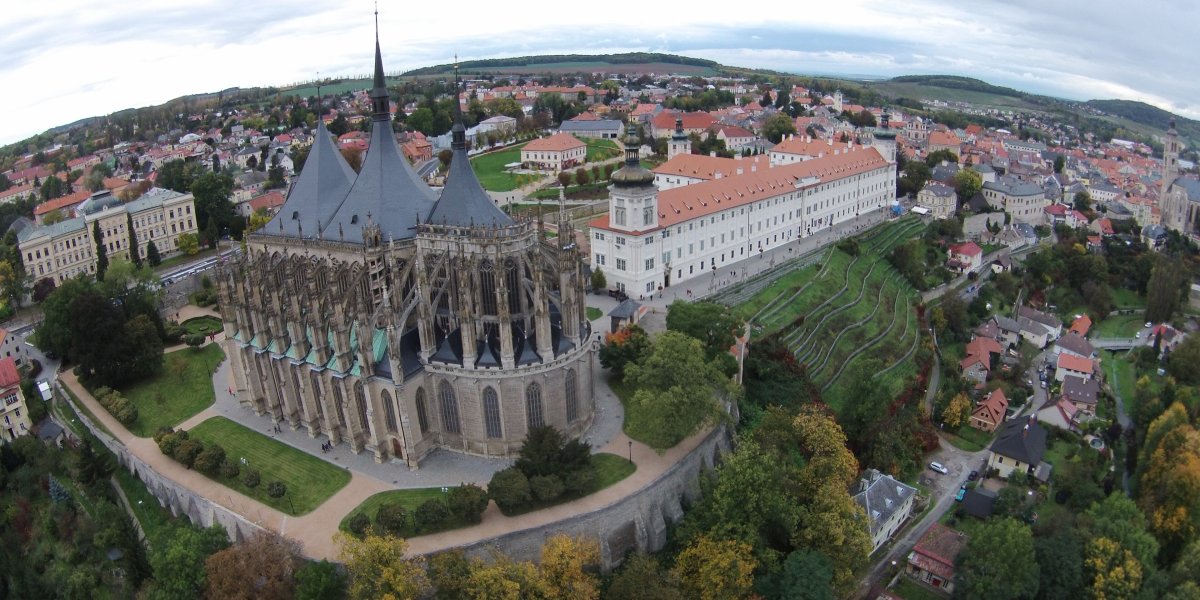
From Italian Court, head south past the Stone House and onto Barborská — the terraced cliff-edge street lined with thirteen Baroque saint statues facing the long Jesuit College, with the tent-roofed spires of St. Barbara's rising at the end like something out of a fairy tale. The cathedral was built by silver miners for their own patron saint, and its three peaked roofs are most beautiful in the last 90 minutes before sunset, when the western light hits the south facade and gilds the flying buttresses. Walk the full perimeter clockwise — the south side, where the buttresses descend toward the valley, is the angle every photograph in every guidebook uses.
Tip: The legendary viewpoint is NOT from Barborská street but from the small downhill road 'Pod Barborou' that loops below the cathedral — three minutes of stairs down on the southwest side, and you frame all three tent spires plus the south facade in one shot, with the Vrchlice valley as the foreground. Aim to be there 60 minutes before sunset for the gold-hour glow; the buttresses go matte after dusk.
Open in Google Maps →19:00
Food
Walk back up Barborská and turn left onto Dačického náměstí — 5 minutes total — to this 16th-century burgher house with stone-vaulted cellars and a fireplace that stays lit even in summer. The kitchen does the duck better than anyone in town: confit duck leg with red cabbage and a pair of bread-and-potato dumplings, finished with house gravy. Order the medovník (eleven-layer Czech honey cake) for dessert and a glass of dry Mělník Ryzlink rýnský from north of Prague — wines you genuinely won't find outside Bohemia.
Tip: The tourist trap belt in Kutná Hora runs along the south side of Palackého náměstí — restaurants with photo menus, English-only staff, and frozen knedlíky that overcharge 40% above local prices. The three places locals actually use are Dačický (lunch), V Ruthardce (dinner), and U Šneka Pohodáře on Vladislavova (late drinks); everything in between on the tourist drag is best avoided. V Ruthardce has only 8 indoor tables — reserve a day ahead by phone or arrive by 18:45 to beat the second wave.
Open in Google Maps →
Trip builder
Plan this trip around Kutna Hora
Turn this guide into a bookable rail itinerary with FlipEarth.
Keep exploring
Related cities
More in the same country




FAQ
Frequently asked questions
How many days do you need in Kutna Hora?
Most travelers enjoy Kutna Hora in 1 days, with enough time for headline sights and a slower meal or museum stop.
What's the best time to visit Kutna Hora?
The easiest season for most travelers is Apr-Oct, especially if you want good weather and manageable crowds.
What's the daily budget for Kutna Hora?
A practical starting point is about €80 per person per day before hotels, then adjust based on museums, dining, and transport.
What are the must-see attractions in Kutna Hora?
A good first shortlist for Kutna Hora includes Italian Court (Vlašský dvůr) and the Old Town.