City Guide
Jurmala
Latvia · Best time to visit: Jun-Aug.
Day-by-day plan
Choose your pace
Trip length
09:30
Neighborhood
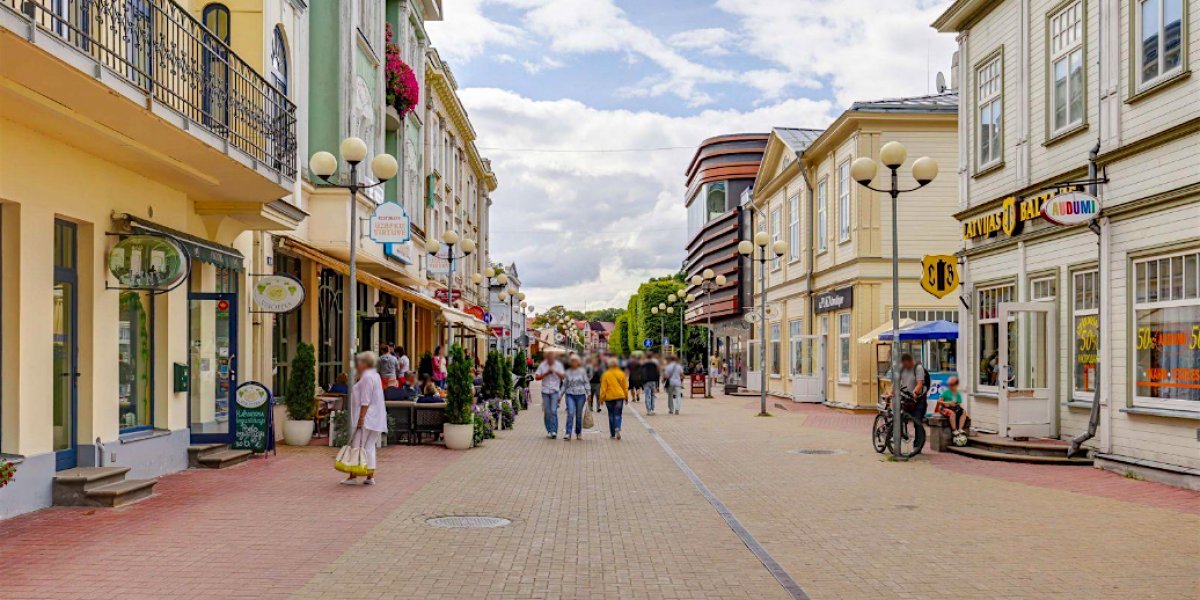
Step out of Majori train station and walk one block north — Jomas iela opens up: 1.4 km of car-free promenade lined with pastel mint, peach and pale-yellow Art Nouveau wooden villas, many over a hundred years old. The morning is when the street is yours; café staff are still putting out chairs and the carved balconies catch the low Baltic sun. This single street is essentially the architectural soul of Jurmala in concentrated form.
Tip: Walk Jomas from east to west (start at the Pilsoņu iela end nearest the station) so the morning sun lights up the facades from behind you. The most photogenic stretch is between Tirgoņu and Pilsoņu — look up: the carved wooden turrets, gables and dragon-head eaves are the real spectacle, not the shop windows.
Open in Google Maps →11:00
Landmark
From the western end of Jomas iela, turn right onto Pilsoņu iela and walk five minutes north through pine shade — the dunes open and the giant turquoise JŪRMALA letters appear, with 33 km of flour-fine white sand stretching east and west. The Baltic here is shallow, glassy and cool even in August; barefoot is the only acceptable footwear. This is the postcard every Latvian has saved on their phone.
Tip: Photograph the letters from the SAND side facing inland with the pine forest as backdrop — from the city side they are backlit and squinty at midday. Then walk west along the firm sand at the waterline for at least twenty minutes; this is exactly where amber-hunters comb the tideline after a storm — you'll spot them with their long-handled scoops.
Open in Google Maps →12:45
Food
Cut back south two blocks to Jomas iela 56 — Kūku Karaliene ("The Cake Queen") is the everyday lunch stop for Jurmala locals: pine-paneled corner café with a glass counter loaded with savoury quiches, smoked-salmon open sandwiches and warm potato-mushroom pīrāgi. Order at the counter, point at what you want, sit on the back terrace under the birch tree. Rye sandwich €5.50, beetroot soup with cream €4, the legendary honey cake (medus kūka) slice €4.20.
Tip: Skip the sandwich queue at the front and head straight to the cake counter — order a slice of medus kūka FIRST (it sells out by 14:00 on summer Saturdays), then circle back for your savoury. Take everything to the back garden terrace, not the indoor tables — it's cooler, quieter, and you eat to the rustle of pines.
Open in Google Maps →13:45
Park
From Jomas, walk east along Konkordijas iela for 25 minutes — pine-scented residential lanes lined with carved wooden mansions in faded mint and rose, almost no traffic — until you reach the entrance to Dzintaru mežaparks. Wooden boardwalks and rope bridges thread through the canopy to a 38-meter timber viewing tower; the climb is gentle, the view is the entire coastline: Riga's spires hazy to the east, Cape Kolka mist to the west, the green pine ribbon dividing white sand from sleepy town. Free to enter, free to climb.
Tip: Climb the tower around 15:00 — the sun has rotated west and lights the entire beach gold from above; before noon it's flat and hazy. Skip the summer toboggan run (it's for kids and the queue is brutal) and instead loop down via the southern boardwalk through the rose garden — it spits you out exactly at the back entrance of the Concert Hall.
Open in Google Maps →16:00
Landmark
Five minutes south of the forest park along Turaidas iela stands Dzintari Concert Hall — a 1936 open-air amphitheater hidden behind a cream Art Nouveau facade, the beating heart of Latvia's summer music season. Even with no concert on, slip past the gate, then wander the surrounding villa quarter: Edinburgas prospekts and Mellužu prospekts are an open-air museum of carved wooden mansions, each with its own tower, veranda and garden of climbing roses. This is the faded grandeur Jurmala is famous for, with almost no crowds.
Tip: Check dzintarukoncertzale.lv before you arrive — a €15 evening ticket buys you a magical open-air concert under the pine canopy, often the highlight of a Jurmala day. Walk Edinburgas prospekts in the late-afternoon golden hour: the western facades catch the last light and the carved balconies cast lace shadows across the road — bring a wide lens.
Open in Google Maps →19:00
Food
Walk 25 minutes west back along quiet Konkordijas iela through the evening pine shade to Jomas iela 60 — Pegasa Pils ("Pegasus Castle") occupies a 1903 wooden Romantic-style mansion with turret, stained glass and a candle-lit garden terrace. The kitchen is modern Latvian: Baltic herring tartare with lovage cream (€16), slow-roasted lamb shoulder with juniper jus (€34), warm sea-buckthorn soufflé (€12). Wine list leans local — ask for the Abavas dry rhubarb wine.
Tip: Reserve at least two days ahead and ASK for the garden terrace, not the indoor parlour — the lantern-lit garden under the wooden tower is half the experience. Order the buckthorn soufflé the moment you sit down (35-min bake). Pitfall warning: ignore the "amber" stalls along Jomas iela on your walk — most cheap pieces are pressed plastic resin; the only certified Baltic-amber shop on the street is Amber Line at Jomas 47, and even there ask to see the ultraviolet test before you buy.
Open in Google Maps →
Trip builder
Plan this trip around Jurmala
Turn this guide into a bookable rail itinerary with FlipEarth.
Keep exploring
Related cities
More in the same country
FAQ
Frequently asked questions
How many days do you need in Jurmala?
Most travelers enjoy Jurmala in 1 days, with enough time for headline sights and a slower meal or museum stop.
What's the best time to visit Jurmala?
The easiest season for most travelers is Jun-Aug, especially if you want good weather and manageable crowds.
What's the daily budget for Jurmala?
A practical starting point is about €110 per person per day before hotels, then adjust based on museums, dining, and transport.
What are the must-see attractions in Jurmala?
A good first shortlist for Jurmala includes Majori Beach & JŪRMALA Letters, Dzintari Concert Hall & Wooden Villa Quarter.