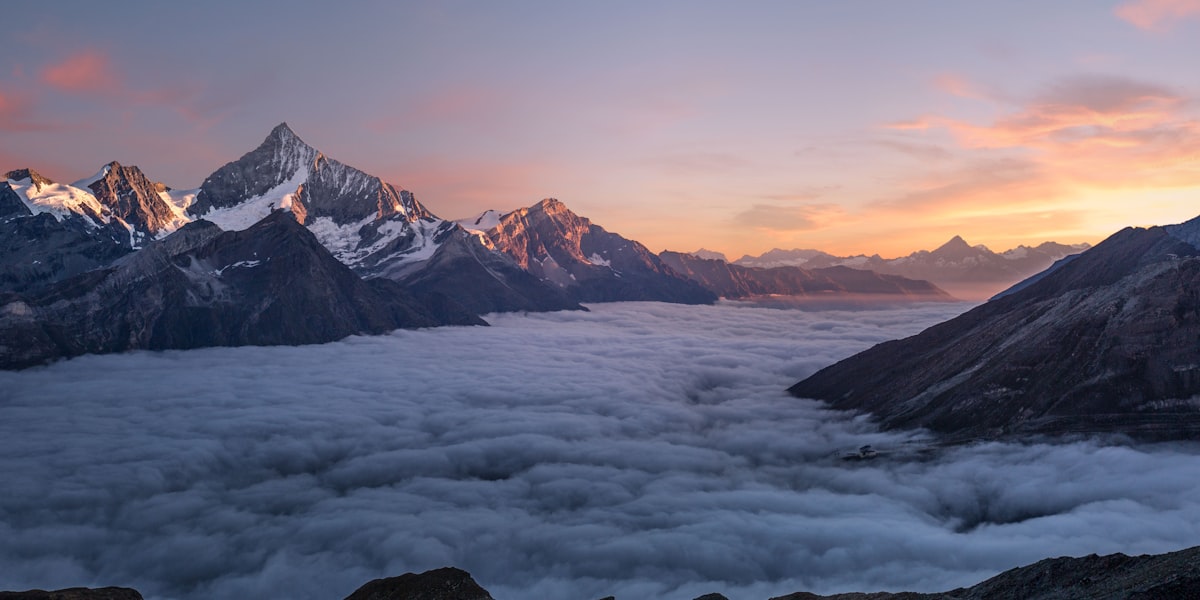
City Guide
Interlaken
Switzerland · Best time to visit: Jun-Sep.
Day-by-day plan
Choose your pace
Trip length
09:00
Landmark
From Interlaken Ost station, cross the Aare on the pedestrian bridge and follow signs to the Harderbahn funicular — a quiet 5-minute walk through a residential lane. The steep funicular climbs 700 meters to the Harder Kulm summit where the Zwei-Seen-Steg juts out over the cliff edge, framing Lake Thun and Lake Brienz in one panoramic sweep with the Eiger, Mönch, and Jungfrau towering ahead. This is the single most efficient viewpoint in the Bernese Oberland — two lakes, three iconic peaks, one photograph. Take the first funicular at 09:00; the platform will be nearly empty and morning light hits the Jungfrau face-on.
Tip: Skip the overpriced restaurant at the top. Walk to the very end of the Zwei-Seen-Steg for the vertigo-inducing look straight down — best photo angle is from the right side facing south with Lake Brienz behind you and the Jungfrau centered. If you hold a Swiss Travel Pass the funicular is free; a Half-Fare Card cuts the price in half.
Open in Google Maps →11:15
Park
From the Harderbahn base station, walk south across the Aare bridge and straight onto Höheweg — the grand boulevard unfolds with the Jungfrau filling the gap between buildings, a flat 10-minute walk. The Höhematte is a vast protected meadow in the center of town — the iconic postcard of Interlaken, the Jungfrau pyramid rising knife-sharp behind the treeline. Walk the full length of the Höheweg that borders it. On clear days paragliders spiral down from the mountains and land right on the grass at your feet.
Tip: Stand at the east end of the Höhematte near the Kursaal casino garden — this is where the Jungfrau is perfectly centered above the meadow. By late morning the peak is fully sunlit with no backlight haze. The west end is where paragliders land; time it right and you can photograph them touching down with the mountain behind.
Open in Google Maps →12:30
Food
From the west end of Höhematte, duck south into the pedestrian streets behind Höheweg — Hüsi Bierhaus is tucked on a side street, a 3-minute walk. A craft brewery and casual beer hall where locals actually eat. Order the Berner Rösti topped with bacon and a fried egg (18 CHF) with their house-brewed pale ale (7 CHF). Quick, hearty, and genuinely Swiss without the tourist markup. Budget 25–35 CHF. No reservation needed.
Tip: The terrace fills fast on sunny days — arrive right at 12:30 to claim a spot. Their seasonal beer rotates monthly; ask the bartender what is fresh and they will pour a free taster before you commit.
Open in Google Maps →13:30
Neighborhood
Cross the Aare on the covered wooden bridge — the bridge itself is a photo stop, turquoise glacial water rushing beneath and the spire of Unterseen visible ahead. A 5-minute walk. Unterseen is the medieval village that existed centuries before Interlaken — quieter, older, and almost tourist-free despite being 300 meters from the main drag. Wander through Stadthausplatz with its painted facades, past the 13th-century Kirche Unterseen with its distinctive tower, and along narrow lanes where flowers cascade from every balcony.
Tip: At the south edge of Unterseen, find the small park overlooking the Aare where it flows toward Lake Thun — the water is an almost unreal shade of glacial turquoise. For the best church-tower-with-mountains photo, stand on Untere Gasse facing east in afternoon light.
Open in Google Maps →15:30
Landmark
From Unterseen follow Seestrasse south for 15 minutes along a quiet road lined with wooden chalets — the lake reveals itself gradually through the trees until the full alpine panorama opens at the water's edge. Where the Aare meets Lake Thun, this small bay offers the most accessible shoreline in the Interlaken area. The water is almost absurdly clear — you can count stones on the bottom meters down. Sit on the grassy bank, take off your shoes, and let the cold alpine water remind you exactly where you are.
Tip: Walk to the end of the small jetty for an unobstructed shot down the full length of Lake Thun — the lake stretches west toward Spiez with layered blue mountains fading into haze. Be here by 16:00 in summer for the warmest golden-hour light on the water.
Open in Google Maps →19:00
Food
Walk back north to Unterseen's Stadthausplatz — 12 minutes at an easy pace along Seestrasse with long evening shadows across the chalets. End the day at this traditional Swiss restaurant in the historic square. Order the cheese fondue moitié-moitié — a Gruyère-Vacherin blend served in a proper caquelon with crusty bread (32 CHF per person). If fondue is not calling, the Zürcher Geschnetzeltes — veal in cream sauce served over golden Rösti (38 CHF) — is the other essential Swiss plate. Budget 50–65 CHF with a drink. Reserve ahead in summer; the terrace fills early.
Tip: After dinner, Interlaken West station is a 5-minute walk east — last trains to Bern, Zurich, and Lucerne run until roughly 22:00. Skip the souvenir shops along Höheweg hawking overpriced Swiss Army knives and stacked Toblerone — if you want a real Swiss keepsake, grab a wedge of Emmentaler from the Coop supermarket near the station for a quarter of the price.
Open in Google Maps →Jump to day
08:00
Landmark
Board the early morning train from Interlaken Ost to Grindelwald Terminal, then transfer to the Eiger Express gondola — the fastest route punches through the clouds in under two hours. At 3,454 meters, step onto the Sphinx Observation Terrace for a panorama that stops all conversation: the Aletsch Glacier — Europe's longest — unspools 23 kilometers into the haze below. Walk through the Ice Palace carved inside the glacier itself, then stand on the snow plateau where the silence is so total you hear your own heartbeat.
Tip: Take the very first departure (around 07:36 from Interlaken Ost) — you'll arrive 45 minutes before the first tour buses. On the Sphinx Terrace, walk to the far left corner for an unobstructed glacier photo without the railing in frame. The altitude hits harder than expected: move slowly for the first 10 minutes and drink water before ascending.
Open in Google Maps →12:00
Food
Take the Jungfrau Railway down from the summit — the 50-minute descent through windows carved into the Eiger's north face is dramatic in its own right. Step off at Kleine Scheidegg where the sun-drenched terrace of Restaurant Grindelwaldblick puts the Eiger Nordwand so close it fills your entire field of vision. Order the Älplermagronen — Alpine macaroni with cream, potatoes, and applesauce (~CHF 24) — the definitive Swiss mountain lunch, or the cheese rösti with a fried egg (~CHF 22). Budget CHF 22–35 per person.
Tip: Grab a table on the south-facing terrace — the midday sun warms it even at 2,061 meters. The lunch rush hits at 12:30 when hikers descend from the trails, so arriving at noon means immediate seating and first pick of the terrace spots.
Open in Google Maps →13:30
Landmark
From Kleine Scheidegg, take the scenic rack railway down through Wengen and into the Lauterbrunnen Valley — 45 minutes of sweeping cliff-edge views. The moment the train pulls into Lauterbrunnen, the 297-meter Staubbach Falls is visible from the platform, pouring off the cliff edge in a single unbroken veil of water. Walk the short trail up behind the falls where the afternoon mist catches sunlight and fractures into rainbows. This is the waterfall that inspired Goethe's poetry and Tolkien's vision of Rivendell.
Tip: The afternoon sun (13:00–15:00) backlights the falls perfectly, creating the rainbow effect you see in photographs. Walk past the main viewing area and take the path up to the platform behind the cascade — most visitors stop at the bottom and miss the best perspective entirely.
Open in Google Maps →15:00
Park
The train from Lauterbrunnen returns you to Interlaken Ost in 20 quiet minutes through the valley floor. Step out of the station and walk west onto Höheweg — Interlaken's grand boulevard — where the Jungfrau massif is framed at the far end like a painting hung specifically for you. The 35-acre Höhematte meadow at its center is protected by federal law: no building may ever obstruct this view. Stroll slowly, watch paragliders spiral down from the ridgeline to land on the grass, and grab a coffee at one of the terrace cafés lining the boulevard.
Tip: The best photo angle of the Jungfrau trilogy — Eiger, Mönch, and Jungfrau in a single frame — is from the southwest corner of Höhematte near the Kursaal, between 15:00–16:00 when the afternoon light illuminates the snow faces without harsh shadows. If the paragliders tempt you, tandem flights can be booked same-day at any tour desk on Höheweg (~CHF 180).
Open in Google Maps →17:00
Landmark
Walk 10 minutes east from Höheweg to the Harderbahn funicular station near Interlaken Ost — you'll cross the Aare River on the way, milky turquoise from glacial melt. The century-old funicular climbs to 1,322 meters in just 10 minutes. At the summit, the Zwei-Seen-Steg — the Two Lakes Bridge — juts out over the void with Lake Thun glimmering turquoise to the west and Lake Brienz shining emerald to the east. The Jungfrau, Mönch, and Eiger stand dead ahead. This is the single best panorama in the Bernese Oberland, and at golden hour, the snow turns amber.
Tip: Arrive by 17:00 in summer for golden hour — the peaks glow amber and the lakes deepen in color as the sun drops. Walk past the restaurant terrace to the far end of the viewing bridge for the emptiest spot with the identical view. The last funicular down runs around 21:00 in summer, so there is no rush.
Open in Google Maps →19:00
Food
Take the funicular back down and walk 8 minutes west along the Aare River toward central Interlaken — the evening light on the water is a quiet reward after a day at altitude. Hüsi is Interlaken's craft beer bar and Swiss kitchen in one: communal tables full of locals and seasonal workers, not tour groups. After a day at 3,454 meters, you want hearty and unpretentious. Order the cheese fondue for two (~CHF 52) paired with their house-brewed ale, or the bratwurst platter with rösti and onion gravy (~CHF 28). Budget CHF 28–50 per person.
Tip: No reservation needed — grab a seat at the long communal tables for the most local atmosphere. Avoid the restaurants directly on Höheweg between the two train stations: they charge 30–40% more for identical dishes and cater exclusively to tour bus groups. If a menu is in six languages and has photos, keep walking.
Open in Google Maps →09:00
Landmark
Take the 07:47 train from Interlaken Ost to Grindelwald (35 minutes), then walk 10 minutes uphill to the Firstbahn gondola station. The 25-minute gondola ride swings you over wildflower meadows while the Eiger's north face grows larger in the window with every pylon. At 2,168 meters, step onto the First Cliff Walk — a steel pathway bolted into sheer rock that ends at a sky-bridge suspended over nothing. The Grindelwald valley drops away beneath your feet while the Eiger, Schreckhorn, and Wetterhorn form a wall of rock and ice before you.
Tip: The gondola opens at 08:30 in summer — be in the first cabin for an empty cliff walk. After the walk, try the First Flyer: a zip line that launches you 800 meters over the valley at 84 km/h (CHF 29 extra, book at the summit kiosk). For the iconic photo, stand at the final platform with the valley behind you and ask someone approaching from the opposite direction to shoot before the bridge fills up.
Open in Google Maps →12:00
Food
Ride the gondola back down to Grindelwald and walk 5 minutes along Dorfstrasse to the village center. Kreuz & Post has anchored Grindelwald since 1889 — a dark-timbered dining room that feels like stepping into a mountaineering postcard. Order the Berner Oberländer Chäsbrätel — grilled cheese bread with gherkins and onion (~CHF 16) — for a quick local bite, or the veal Zürich-style with rösti (~CHF 34) if you want the full mountain lunch. Budget CHF 18–38 per person.
Tip: Sit on the south-facing terrace — the Eiger dominates the view so completely it looks painted on. The restaurant fills by 12:30 with hikers coming off the morning trails, so arriving at noon means the best terrace table and faster service.
Open in Google Maps →13:30
Landmark
Walk 20 minutes east from the village center along the valley road — the path follows a stream with the Eiger overhead, the houses thinning into farmland. Enter the gorge and follow the wooden walkway bolted into the rock face as it winds one kilometer into a crevasse carved over millennia by glacial meltwater. The walls narrow to barely a meter apart in places, polished smooth and streaked blue-green from mineral deposits. The sound of rushing water echoes off stone in a way that makes the entire gorge feel alive.
Tip: The gorge interior drops 5–8°C from the narrow walls and meltwater — bring a light layer even on hot summer days. Visit in early afternoon when direct sunlight penetrates the upper section, illuminating the wet rock in vivid turquoise and green that photographs beautifully.
Open in Google Maps →15:00
Park
Walk back to Grindelwald station and take the 35-minute train to Interlaken Ost, where the turquoise edge of Lake Brienz begins just 200 meters from the platform. Turn right and follow the lakeside path east — the water is an impossible shade of milky turquoise from glacial flour suspended in snowmelt. The wooden jetties along the way are perfect for sitting with your feet over the water, watching the light shift across the surface while the mountains on the far shore reflect in near-perfect symmetry.
Tip: The water color is most vivid between 14:00–16:00 when the sun is high enough to illuminate the suspended glacial sediment. Walk past the boat dock to the second wooden jetty — it is quieter, and the reflection of the Augstmatthorn ridge in the still water is the photograph most people come here for.
Open in Google Maps →16:30
Neighborhood
Cross the Aare River on the covered wooden bridge — the bridge itself is 600 years old and frames a perfect view of the river with Harder Kulm rising above. Unterseen is the quiet medieval half of Interlaken that most visitors never find. The Marktplatz is ringed with 17th-century painted facades, and the lanes are narrow enough to touch both walls. This is where Interlaken's residents actually live and shop — a world apart from the souvenir stores on Höheweg, and the perfect counterpoint to a day of Alpine spectacle.
Tip: Look for the painted house facades on Obere Gasse — the murals date to the 1600s and most visitors walk right past without noticing. The small square in front of the church has a bench with a hidden sightline straight down the Aare to Lake Brienz.
Open in Google Maps →19:00
Food
From the Marktplatz, walk two minutes deeper into Unterseen's old quarter. This is the farewell dinner: a candlelit room in a centuries-old timber-frame inn, the kind of place where the floorboards creak and the menu has not changed in a generation because nobody wants it to. Order the filet of Lake Brienz whitefish with brown butter and almonds (~CHF 38) — fish from the lake you were sitting beside two hours ago — or the Bernese veal in cream sauce with rösti (~CHF 42). Budget CHF 38–55 per person. Reserve for 19:00.
Tip: Ask for a window table overlooking the quiet square. If Lake Brienz whitefish appears on the daily specials board, order it regardless of what else you were considering — fresh lake fish in the Oberland is a fleeting privilege. End with a Kirsch (local cherry brandy) as a digestif. Avoid the 'Swiss Experience Dinner' packages sold at hotels on Höheweg — they charge CHF 80+ for reheated fondue served in a banquet hall.
Open in Google Maps →
Trip builder
Plan this trip around Interlaken
Turn this guide into a bookable rail itinerary with FlipEarth.
Keep exploring
Related cities
Nearby cities
More in the same country
FAQ
Frequently asked questions
How many days do you need in Interlaken?
Most travelers enjoy Interlaken in 1 days, with enough time for headline sights and a slower meal or museum stop.
What's the best time to visit Interlaken?
The easiest season for most travelers is Jun-Sep, especially if you want good weather and manageable crowds.
What's the daily budget for Interlaken?
A practical starting point is about €120 per person per day before hotels, then adjust based on museums, dining, and transport.
What are the must-see attractions in Interlaken?
A good first shortlist for Interlaken includes Harder Kulm, Neuhaus Bay, Lake Thun.