City Guide
Graz
Austria · Best time to visit: Apr-Oct.
Day-by-day plan
Choose your pace
Trip length
09:00
Landmark
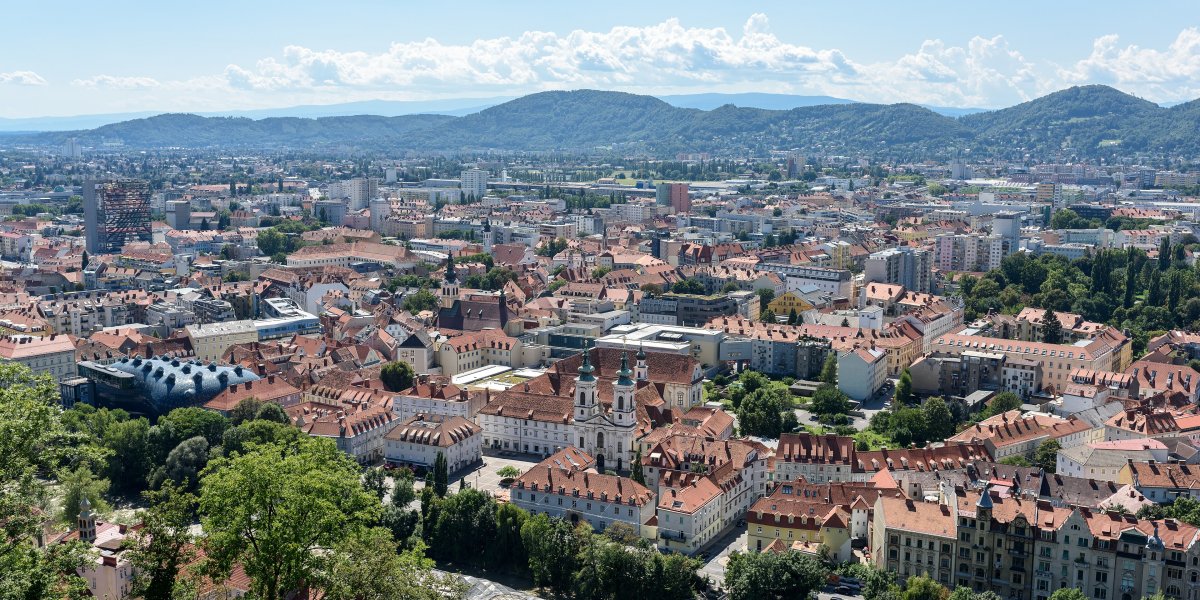
Take the Schlossbergbahn funicular from Kaiser-Franz-Josef-Kai — the two-minute ride lifts you above the terracotta rooftops into a forested hilltop park that was once a fortress so strong Napoleon's army couldn't take it. Follow the gravel path through chestnut trees to the Uhrturm, Graz's 16th-century clock tower and the single most photographed symbol of the city, where the panorama stretches from the red-roofed Altstadt to the hazy Styrian Alps. The morning sun backlights the old town from the east, giving the rooftops a warm copper glow that flattens out by noon.
Tip: Stand at the wooden viewing platform just below the clock tower on the south side for the classic postcard shot with Hauptplatz and the Rathaus dome in frame. The funicular costs €2.50 one way — ride up, then walk down via the Schlossbergsteig steps (260 steps, well-maintained) to save money and see the cascading hillside gardens. Note the clock's quirk: the large hands show hours, the small hands show minutes — reversed from every other clock you've ever read.
Open in Google Maps →10:45
Neighborhood
Descend the Schlossbergsteig staircase through cascading ivy and chestnut shade — the 260 stone steps drop you directly onto Sackstraße, the old town's narrowest and most atmospheric lane, lined with artisan shops in medieval townhouses. Turn right and you emerge into Hauptplatz, Graz's grand main square anchored by the Erzherzog-Johann-Brunnen fountain and ringed by pastel-painted baroque facades. Continue south along Herrengasse, the city's elegant main artery, and step through the archway at Landhausgasse 1 into the Landhaus courtyard — three storeys of Renaissance arcades surrounding a quiet stone courtyard, one of the finest examples of Italian Renaissance architecture north of the Alps.
Tip: The Landhaus courtyard is virtually empty before 11:00 and photographs beautifully with a wide-angle lens from the far corner — the symmetry of the triple-tiered arcades against the sky is as satisfying as anything in Tuscany. In summer, free classical concerts are held here on certain evenings; check the poster at the entrance. Skip the Rathaus interior; the exterior framed from Hauptplatz is all you need.
Open in Google Maps →12:00
Food
Walk one block east from Herrengasse along Stempfergasse — a 2-minute stroll past boutique storefronts. Frankowitsch is a Graz institution since 1932: a stand-up sandwich bar where office workers and professors queue elbow-to-elbow for exquisitely topped open-faced brötchen. The display case is a mosaic of smoked salmon rosettes, egg crowned with truffle cream, roast beef with horseradish, and seasonal vegetable arrangements on small rounds of bread. Order three or four pieces, grab a Pfiff (small draught beer), and eat standing at the marble counter like every Grazer on their lunch break.
Tip: The salmon-cream cheese brötchen (€2.80) and the egg-with-chive version (€2.50) are the signatures — order those plus one seasonal special. Arrive right at noon before the office-worker crush that peaks at 12:30. No reservations, no seating; this is a stand-and-eat affair, done in twenty minutes. If the queue snakes out the door, it still moves fast.
Open in Google Maps →13:00
Landmark
Walk west from Stempfergasse to the Hauptbrücke and cross the Mur — the 7-minute stroll along the riverbank reveals the Kunsthaus gradually, its bulging blue biomorphic skin looking increasingly alien against the baroque skyline behind it. Dubbed 'the Friendly Alien' when it opened in 2003 as part of Graz's European Capital of Culture year, the building's acrylic facade is studded with 930 light nozzles that turn it into a massive media screen after dark. Circle the building from the riverside to appreciate its full blobby silhouette, then shoot it from the Hauptbrücke with the Schlossberg clock tower framed directly above — Graz's most dramatic old-meets-new composition in a single frame.
Tip: The best exterior photo is from the middle of the Hauptbrücke facing west — you get the Kunsthaus blob with the Schlossberg and Uhrturm rising behind it. Early afternoon light (13:00–14:00) illuminates the blue skin evenly without harsh reflections. Don't pay for the interior unless you specifically follow contemporary art — the architecture is the exhibit.
Open in Google Maps →13:45
Landmark
Walk 150 metres south along the river promenade from the Kunsthaus — you will spot the Murinsel's twisted steel shell floating mid-river, connected to both banks by slender footbridges. Designed by New York artist Vito Acconci for the 2003 Capital of Culture programme, this seashell-shaped floating platform holds a tiny café and an open-air amphitheatre. Step onto the island, order an espresso, and sit in the bowl-shaped amphitheatre with the Mur rushing beneath your feet and the old town skyline to the east — one of Europe's most unusual café experiences, lasting only as long as your coffee.
Tip: Order a Melange (Viennese-style cappuccino, ~€3.50) and sit on the amphitheatre side facing upstream — the framing of the river, the bridges, and the Schlossberg hill is unexpectedly cinematic. The island sways perceptibly during spring high water, adding to the novelty. After your coffee, cross to the east bank and you are back in the old town within three minutes.
Open in Google Maps →19:00
Food
From the old town, walk 3 minutes south along Schmiedgasse to Belgiergasse — Der Steirer sits on a quiet side street with a handful of candlelit outdoor tables in summer. This is Graz's definitive showcase of Styrian cooking: the kitchen revolves around Kernöl, the region's dark-green pumpkin seed oil that appears as a glossy drizzle on salads, soups, and even vanilla ice cream. Start with the Kürbiscremesuppe (pumpkin cream soup, €6.50), then order the Backhendl — Styrian fried chicken in a shattering breadcrumb crust served with pumpkin seed oil potato salad (€16.90). Pair it with a glass of Schilcher, the bracingly dry rosé made from Blauer Wildbacher grapes grown only in western Styria.
Tip: Reserve for Friday or Saturday evening; weeknights you can walk in at 19:00 without trouble. Ask for a table in the vaulted interior if the night is cool — the stone ceiling and warm lighting make it feel like a Styrian farmhouse cellar. Budget €25–35 per person with wine. Avoid the tourist-facing restaurants lining Hauptplatz — they charge 30% more for half the flavour, and the schnitzel comes from a freezer.
Open in Google Maps →Jump to day
09:00
Landmark
From Hauptplatz, walk 5 minutes north along Sackstraße to the Schlossbergbahn funicular station at Kaiser-Franz-Josef-Kai — the two-minute ride lifts you above the rooftops to Graz's defining landmark. The Uhrturm dates to 1712, its hands deliberately reversed: the large one marks hours, the small one minutes, because the hour hand came first and locals refused to change it. At 09:00 the morning sun illuminates the old town from the east, turning the terracotta roofscape golden with the Alps faintly visible beyond.
Tip: Take the funicular up but walk down via the Schlossbergsteig — 260 steps carved through rock, dappled with chestnut shade and sudden rooftop glimpses. Going down is easy on the knees, saves the return queue, and is far more scenic than the ride. At the top, walk past the Uhrturm to the Glockenturm (bell tower) for a second angle with almost no one around.
Open in Google Maps →10:45
Landmark
Descend the Schlossbergsteig to Karmeliterplatz, then walk south through Sackstraße — Graz's most beautiful street, lined with Renaissance facades, stucco angels, and wrought-iron signs. At the bottom, turn right onto Herrengasse and enter the Landhaus courtyard, a three-story arcaded loggia built in the 1550s by Italian architect Domenico dell'Allio. It is the finest Italian Renaissance courtyard north of the Alps, so perfectly proportioned it feels like stepping into a Veronese palazzo.
Tip: The courtyard is free to enter and nearly empty before 11:00. Stand dead center on the ground floor for a symmetrical photo capturing all three arcade levels. In summer, check the poster at the entrance — classical concerts are held here on selected evenings, and the acoustics in this stone courtyard are extraordinary.
Open in Google Maps →12:00
Food
Exit the Landhaus onto Herrengasse, walk 2 minutes north and turn left into Stempfergasse — a quiet lane most tourists walk past. Frankowitsch has served Brötchen (open-face sandwiches) at its marble counter since 1932: no menu, you point at the glass display and staff plate your picks. The smoked salmon with horseradish cream and the egg-truffle Brötchen are signatures — three pieces with a glass of Styrian Welschriesling costs about €12.
Tip: Arrive before 12:15 — the best selections vanish by 12:30 and the counter gets three-deep. A glass of chilled Styrian white wine with your Brötchen is the local power-lunch move. The shop also sells gourmet provisions — oils, preserves, vinegars — if you want to browse after eating.
Open in Google Maps →13:00
Religious
Walk east along Herrengasse for 5 minutes, then turn right into Burggasse toward the cathedral's Gothic spire. Before entering, find the Landplagenbild on the exterior south wall — a 1485 painting depicting three simultaneous plagues (locusts, Ottomans, pestilence) in a single scene, one of the most unusual medieval artworks in Austria. Inside the cathedral the vaulted nave is austere and powerful; next door, the Mausoleum of Emperor Ferdinand II, designed by Pietro de Pomis, contains an oval dome with swirling Mannerist frescoes that are the most ornate interior in Graz.
Tip: The Mausoleum is more visually stunning than the cathedral — do not skip it for time. Stand directly beneath the oval dome and look straight up: the frescoes spiral upward in a way that makes the room feel like it is rotating. The cathedral is free; the €6 covers the Mausoleum entrance.
Open in Google Maps →15:00
Landmark
Exit the cathedral's north door and walk 2 minutes through Burggasse into the courtyard of the Grazer Burg — the former imperial castle that most visitors walk past without a glance. Inside, the double spiral staircase from 1499 is a Gothic riddle: two independent spirals intertwine, meeting at each landing and separating again — a medieval symbol of union and parting. It is one of only three surviving examples in Europe and, thanks to its hidden location, the least crowded.
Tip: Walk through the Burg's main archway and look immediately left — the staircase is tucked behind a modest doorway that gives no hint of what is inside. Climb the left spiral up, then descend the right one to experience both paths. You will almost certainly have it entirely to yourself, even in July.
Open in Google Maps →19:00
Food
Walk 5 minutes west from the Burg through Hofgasse, across Hauptplatz, and one block south into Belgiergasse. Der Steirer is the definitive Styrian kitchen, where pumpkin seed oil is treated with the reverence Tuscans reserve for their olive oil. Start with the Käferbohnensalat — giant runner beans with dark-green Kernöl (€8) — then the Backhendlsalat, crispy fried chicken on dressed greens (€16); budget €25-30 per person.
Tip: Reserve for 19:00 — by 19:30 on weekends every table is taken. Ask for the courtyard in summer. Whatever you do, avoid the restaurants lining Hauptplatz directly: they charge tourist prices for mediocre food and exist solely on foot traffic. Der Steirer, one street south, is where Graz locals actually spend their Friday evenings.
Open in Google Maps →09:00
Shopping
From the old town, walk 5 minutes west along Neutorgasse to Kaiser-Josef-Platz, where Graz's largest open-air market runs Tuesday through Saturday. By 09:00 the stalls are stacked with Styrian pumpkin seed oil, farmstead cheeses, cured Speck, and whatever fruit the season demands — this is not a tourist market, it is where Graz feeds itself. The air smells of roasting Kürbiskerne and fresh bread, and vendors will happily let you taste everything before you buy.
Tip: Buy a bottle of Styrian Kürbiskernöl (pumpkin seed oil) — look for the dark green, almost black variety with the PGI seal. Vendors let you taste first. A 250ml farm-stand bottle runs about €8 and is the single best edible souvenir from Graz; the nutty, toasty flavor is unlike anything from a supermarket shelf.
Open in Google Maps →10:15
Museum
From the market, walk 5 minutes south to the Hauptbrücke and cross the Mur to the west bank — the Kunsthaus rises before you like a beached sea creature, a bulging blue blob locals call the 'Friendly Alien.' Designed by Peter Cook and Colin Fournier for European Capital of Culture 2003, it was built as a deliberate provocation against the Baroque skyline visible just behind it. Inside, rotating contemporary exhibitions fill the cavernous upper gallery; ride the travelator to the top floor and step onto the rooftop terrace for a panorama back toward the Schlossberg.
Tip: Check the current exhibition online before visiting — with no permanent collection, the show determines the experience. The building itself, however, is always worth the trip. For the best exterior photo, stand on the east bank near the Hauptbrücke to capture the Kunsthaus and its reflection in the Mur simultaneously.
Open in Google Maps →12:00
Food
Cross back over the Hauptbrücke — a 5-minute walk with the Schlossberg growing ahead of you — and turn right into Glockengasse just north of Hauptplatz. Glöckl Bräu has been pouring in its vaulted cellar rooms since the 17th century, and the brick arches and worn wooden benches feel like they have barely changed since. Order the Steirisches Wurzelfleisch — slow-braised pork with root vegetables and sharp horseradish (€14) — with a half-liter of house Märzen (€4.50); budget €15-20.
Tip: Ask to sit in the vaulted cellar room, not on the street terrace — the brick arches and candlelight are the whole point. No reservation needed at lunch; arrive before 12:15 for your pick of tables. The Brettljause — a wooden board of cured meats, cheeses, horseradish, and dark bread for €13 — is the other strong order if you want to share.
Open in Google Maps →13:30
Landmark
From Glöckl Bräu, walk 7 minutes south along the Mur's east-bank promenade — the shaded river path offers views across to the Lend district's colorful facades. You will see the Murinsel before you reach it: a shell-shaped steel-and-glass platform floating mid-river, connected to both banks by slender footbridges, designed by New York artist Vito Acconci for 2003's Capital of Culture. Walk onto it from the east bank, feel the river rush beneath the glass floor, then exit to the west bank.
Tip: The best photograph is not from the island but from the Erzherzog-Johann-Brücke looking downstream — the steel shell catches afternoon light beautifully against the green water around 14:00. The café on the island is fine for a quick espresso but nothing special; you have just eaten well at Glöckl Bräu, so save your appetite for tonight.
Open in Google Maps →14:30
Park
Cross back to the east bank via the Erzherzog-Johann-Brücke and walk 10 minutes northeast through Glacisstraße, where elegant 19th-century buildings gradually give way to green. The Stadtpark unfolds as a gracious spread of century-old plane trees, winding gravel paths, and tucked-away sculptures — in spring the magnolias erupt in white and pink, in autumn chestnuts carpet the ground. Find a bench near the ornamental pond and let two full days of walking settle into your legs; the Forum Stadtpark at the southern edge has been a laboratory for avant-garde art since 1960.
Tip: The park is loveliest between 14:00 and 16:00 when dappled light filters through the canopy and locals drift in with books and coffee. If you need a final caffeine fix, Café Promenade at the park's western edge has outdoor seating under the trees and has been serving Graz for over a century.
Open in Google Maps →19:00
Food
From the Stadtpark, walk 10 minutes west through the old town to Schlossbergplatz and take the Schlossberg lift — an elevator carved through the rock that brings you to the summit in 30 seconds. Aiola Upstairs sits near the top with an open terrace cantilevered over the city; as the sun drops behind the western hills, the rooftops glow amber and the Mur turns to gold. Order the Styrian beef tartare hand-cut at the table (€16) and the pan-seared Saibling, an Alpine char with seasonal vegetables (€24); budget €35-45 with wine.
Tip: Reserve a terrace table for 19:00 at least two days ahead — this is the most coveted dinner seat in Graz. The lift costs €1.50 each way. Ignore the souvenir kiosks clustered near the Schlossberg summit — they sell the same generic Austrian trinkets at inflated prices you will find in every tourist town. Your best Graz souvenir is already in your bag: the pumpkin seed oil from this morning's market.
Open in Google Maps →
Trip builder
Plan this trip around Graz
Turn this guide into a bookable rail itinerary with FlipEarth.
Keep exploring
Related cities
More in the same country
FAQ
Frequently asked questions
How many days do you need in Graz?
Most travelers enjoy Graz in 1 days, with enough time for headline sights and a slower meal or museum stop.
What's the best time to visit Graz?
The easiest season for most travelers is Apr-Oct, especially if you want good weather and manageable crowds.
What's the daily budget for Graz?
A practical starting point is about €65 per person per day before hotels, then adjust based on museums, dining, and transport.
What are the must-see attractions in Graz?
A good first shortlist for Graz includes Schlossberg and Uhrturm (Clock Tower), Kunsthaus Graz, Murinsel (Island in the Mur).