City Guide
Catania
Italy · Best time to visit: Apr-Oct.
Day-by-day plan
Choose your pace
Trip length
08:30
Neighborhood
Start in the visceral heart of old Catania — the fish market that has roared beside the cathedral since the 1700s. Enter through the stone arch beside the Amenano fountain: swordfish butchered on lava-stone slabs, vendors chanting in Catanese dialect, water and ice slicking the black cobbles. Stay until the auction tempo peaks around 09:30 — this is theatre, not shopping, and you smell the Ionian Sea before you see it.
Tip: Enter through the stone arch beside the Amenano fountain (not from Via Pardo) — action peaks 8:30–9:30 when the morning catch hits the stalls. Ask the swordfish vendor on the central aisle for a slice grilled at the adjacent counter (€4). Skip touts offering 'market tours' — entry is free and the chaos works better unguided.
Open in Google Maps →09:45
Landmark
Exit the fish market through the same stone arch by the Amenano fountain — sixty metres and you stand in Piazza del Duomo, the only square in Italy where the contrast of black lava and white limestone is this stark. At its centre, the Fontana dell'Elefante (Liotru) — Catania's symbol — is carved from a single lava block and crowned with an Egyptian obelisk. Behind it rises the cathedral of Sant'Agata, rebuilt after the 1693 earthquake; the composer Bellini, born two hundred metres away, lies inside the right nave.
Tip: Shoot the elephant fountain from the southeast corner near the Amenano fountain — late-morning side-light catches both the dark lava and the cathedral's pale façade. Step inside (free) to find Bellini's tomb on the right nave. The cathedral closes 12:00–16:00 for siesta, so do not plan to return after lunch — see it now.
Open in Google Maps →11:00
Landmark
From the cathedral, walk five minutes north on Via Etnea and turn left into Via dei Crociferi — UNESCO calls this 200-metre stretch 'the most concentrated late Baroque street in Europe' and it punches you in the chest immediately. Four churches and a convent rise from black lava, built in the optimistic decades after the 1693 quake. The street ends at Piazza Dante and the Monastero dei Benedettini di San Nicolò l'Arena — the largest Benedictine monastery in Europe and the second-largest in the world, its façade a riot of swirling lava-stone cherubs.
Tip: At the start of Via dei Crociferi, climb the steps of San Benedetto church (free, open until 12:30) for an elevated photo straight down the entire Baroque street. Inside the Monastero, both grand cloisters are open free of charge through the main entrance on Piazza Dante — only the frescoed anatomical hall needs a paid tour. Walk straight in past the ticket desk; the cloisters are unrestricted.
Open in Google Maps →13:30
Food
From the Monastero's main entrance, walk eight minutes east along Via Antonino di San Giuliano to Via Santa Filomena — a narrow alley of local trattorie hidden one block off Via Etnea. FUD reinvents Sicilian street food at lunchtime speed: gourmet burgers with Bronte pistachio cream, arancini the size of fists, charcuterie from producers you'd recognise from the morning's fish market. Vintage tiles, communal benches, no fuss — the exact lunch a power-walk demands.
Tip: Order the 'Brontolone' burger with Bronte pistachio cream and provola (€12) — Bronte is the volcanic village on Etna where the world's finest pistachios grow, and you'll spot the green flecks. The menu is written in Sicilian dialect; staff will translate. Arrive before 13:00 or after 14:30 — the 13:00–14:30 rush carries a 30-minute wait.
Open in Google Maps →15:00
Neighborhood
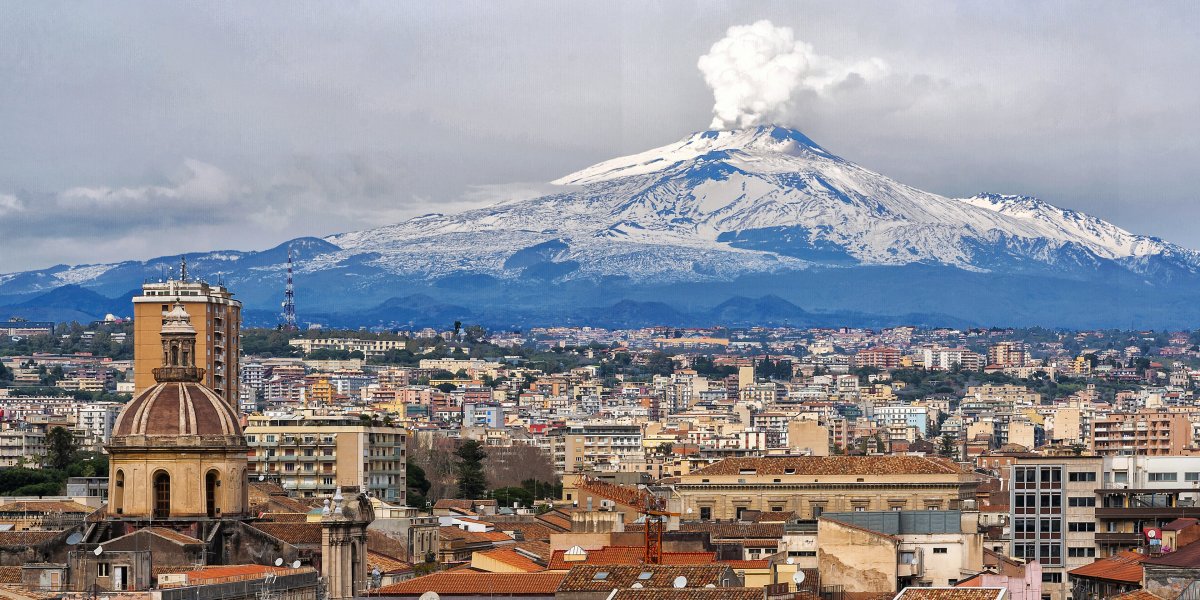
From FUD, walk twelve minutes north up Via Etnea — Catania's grand shopping artery, dead-straight and aimed at the volcano. Pause at Piazza Stesicoro to peer down into the sunken Roman amphitheatre ruins (visible free from street level), then continue past Quattro Canti's lava-stone palaces to Villa Bellini, the city's 'garden in the air' opened in 1883. Linger in the gardens; from the upper bandstand terrace, Mount Etna sits perfectly framed at the end of Via Etnea, often smoking faintly orange against the sky as the sun drops behind you.
Tip: For the iconic Etna sunset shot, stand at the central bandstand in Villa Bellini facing north up Via Etnea — the volcano sits perfectly framed between the palms. Arrive 30 minutes before sunset (~18:00 summer, ~17:00 winter). Avoid every restaurant on Via Etnea between Piazza Duomo and Quattro Canti — the ones with menu-touters at the door are uniformly overpriced microwaved tourist traps; locals eat one block off Via Etnea, never on it.
Open in Google Maps →19:45
Food
From Villa Bellini's north exit, walk four minutes east on Via Antonino di Sangiuliano to Piazza Turi Ferro and one of Sicily's most-loved restaurants. Me Cumpari Turiddu — vintage maiolica tiles, grandmother cookbooks lining the walls, a wine list of Etna reds — closes a black-stone day exactly as it should: with the dish invented in this city, pasta alla Norma, named for Bellini's opera and crowned with ricotta salata and fried Sicilian eggplant.
Tip: Reserve at least 48 hours ahead via their website — walk-ins after 20:00 are routinely turned away. Order the pasta alla Norma (€14) — invented in Catania and named for Bellini's opera — and the cannolo siciliano filled at the table (€6, never pre-filled, which goes soggy). Ask the sommelier for a glass of Etna Rosso (Nerello Mascalese, ~€7) — grown on the volcano you just watched from the gardens.
Open in Google Maps →Jump to day
09:00
Landmark
Start where Catania wakes up. Tucked under the arches behind Piazza del Duomo, the fish market is pure theatre — vendors slap swordfish heads onto marble, octopus tentacles still curl on the slab, and the lava cobblestones run silver with melted ice. This is not a museum piece; it's the same scene Bellini would have walked through in 1820. Stay on the inner ring, where the gambero rosso, sea urchin and bluefin tuna live.
Tip: Enter from Via Pardo on the western side rather than Piazza Alonzo di Benedetto — fishermen still treat you as a guest, not a target. The peak chaos is 09:00–11:00; by midday the show is over and the smell takes over. Don't buy the souvenir stalls at the edges; they're a separate tourist circuit.
Open in Google Maps →10:00
Religious
Climb the short ramp out of the market and you emerge directly in front of the Fontana dell'Elefante — a black lava elephant carrying an Egyptian obelisk, Catania's grinning city emblem. The square was rebuilt entirely after the 1693 earthquake in white limestone and black basalt; everything you see is post-disaster. Inside the cathedral lie Vincenzo Bellini's tomb and the silver bust of Sant'Agata, the patron saint Catania carries through the streets every February in Sicily's wildest religious festival.
Tip: Photograph the elephant fountain from its south side mid-morning — the cathedral facade glows behind it and the obelisk lines up clean. Inside the cathedral, walk straight to the right transept for Bellini's tomb (most visitors miss it on the left). The dress code is enforced — knees and shoulders covered.
Open in Google Maps →11:30
Landmark
Walk west on Via Vittorio Emanuele II then up Via Antonino di Sangiuliano — 8 minutes through the Baroque heart of the old town, past four churches in a row. The second-largest Benedictine monastery in Europe was half-buried by the 1669 lava flow and then defiantly rebuilt on top of it, so you literally walk on a frozen black river. Now part of the University, it preserves underground cisterns, medieval kitchens carved into the basalt and a vast cloister where students still cross between lectures.
Tip: Take the official guided tour (€10, on the hour) — without a guide you wander empty corridors and miss the Lava Stone Kitchens and the subterranean cisterns, which are the whole point. Ask the guide to unlock the roof terrace; the view back over the city to the sea is the best in the old town.
Open in Google Maps →13:30
Food
Walk back down Via Antonino di Sangiuliano, then right onto Via Coppola — 6 minutes through the most theatrical Baroque stretch of the city. Signora Rosanna De Fiore makes the pasta alla Norma that Catania measures all others by: hand-rolled maccheroni, fried aubergine sliced paper-thin, salted ricotta grated tableside. She cooks alone, slowly, behind a half-open door. The menu is whatever she made that morning.
Tip: Arrive at 12:45 sharp — only around ten tables, reservations are hit-or-miss by phone, and once she sells out the kitchen closes (often before 14:00). Order the pasta alla Norma (€12) and the cannolo siciliano filled to order (€4) — never the pre-filled ones. Cash only, and don't ask for the bill — wait for her to come to you.
Open in Google Maps →15:30
Landmark
Walk south on Via Antonino di Sangiuliano then right onto Via Vittorio Emanuele II — 7 minutes. Catania's Greek-Roman theatre is the city's hidden secret: a 7,000-seat amphitheatre half-submerged in lava with residential houses growing on its upper tiers. You enter through what looks like someone's garden gate. From there, Via dei Crociferi unfolds — a 200-metre Baroque corridor where four churches face each other in stone-cold competition, the most photogenic street in Catania.
Tip: Buy the combined ticket (€6) that also covers the small Odeon next door — almost everyone skips it and misses the best-preserved cavea. Afternoon light hits Via dei Crociferi at 16:30; stand at the Arco di San Benedetto looking north and frame all four church facades in one shot.
Open in Google Maps →20:00
Food
10-minute walk up Via Etnea past the lit-up Quattro Canti — by 19:30 the avenue is full of locals on the passeggiata, slow-walking from gelateria to wine bar in linen and white sneakers. The restaurant is a re-imagined old grocery: antique brass scales, hanging salamis, candlelight, a soundtrack of 1960s Sicilian folk. The kitchen treats tradition with reverence: caponata catanese with toasted almonds (€12), spaghetti with sea urchin and breadcrumbs (€22), and a wine list that reads like a love letter to Etna's small producers.
Tip: Book 24 hours ahead online — locals fill the room by 20:30. Ask for the small upstairs room or the courtyard, not the front shop. Order an Etna Rosso from Pietradolce or Graci by the glass. PITFALL: do not eat at any restaurant on Via Etnea between Piazza Duomo and Piazza Stesicoro that displays multilingual menus with photographs — pure tourist traps charging €15 for microwaved arancini, and the seafood is frozen.
Open in Google Maps →09:30
Landmark
Drive 50 km up the volcano (rental car or shared van, 1 hour) to Rifugio Sapienza at 1,900 m. The Silvestri Craters sit right at the car park — twin extinct cones from the 1892 eruption, black sand crunching underfoot, scrubby yellow broom in bloom from May. Walk the rim of the southern crater (the wider one, 30 minutes) for your first proper view: ice fields above, the Ionian Sea glittering 30 km below.
Tip: Park in the small lot just south of Rifugio Sapienza (€2 per day) — the big lot fills by 10:30 and you'll lose 20 minutes. Walk the south crater first (clockwise from the parking) — fewer tour buses start there, and you finish at the funivia entrance for the cable car next.
Open in Google Maps →10:30
Landmark
5-minute uphill walk from the Silvestri car park brings you to the Funivia base station. The cable car climbs to 2,500 m, then a 4x4 jeep with a volcanological guide grinds up the black gravel road to 2,900 m. From there, you walk the rim of the active Crateri Sommitali — the wind warm from the vents, sulfur sharp in the air, the silence absolute except for the volcano breathing. You will not feel further from Europe.
Tip: Buy the full combo ticket at the base (funivia + jeep + guide, €78) — the cable car alone to 2,500 m is anticlimactic and you'll regret stopping there. Wear closed shoes (sandals shred on lava grit) and a fleece even in August (summit is 5°C). Aim for the 11:00 jeep batch — the sun is behind you on the crater rim and clouds usually swallow the summit by 13:00.
Open in Google Maps →14:00
Food
25-minute descent through chestnut forest and vineyard terraces to Trecastagni — black volcanic soil, prickly pear hedges, the volcano now framed behind you. A fourth-generation Etna winery, lunch is served on the east terrace with the entire south flank of Etna in view. Four wines paired with caponata, pasta alla Norma made with their own tomatoes, grilled sausage from the village butcher, and the Etna Rosso (100% Nerello Mascalese) that is the wine of this trip.
Tip: Book the 'Lunch and Tasting' package (€45) two days ahead — walk-ins are turned away on weekends. Request the east-terrace table when reserving; the indoor room misses the view entirely. Buy a bottle of their Etna Bianco (Carricante, €18) at the cellar door on the way out — almost impossible to find outside Sicily.
Open in Google Maps →17:00
Museum
30-minute drive back into Catania; park outside the old town and walk 5 minutes south of the fish market. The squat black fortress sits alone on its square — once on the seashore, then stranded inland by the 1669 lava flow that pushed the coastline 800 m east. Frederick II built it in 1239 as his Sicilian power base; today it holds the Museo Civico — Sicilian medieval painting, Greek vases pulled from the surrounding necropoleis, and a small but extraordinary Caravaggio-school room.
Tip: Enter at 17:00 sharp — last hour before close, almost empty. Go directly upstairs to the Sala dei Parlamenti for the painted wooden ceiling, then down to the ground floor for the Roman mosaic and the Caravaggesque 'San Francesco' attributed to Pietro Novelli. Skip the modern art rooms; they're filler.
Open in Google Maps →18:00
Park
Walk up Via Etnea for 12 minutes — the city's main artery, opening into the iron gates of the gardens just north of Piazza Stesicoro. Catania's living room: 19th-century gardens with a date-palm avenue, two artificial hills, a wedding-cake bandstand, and a floral calendar that gardeners reset every dawn (today's date spelled in marigolds). Climb the higher hill (Collinetta) for the view that closes the trip: Mount Etna in pink behind the Cathedral domes, the city you walked all morning laid out at your feet.
Tip: Arrive at 18:00 sharp from April to October — the golden hour turns Etna pink between 18:30 and 19:00, and the upper hill empties as locals head down for aperitivo. Skip the café kiosks inside the park (overpriced and stale); walk out to Pasticceria Spinella on Via Etnea for a proper granita di mandorla.
Open in Google Maps →20:30
Food
8-minute walk down Via Etnea, past the lit-up Piazza Università and under the Quattro Canti. FUD is a modern Sicilian 'panino bar' that refuses to use the word 'burger' — gourmet sandwiches with Nebrodi black pork, Bronte pistachio cream, Modica chocolate, all stamped with the producers' names. Casual, loud, joyful; the bread is baked downstairs every morning and the chalkboards list every farm by village.
Tip: No reservations — arrive by 20:30 to dodge the 21:00 queue. Order the 'Suino Nero dei Nebrodi' panino (€12, black pork + pistachio pesto) with a Birrificio dell'Etna craft beer (€5). PITFALL: do not buy 'granita' from kiosks open after 22:00 along Via Etnea or near the fish market — they sell scoops of melted slush. Real Catanese granita is breakfast food, served before 11:00, eaten with a soft brioche col tuppo; anywhere selling it at night is selling you a story.
Open in Google Maps →Jump to day
08:30
Neighborhood
Begin at Piazza del Duomo and descend the worn stone steps behind the Fontana dell'Amenano, where an underground river surfaces — you'll hear the market before you see it. Fishmongers shout in Sicilian dialect, swordfish heads rest on shaved ice, octopuses still curl, and the lava-stone alleys smell of salt, lemon and burning coffee. By 8:30 the theatre is at full pitch and by noon the stalls begin to dismantle, so this is the one Catania moment you cannot reschedule to the afternoon.
Tip: Stand near the swordfish stalls between 8:30 and 9:30 — the auctioneer's rhythmic shout is the closest thing to Sicilian opera you'll hear all trip. Bring small notes; vendors will hand you a sliver of bottarga or tuna to taste, but politely refuse the 'photograph fee' some try on tourists with big cameras.
Open in Google Maps →10:30
Landmark
Climb back up the same stairs — five minutes — and emerge into Piazza del Duomo, the heart of Catania carved entirely from black lava and pale limestone. At the centre stands the Fontana dell'Elefante, a Roman-era lava elephant carrying an Egyptian obelisk on its back. Inside the Cattedrale di Sant'Agata, on the right of the nave, is the tomb of Vincenzo Bellini — go before 11:00 and you'll have the cool stone interior almost to yourself.
Tip: Enter the cathedral before 11:00 — by 11:30 cruise groups arrive in waves and the nave becomes a corridor. Skip the €1 'photograph permits' touted at the Norman Cappella di Sant'Agata; the chapel is free, and Bellini's tomb is in the smaller chapel to the right of the main altar.
Open in Google Maps →13:00
Food
Walk 100 metres back into the market — Antica Marina sits at Via Pardo 29, and the kitchen sources directly from the stalls you just walked through. Order the spaghetti ai ricci di mare (sea urchin pasta, €18) and the involtini di pesce spada (swordfish rolls with pine nuts and currants, €16); these are the dishes Catania is shaped around. Budget €30-40 per person with a glass of Etna Bianco — this is one of the rare market trattorias where Catanesi still outnumber tourists.
Tip: Reserve a day ahead and arrive by 12:45 — the small dining room fills in waves between 13:00 and 14:00. Skip the menu's grigliata mista; the seafood pasta and whichever fish the waiter says was bought across the alley that morning are the point here. If they offer Malvasia delle Lipari with almond biscotti at the end — say yes.
Open in Google Maps →15:30
Religious
After lunch walk west up Via Vittorio Emanuele II for about 12 minutes, past the Roman Theatre on your left and the old Jesuit college on your right, until the lava-stone facade of San Nicolò opens onto Piazza Dante. This was the second-largest Benedictine complex in Europe and is now part of the University of Catania; the guided tour walks you through two cloisters, the kitchens with their lava-floor ovens, the hanging gardens and excavated Roman houses beneath the floor. Afternoon light angling into the western cloister is the photograph everyone misses on a morning visit.
Tip: Book the 15:30 English-language 'Officina di Studi Medievali' tour on monasterodeibenedettini.it the day before — walk-ups are routinely turned away in summer. The unfinished facade of the adjoining church is not a ruin: the 1693 earthquake stopped construction and the city deliberately left it that way.
Open in Google Maps →20:00
Food
Walk north from the monastery up Via Antonino di Sangiuliano for 10 minutes — you'll cross Via Etnea mid-passeggiata, the whole city out walking — and arrive at the warm wooden room of Me Cumpari Turiddu on Piazza Turi Ferro. This is where you eat the city's signature dish, pasta alla Norma with grated salted ricotta (€14), with caponata catanese (€10) and a cannolo finished at the table with fresh sheep-milk ricotta (€6). Budget €45-55 per person with a glass of Etna Rosso; ask for the inner courtyard for the quietest seating.
Tip: Reserve at least two days ahead and specifically request the courtyard — the front room shares a wall with the bar and gets loud after 21:00. Pitfall: ignore the cluster of identical 'tipico siciliano' restaurants on Via Etnea between the Duomo and Via Pacini with laminated photo menus and hosts grabbing tourists by the sleeve — pasta alla Norma at €18 that no Catanese would eat.
Open in Google Maps →09:00
Landmark
Drive south then east up the SP92 for about 60 minutes from Catania — the road climbs through Nicolosi's pine forests and out onto a black moonscape — until you reach Rifugio Sapienza at 1900 metres, just below the Silvestri Craters. These four extinct lower craters, formed in the 1892 eruption, are walkable on a gentle 45-minute loop and prepare your lungs for the thinner air above. Going at 09:00 means you climb in cool, clear morning light before the daily cloud cap settles over the summit around noon.
Tip: Wear a wind layer even in July — at 1900 m the wind runs 10°C colder than in Catania. The southern crater rim has the cleanest view back toward the Ionian Sea; the northern rim is closer to the parking lot and noisier with buses. Use the clean restrooms inside the rifugio building before you start — they're the last ones until you come back down.
Open in Google Maps →10:30
Landmark
Walk 200 metres uphill across the Rifugio Sapienza piazza to the Funivia dell'Etna base station, where the cable car lifts you in fifteen minutes from 1900 m to La Montagnola at 2500 m. From there a 4×4 minibus carries you to 2900 m and an authorised alpine guide walks you the final stretch toward the active summit craters — black ash underfoot, sulphurous yellow vents, lava still warm from 2024's eruption. Going up before noon is essential: by 14:00 a cloud bank usually closes over the summit and the view collapses to grey.
Tip: Buy the combined Funivia + 4×4 + Guide ticket at the official window — not from the touts in the parking lot, who sell only the cable car and leave you stranded above. Hiking boots are mandatory above 2500 m; the booth at the base rents boots and a wind jacket for €5 if you only brought sneakers. If sulphur gas thickens, the guide will turn the group around — do not wander toward steam plumes alone, the gas can drop you in seconds.
Open in Google Maps →14:30
Food
Take the cable car back down — the descent is its own short pleasure with Catania and the sea spread below — and walk five minutes across the piazza to Ristorante Corsaro, a family-run mountain restaurant operating here since 1965. Order the maccheroni al ragù di funghi (mushroom pasta with porcini gathered on Etna's slopes, €14) and the salsiccia al finocchietto cotta sulla pietra lavica (wild-fennel sausage grilled on a lava-stone slab, €16); the wild-boar ragù is also a serious dish. Budget €25-30 per person with a glass of their house Etna Rosso.
Tip: Sit on the outdoor terrace facing the cone — the indoor room is fine but the whole point is eating with the volcano right above you. Skip the bus-tour buffet places one door over (you'll recognise them by chalkboard group menus); Corsaro's kitchen still cooks to order. The lava-stone shop next door sells real Etna ornaments rather than the imported volcanic-glass jewellery sold below.
Open in Google Maps →16:30
Food
From Rifugio Sapienza descend the SP92 for 35 minutes back down the south slope to Trecastagni, where Cantine Nicosia has been making Etna wine since 1898. The cellar sits at 700 metres on terraced lava soil; the 'Visita & Degustazione' (€25, 90 minutes) walks you through a flight of four wines including their Etna Rosso DOC and the rare Etna Bianco from Carricante grapes you cannot find outside Sicily. Late-afternoon light angled across the vineyard rows toward the smoking summit is the photograph that explains why Etna terroir is unlike anywhere else.
Tip: Book the 16:30 'Visita & Degustazione' on cantinenicosia.it before your trip — Saturdays sell out a week in advance. Buy a bottle of Etna Bianco 'Sosta Tre Santi' at the cellar door for €18; the same wine in a Catania bar runs €40. There is no public transport back to Catania after 19:00 — designate a driver or pre-book a transfer.
Open in Google Maps →20:30
Food
Drive 40 minutes back to Catania and walk along Via Dusmet beneath the old port walls — the lava arches of the railway viaduct overhead — to Sicilia in Bocca alla Marina, opposite the fishing harbour. After a day above the clouds, the seafood-focused menu closes the day in the other Catania: pasta con le sarde (€14), spada alla ghiotta (swordfish with capers, olives and tomato, €18), a half-litre carafe of Etna Bianco. Budget €40-50 per person; ask for a window table to watch the boats come in for the next morning's market.
Tip: Ask for the back dining room rather than the glass veranda — quieter, and the kitchen pass is in view, which is half the show. Pitfall: do not eat at the row of identical seafood restaurants directly on Via Dusmet's tourist strip closer to Piazza Duca di Genova — frozen swordfish, fixed-price menus, and a 40% mark-up for a harbour view you get for free from the wall outside.
Open in Google Maps →08:30
Food
Begin where every Catanese morning begins — Pasticceria Savia at Via Etnea 302, founded in 1897, standing at the gates of Villa Bellini. Order the breakfast Sicily invented: granita di pistacchio or mandorla (€3) with a brioche col tuppo (€2.50) still warm enough to dunk. Stand at the marble bar like the locals — both cheaper and faster than sitting — and watch the morning crowd of professors, students and old men in linen reading the Giornale di Sicilia.
Tip: Order pistacchio in the morning, mandorla in the afternoon — pistachio is denser and considered the breakfast variant; almond is the post-walk refresher. Ask for it 'mezza e mezza' (half pistachio, half almond) if you cannot choose. The brioche must arrive hot — if it isn't, send it back; they will not be offended.
Open in Google Maps →09:30
Park
Cross Via Etnea at the crossing — two minutes — and enter Villa Bellini, the 19th-century public garden Catanesi simply call 'u' giardinu di Catania'. Walk straight to the upper terrace by the floral clock, replanted every month in fresh flowers spelling out the current date; from the balustrade behind it is the postcard view of Mount Etna rising over Via Etnea's rooftops, smoking gently. Morning here is the city in its pyjamas — joggers, mothers with strollers, retirees on benches reading the paper.
Tip: The eastern path past the bandstand is shaded all morning; the western path past the bust of Bellini gets full sun by 10:00 — choose accordingly. The two lower lakes are home to turtles the local kids feed — bring a lettuce leaf, not bread, which is bad for them. The free public restrooms by the Via Etnea entrance are clean.
Open in Google Maps →11:00
Entertainment
Leave Villa Bellini by the Via Etnea exit and walk south for 12 minutes down the city's grand artery, then turn left at Via Antonino di Sangiuliano and right onto Via Perrotta — Piazza Vincenzo Bellini opens with the wedding-cake facade of the Teatro Massimo, inaugurated in 1890 with a performance of Bellini's Norma. The guided tour (€7, hourly between 09:00 and 12:00) takes you into the four-tiered horseshoe auditorium and the painted ceiling by Ernesto Bellandi — an interior considered acoustically among the finest in Italy. Late morning is the only window the theatre opens for visits before evening rehearsals begin.
Tip: Buy the ticket in person at the Via Perrotta box office — the online system does not show the daily English slot and walk-up seats are reserved for it. If the tour is sold out, ask for the 'visita libera' to the foyer alone (€3); the marble grand staircase and the bust of Bellini are the heart of the building. Check the noticeboard for last-minute opera tickets from €15.
Open in Google Maps →13:00
Food
Walk five minutes west from the theatre along Via Santa Filomena — a narrow alley closed to cars and lined with restaurant terraces — to FUD Bottega Sicula at number 35. This is Catania's most loved 'gastrostreet' kitchen, run by chef Andrea Graziano, who renames every dish in dense Sicilian dialect: order the 'parmiggiana' burger (eggplant parmigiana in a bun, €11), the arancin-O-trip rice-ball plate (€12) and the cassatina dessert (€6). Budget €25-30 with a glass of Etna Rosso — informal Sicilian food at its sharpest.
Tip: Arrive by 12:45 — by 13:15 the queue stretches down the alley and they don't take reservations at lunch. Sit upstairs if the ground floor is full; same kitchen, much quieter. Cash and cards both accepted, but the bill comes faster if you pay at the counter on the way out.
Open in Google Maps →15:30
Landmark
Walk eight minutes south-west from FUD along Via Manzoni and Via Vittorio Emanuele II to the Teatro Greco-Romano, a 2nd-century Roman amphitheatre built on Greek foundations and half-swallowed by 18th-century palazzi — the contrast of black lava arches under apartment balconies is unique to Catania. The combined ticket (€6) also covers the Casa-Museo di Vincenzo Bellini at Piazza San Francesco d'Assisi 3, two minutes away, where the composer was born in 1801 and where his original spinet piano and death mask are displayed. Late afternoon is the soft-light moment for the theatre — the western terrace catches the last sun over Via Crociferi's bell towers.
Tip: Buy the combined ticket at the Teatro entrance, not the Bellini house — fewer people, faster, same price. Pitfall: skip the 'archeological guided tour of Catania' touts who work the Via Crociferi corner with laminated brochures (€25 for what you can read on the on-site panels for free). Leave 30 minutes to wander Via Crociferi itself — UNESCO's most photographed Catania street — before the sun drops behind the bell towers.
Open in Google Maps →
Trip builder
Plan this trip around Catania
Turn this guide into a bookable rail itinerary with FlipEarth.
Keep exploring
Related cities
More in the same country
FAQ
Frequently asked questions
How many days do you need in Catania?
Most travelers enjoy Catania in 1 days, with enough time for headline sights and a slower meal or museum stop.
What's the best time to visit Catania?
The easiest season for most travelers is Apr-Oct, especially if you want good weather and manageable crowds.
What's the daily budget for Catania?
A practical starting point is about €110 per person per day before hotels, then adjust based on museums, dining, and transport.
What are the must-see attractions in Catania?
A good first shortlist for Catania includes Piazza del Duomo & Cattedrale di Sant'Agata, Via dei Crociferi & Monastero dei Benedettini.