City Guide
Bergamo
Italy · Best time to visit: Apr-Oct.
Day-by-day plan
Choose your pace
Trip length
09:00
Landmark
From Citta Bassa, ride the Funicolare di Bergamo Alta up to Piazza Mercato delle Scarpe, then climb Via Gombito for five minutes through tunnel-like medieval lanes that suddenly open onto Lombardy's most beautiful square. Palazzo della Ragione's Venetian arcade frames the Contarini fountain across the cobbles, the Campanone bell tower looms behind, and Le Corbusier famously declared this piazza one of the most harmonious in Europe. At nine in the morning the square belongs to the espresso-drinking locals — order a one-euro caffe at the counter of Caffe del Tasso and stand at the bar like a Bergamasco.
Tip: Stand directly under the Palazzo della Ragione arches and shoot Santa Maria Maggiore's pink dome framed between the stone columns — that's the single image every Bergamo postcard is copying, and before 9:30 you'll have the entire arcade to yourself. Tour groups don't arrive until 10:30.
Open in Google Maps →10:30
Religious
Walk twenty steps under the Palazzo della Ragione arches and you slip from Piazza Vecchia into the smaller, quieter Piazza del Duomo — three of Bergamo's most famous facades pressed shoulder to shoulder around a single fountain. The Cappella Colleoni is the showstopper: a pink, white and black marble Renaissance jewel-box built in 1476 by Giovanni Antonio Amadeo for the condottiero Bartolomeo Colleoni, every inch of the facade carved with medallions of Hercules and Caesar in candy-coloured stone. Beside it the Romanesque Santa Maria Maggiore looks almost shy, its lion-shouldered north porch carved in red Verona marble and supported by two patient stone lions.
Tip: Circle around to the rear of the basilica and shoot the Porta dei Leoni Rossi from the north — almost no one walks behind the church, and the morning sun hits the red marble lions between 10:30 and 11:30 only, after which the basilica blocks the light. Skip the chapel's interior queue; the facade is the masterpiece.
Open in Google Maps →12:00
Food
Walk west out of Piazza del Duomo straight onto Via Bartolomeo Colleoni, the cobbled spine of Citta Alta — three minutes of weaving past tiny butchers and grocers takes you to a wooden counter where polenta is the only thing on the menu. Polentone serves polenta taragna (rough cornmeal cooked with buckwheat and aged Branzi cheese) in paper cones, topped with bergamasco salamella sausage, braised donkey ragu or porcini mushrooms, plus a glass of Valcalepio red for under ten euros. Eat standing at the wooden wine barrels outside — this is exactly how Bergamasco workers have refuelled at midday for two centuries.
Tip: Order the polenta taragna con salamella (8 EUR) — the buckwheat in the taragna gives it a smoky depth that yellow polenta cannot match, and the local sausage is fattier and coarser than anything you'll find in Milan. Pair it with a calice of Valcalepio Rosso, not beer; the tannin cuts the cheese.
Open in Google Maps →13:00
Landmark
Continue west on Via Colleoni for two minutes until it widens into Piazza Mascheroni, then drop south down Via San Giacomo — four minutes later you step onto the UNESCO ramparts themselves at Porta San Giacomo, a six-kilometre belt of military engineering built between 1561 and 1588 to defend the Venetian Republic's western frontier. From here walk westward along the bastions toward Porta Sant'Alessandro: the Lombard plain unrolls below, and on a clear afternoon you can pick out the Milan skyline shimmering 40 kilometres away. The dry moats, redoubts and wedge bastions are still entirely intact — you are walking on top of a working 16th-century war machine.
Tip: The bastion of San Giovanni (the round projection halfway between Porta San Giacomo and San Lorenzo) has a tucked-away stone bench facing south that catches the full afternoon sun and gives you the cleanest profile shot of the walls curving back toward the Citta Alta skyline — almost no tourist makes it off the main path to find it.
Open in Google Maps →16:00
Landmark
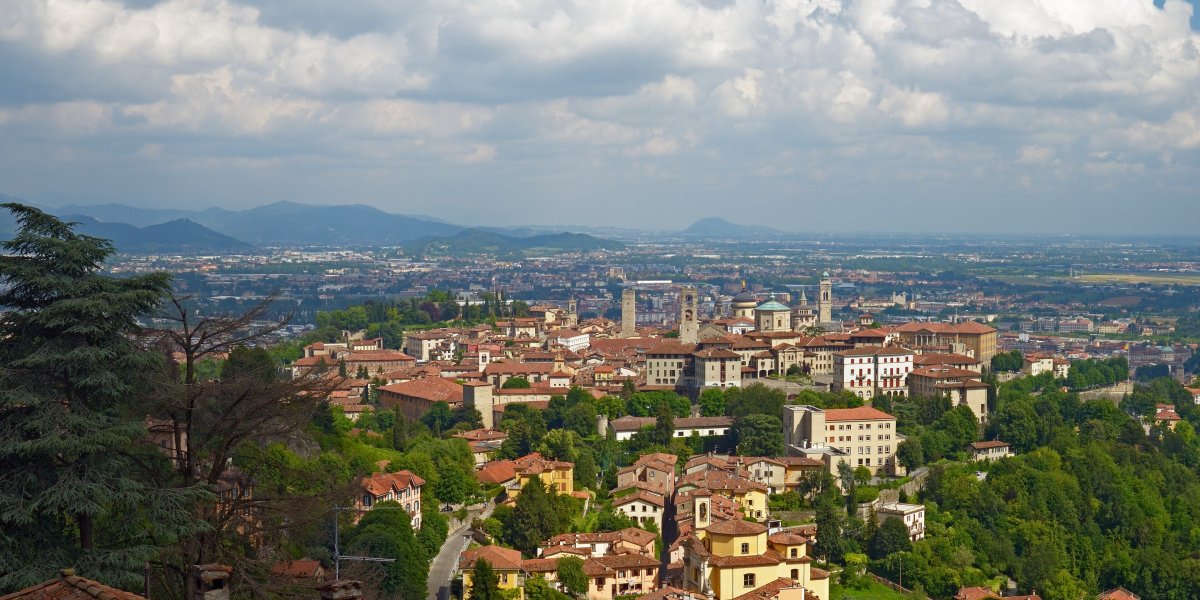
Step off the walls at Porta Sant'Alessandro and you are already at Colle Aperto — the tiny second funicular, Funicolare di San Vigilio, is sixty metres ahead and lifts you to the highest point in Bergamo in ninety creaking seconds. The Castello itself is a ruined 14th-century fortress with four wedge bastions, but nobody climbs up for the stones; they come for the only 360-degree panorama in the city, putting the entire Citta Alta directly below you, the Po Valley unrolling to the south, and the Bergamo Alps rising white in the north. This is the single viewpoint where Bergamo finally makes sense as a whole — walls, towers, basilica dome and red rooftops in one frame.
Tip: Skip the obvious viewing platform and walk 80 metres along the dirt path on the western bastion — only from there does Santa Maria Maggiore's dome line up perfectly with the snow-line of the Orobie Alps behind it. Time your arrival forty-five minutes before sunset; the warm light on the red roofs is the picture you came for.
Open in Google Maps →19:30
Food
Ride the funicular back down to Colle Aperto and walk five minutes east along Via Colle Aperto into Piazza Mascheroni — under the loggia at the far corner sits the small trattoria that Bergamaschi actually book in advance, with no tourist menu and no photos in the window. The casoncelli alla bergamasca (12 EUR) arrive folded into little candy-wrapper shapes, stuffed with beef, raisins, amaretti and pear, drowned in browned butter, sage and crisp pancetta — this is Bergamo's signature dish and Del Teatro's version is the benchmark every other kitchen in town is judged against. Follow with the coniglio in salmi (rabbit braised in red wine, 18 EUR) and half a litre of Valcalepio Rosso, and you've eaten Bergamo. Budget around 45 EUR per person.
Tip: Reserve a day ahead and ask for a table outside under the loggia — the piazza empties of tourists after 20:00 and you get the medieval square almost to yourself. Pitfall warning: avoid every restaurant directly on Piazza Vecchia with menus in five languages and pictures of the food — they double the price for tepid microwaved casoncelli; the iron rule in Citta Alta is that one street back from the main square always eats better.
Open in Google Maps →Jump to day
09:00
Landmark
From Lower Town, board the funicolare at Viale Vittorio Emanuele II — ninety seconds clattering up the hillside and you step out into medieval Italy. Walk up Via Gombito for two minutes and Piazza Vecchia opens before you; the 52-meter civic bell tower stands at its eastern edge. The elevator lifts you to the loggia in two minutes, where the entire Po plain spreads south and the red-tiled roofs of the upper city pile below like a stone tide.
Tip: Arrive at 09:30 sharp — the elevator only fits six people and queues after 11:00 routinely exceed 30 minutes. The bell still rings the old curfew at 22:00 with 100 strokes, a Venetian-era tradition observed for 600 years.
Open in Google Maps →10:15
Religious
Step down from the tower into Piazza Vecchia, cross under the arched passage of Palazzo della Ragione and you arrive in Piazza del Duomo — three masterpieces facing each other across thirty meters. The basilica's plain Romanesque exterior hides a baroque interior dripping with intarsia woodwork designed by Lorenzo Lotto. Next door, the Cappella Colleoni is the city's small Renaissance jewel: pink-and-white marble façade, a gilded equestrian statue of the condottiere overhead, and a Tiepolo fresco on the dome.
Tip: The Cappella Colleoni has its own separate door to the left of the basilica — most groups miss it entirely and only see the church. Both close 12:30-14:30 for the long Italian lunch. Lift the wooden flaps of the intarsia choir panels yourself — that's Lotto's hidden second masterpiece in this church.
Open in Google Maps →12:30
Food
Exit the basilica into Piazza del Duomo, turn right onto Via Bartolomeo Colleoni — the spine of the upper city — and the wine bar appears two minutes on, ivy crawling above a tiny wood-paneled doorway. This is where bergamaschi actually eat: a long marble bar, a chalkboard of Valcalepio wines, and a kitchen that does only what the season allows. Casoncelli alla bergamasca arrive in burnt butter with sage and pancetta — pasta pillows the locals have been folding the same way for 500 years.
Tip: Order the casoncelli alla bergamasca (€12) and ask the owner for his Valcalepio rosso of the day — skip the printed wine list entirely. Two seatings: arrive at 12:30 or after 14:00; the slot in between is when local office workers pack the eight tables.
Open in Google Maps →14:30
Landmark
Walk southwest from Cozzi down Via della Noca and Via della Boccola — seven minutes through quiet residential lanes that empty onto the walls. Porta San Giacomo is the most theatrical of the four Venetian gates: white marble, the winged lion of San Marco above the arch, and the entire plain stretching to the horizon below. Walk the bastion path counterclockwise — about 2.5 kilometers along the UNESCO-listed defenses Venice built in the 1560s and never once had to use.
Tip: The viewpoint at Cannoniera di San Michele empties after 15:30 — that bastion frames the Apennines on a clear afternoon. Stay on the inner grass path, not the perimeter road; cars use the outer ring and the parapet blocks the view from up there.
Open in Google Maps →17:00
Landmark
Backtrack along the walls to Largo Colle Aperto and board the second, smaller funicular — most visitors never notice it exists. Ninety seconds straight up the hill brings you to San Vigilio, the highest point in Bergamo. The castle is a ruin of Venetian-era star-shaped bastions overrun by wildflowers; the views face due west across the prealpi. The light at six o'clock turns the upper city below you molten gold.
Tip: The grass tier behind the castle ruins faces due west — sit there for sunset, not the south-facing main terrace where the tour groups gather. The San Vigilio funicular runs every 15 minutes until 22:30; €1.30 each way, accept no shuttle-van offers at Colle Aperto.
Open in Google Maps →20:00
Food
Funicular back down to Colle Aperto, then a twelve-minute downhill stroll through Porta Sant'Alessandro along Via Colleoni — the cobblestones wet from the day's wash, the medieval shopfronts now lit by yellow lanterns. Da Mimmo has fed three generations of this city since 1956. The polenta taragna arrives the way bergamaschi grew up eating it: stone-ground buckwheat and corn whisked with mountain butter and casera cheese until it pulls from the spoon, served beside slow-braised brasato or wild boar.
Tip: Reserve a day ahead for the back garden under the ivy — front-room tables face the kitchen and stay loud. Order the polenta taragna with brasato (€22) over the famous pizza. Pitfall warning: avoid the menu-flapping restaurants right on Piazza Vecchia — they charge double for tour-bus pasta and ignore the city's actual food traditions entirely.
Open in Google Maps →10:00
Museum
Begin in Lower Town along Via San Tomaso — a ten-minute walk uphill from the Sentierone past artists' studios and gallery doors painted shades of ochre and rust. The Accademia opens at 10:00 and is the great secret of Italian art collections: 1,800 works given to the city by a single 18th-century count, hung in a neoclassical palace nobody outside Lombardy seems to know about. Botticelli, Raphael, Bellini, Mantegna, Pisanello — every name in the textbook, and not a single tour bus.
Tip: Closed Tuesdays — verify before you arrive. Head straight to Sala 12 for Lorenzo Lotto's Portrait of a Young Man (the Lotto reproduced in every art textbook), then Sala 7 for the Bellini Madonnas. The audio guide is free with admission but only handed out at the cloakroom desk — no sign points to it, so most visitors miss it entirely.
Open in Google Maps →12:15
Neighborhood
From the Accademia head southwest down Via San Tomaso into Via Pignolo — four minutes downhill through the old artists' quarter. Borgo Pignolo was where Bergamo's nobility built their secondary palazzi in the 16th and 17th centuries: thirty buildings stand shoulder to shoulder, each with a frescoed cornice or carved coat of arms hidden under the eaves. The street descends in a gentle S toward the Sentierone, growing more elegant as it goes.
Tip: Look up — every palazzo has a hidden frieze under its eaves that pedestrians at street level never notice. Palazzo Agliardi at number 76 sometimes leaves its gate open on weekday afternoons; a glance through reveals the private courtyard with its old cobbled well.
Open in Google Maps →13:30
Food
Continue south to Via San Bernardino — eight minutes from Pignolo, the street narrowing as it leaves the noble palaces and enters the working-class borgo. Casa Mia is the small wood-paneled trattoria locals send their visiting in-laws to: handwritten daily menu, a polenta cauldron on the stove, and a mother-and-daughter team running the floor. The foiade with porcini and the polenta e osei — the city's signature sweet shaped like little birds — are the two things you came for.
Tip: Order the foiade ai porcini (€14) and split a polenta e osei dessert (€8) — the marzipan birds on yellow sponge cake are a 19th-century Bergamo invention you won't find served right anywhere outside the province. Arrive by 13:30 before the office crowd; no reservation needed for two.
Open in Google Maps →15:30
Religious
Walk west from the trattoria across Via Camozzi to Largo Belotti — five minutes, and the Sentierone suddenly opens up before you. This unremarkable church on its eastern edge holds something most travelers never know to look for: the Pala Martinengo, painted by Lorenzo Lotto in 1516 and the only Lotto altarpiece still hanging in the church it was painted for. Every other Lotto has been moved to a museum.
Tip: Free entry, no flash photography. The altarpiece is in the apse — the spotlights only switch on with a small coin in the box to the left. Look for the cat Lotto painted in the lower left of the composition; cats are his recurring private signature across his sacred paintings.
Open in Google Maps →16:30
Neighborhood
Step out of San Bartolomeo and the Sentierone runs west right under your feet. This colonnaded boulevard is the heart of modern Bergamo — Marcello Piacentini designed the Centro Piacentiniano in 1927 to face the late afternoon sun, and the orientation still pays off every day around five o'clock when the porticoes turn honey-colored. Teatro Donizetti anchors the western end; the bronze equestrian Donizetti stands grumpy in front of it, hand raised mid-conducting.
Tip: Walk the colonnade east-to-west during golden hour — Piacentini designed the porticoes for exactly this angle of light. The Donizetti statue is a 19th-century original; the gelaterias around the square are all post-2010 imitations charging tourist prices for industrial ice cream.
Open in Google Maps →19:30
Food
Walk one block north to Piazza della Repubblica — two minutes, the NH Bergamo's modernist tower rising at the corner. The elevator opens onto the seventh floor and the entire upper city appears across the rooftops, floodlit gold against the indigo sky. The kitchen is contemporary bergamasque: casoncelli reimagined with brown-butter foam, slow-cooked guinea hen with polenta cream, and a Moscato di Scanzo selection from producers you'll never find outside the province.
Tip: Reserve table 12 in the corner of the terrace — only that one frames Città Alta head-on at night under the floodlights. Order the casoncelli al burro nero (€18) and a glass of Moscato di Scanzo (€8) for dessert. Pitfall warning: the Sentierone-level cafes push 'menu turistico' boards at €25 for frozen pasta — every actual bergamasco eats one floor up, at the rooftop or first-floor places that don't put menus on the sidewalk.
Open in Google Maps →
Trip builder
Plan this trip around Bergamo
Turn this guide into a bookable rail itinerary with FlipEarth.
Keep exploring
Related cities
More in the same country
FAQ
Frequently asked questions
How many days do you need in Bergamo?
Most travelers enjoy Bergamo in 1 days, with enough time for headline sights and a slower meal or museum stop.
What's the best time to visit Bergamo?
The easiest season for most travelers is Apr-Oct, especially if you want good weather and manageable crowds.
What's the daily budget for Bergamo?
A practical starting point is about €120 per person per day before hotels, then adjust based on museums, dining, and transport.
What are the must-see attractions in Bergamo?
A good first shortlist for Bergamo includes Piazza Vecchia, Venetian Walls (Mura Venete), Castello di San Vigilio.