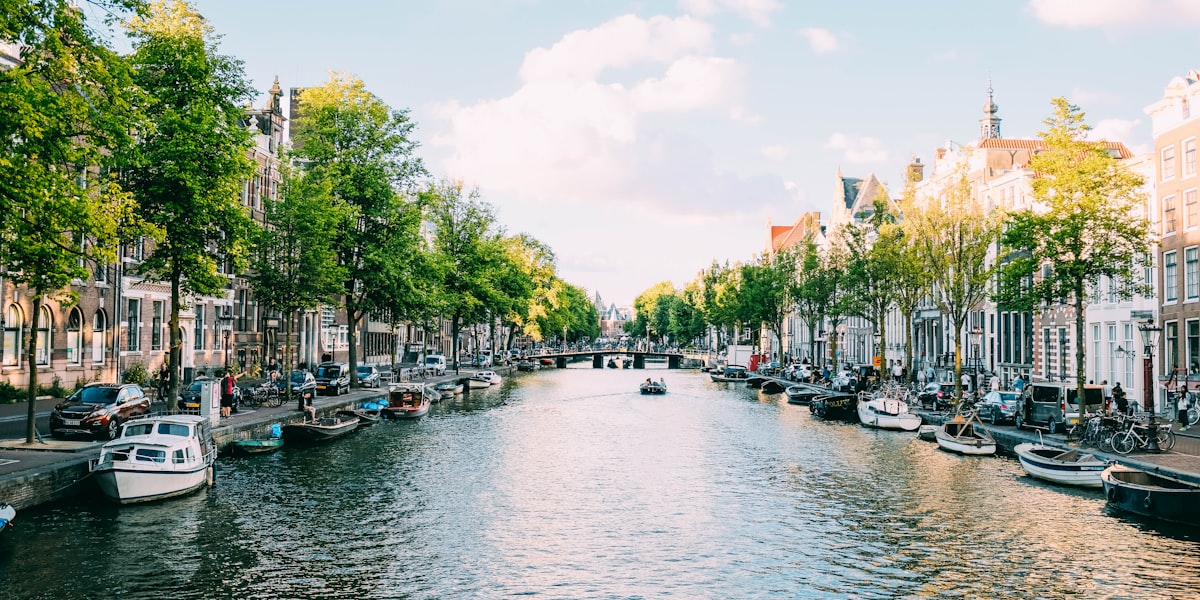
City Guide
Amsterdam
Netherlands · Best time to visit: Apr-Jun, Sep-Oct.
Day-by-day plan
Choose your pace
Trip length
09:00
Landmark
Walk 10 minutes straight down Damrak from Central Station — the boulevard narrows then suddenly opens into Dam Square with the Royal Palace dominating the western wall. At 9 AM the square belongs to you and the pigeons, morning sun lighting up the 17th-century sandstone facade. This is the only hour you'll see it without a sea of selfie sticks.
Tip: Skip the Palace interior (€12.50, not worth it on a day trip). Best full-facade photo is from the southeast corner near De Bijenkorf — frame the Palace behind the National Monument with morning light hitting both.
Open in Google Maps →10:45
Landmark
From Dam Square, cut west into the Nine Streets (De Negen Straatjes) — nine cross-streets between the canals packed with vintage shops, Amsterdam's most charming 15-minute walk. You'll emerge at Prinsengracht 263, the Anne Frank House; stand at the canal edge and look up at the annex windows — knowing the story makes this the most powerful quiet moment of the day. Around the corner, Westerkerk's 85-meter tower is the tallest in the city, worth circling for the Rembrandt memorial plaque at its base.
Tip: The ground-floor bookshop is free to enter without a ticket — worth a 5-minute browse. The small Anne Frank statue on the canal is 50m south of the house, easy to miss if you don't look for it.
Open in Google Maps →12:15
Food
Walk south along Prinsengracht for 25 minutes — midday light warms the canal houses' stepped gables into gold as you cut through the Grachtengordel into De Pijp neighborhood. Enter Albert Cuyp Market at Ferdinand Bolstraat and browse westward: grab a fresh-pressed stroopwafel (€3.50, warm caramel oozing between wafers), kibbeling with garlic mayo (€7, crispy fried cod chunks), and a broodje haring if you're brave (€5, raw herring sweeter than you'd expect). This is Amsterdam's biggest outdoor market and the best street-food lunch you'll spend €15 on.
Tip: Only buy stroopwafels from stands pressing them fresh — look for the iron press and the queue. The packaged ones are an entirely different (worse) food. Market open Mon-Sat until 17:00, closed Sundays.
Open in Google Maps →13:30
Landmark
Exit the market's western end and walk 10 minutes north — the Rijksmuseum's twin towers appear above the rooftops like a red-brick castle. Walk through the free bicycle passage beneath the museum first (buskers echo off the vaulted ceiling), then loop around to Museumplein: afternoon sun hits the south facade perfectly, lighting up every Gothic detail against the reflecting pool. Even without going inside, this building and the wide green lawn behind it are Amsterdam's single most iconic photo.
Tip: The 'I amsterdam' letters were removed from Museumplein in 2018 — don't waste time looking for them. Best reflection shot: south side of the pool on a windless moment. The bicycle passage under the museum is open 24/7 and free — walk through even if you skip everything else.
Open in Google Maps →15:15
Park
Cross Van Baerlestraat and slip into the main gate of Vondelpark — by mid-afternoon your feet have earned this. Find a bench by the large pond and watch Amsterdam live the way it actually does: cyclists gliding past, couples reading on the grass, dogs chasing nothing in particular. The rose garden deeper inside is the quietest spot in the city; the UFO-shaped Blauwe Theehuis café makes a fine rest stop for coffee (€3.50) or a cold Heineken (€5.50).
Tip: The east side where you enter is the liveliest with the best people-watching. Walk 10 minutes deeper to the rose garden for near-solitude. The open-air theater near the center sometimes has free performances in summer — check the board at the entrance.
Open in Google Maps →18:30
Food
Leave Vondelpark through the east gate and walk 15 minutes northeast — evening light turns the canal water amber as you cross back into the Grachtengordel toward Kerkstraat. You'll smell Café de Klos before you see it: wood smoke drifting from the open-flame grill of this tiny, 30-seat institution that has served Amsterdam's best spare ribs for decades. Order the half rack (€18.50, slow-roasted until it falls off the bone) with a baked potato (€4.50) and a beer — you're out for €28-35.
Tip: No reservations, ever. Arrive by 18:15 to beat the queue — by 19:00 you'll wait 30+ minutes outside. Order the ribs only; the steak is fine but unremarkable. Avoid every restaurant on nearby Leidseplein — overpriced tourist traps, no local has eaten there since 2005.
Open in Google Maps →Jump to day
09:00
Museum
Enter at 9am opening to beat the crowds. Head straight to the Gallery of Honour on Floor 2 — Rembrandt's Night Watch awaits at the far end, and at this hour you can stand before it without a single head blocking your view. Circle back through the Vermeer rooms; The Milkmaid is smaller than expected but the colors will stop you cold. The library on Floor 1 is one of the most photogenic rooms in Europe — free to enter, don't miss it.
Tip: Enter via the main entrance under the building passage, go straight to Floor 2 for the masterpieces, then work your way down. Skip the ground floor on a tight schedule. The museum shop has the best art book selection in Amsterdam.
Open in Google Maps →11:15
Museum
Walk out the back of the Rijksmuseum and across Museumplein — 5 minutes through the wide lawn where locals picnic in the sun. Start on Floor 0 and follow the chronological path: Van Gogh's life unfolds from somber Dutch peasant paintings to the luminous explosion in Arles. The Sunflowers and Almond Blossom are on Floor 1. At mid-morning the light inside the museum is at its best, and the late-morning crowds haven't peaked yet.
Tip: Timed-entry tickets must be purchased online — no walk-up sales. On Friday evenings the museum stays open until 21:00 with DJs and cocktails — if you're here on a Friday, it's the coolest evening event in town.
Open in Google Maps →12:45
Food
Exit the Van Gogh Museum, turn right, and walk 3 minutes down Van Baerlestraat — the blue sign is hard to miss. Skip the overpriced tourist traps on Museum Square and come here where locals actually queue. The Fish & Chips (€17.50) is golden and perfectly flaky, or go for the Fruits de Mer platter (€29.50/person) — a tower of oysters, crab, and prawns. Dutch grey shrimp (Hollandse garnalen) is the most authentic thing on the menu. Arriving at 12:45 on a weekday means you beat the 13:00 office crowd.
Tip: Weekdays at 12:30 you'll be seated immediately. Weekends, sign up at the door — they'll text when your table is ready. Budget €25-35 per person. Cash and cards accepted.
Open in Google Maps →14:00
Park
From the restaurant, walk 5 minutes west along Van Baerlestraat and enter the park from its southeast gate near Museum Square. After a morning of museums, don't rush — stroll like a local through Amsterdam's largest city park. Afternoon light filtering through the plane trees onto the water will teach you the meaning of 'gezellig,' that untranslatable Dutch feeling of warmth and belonging. Walk the main path to the Open Air Theatre and back — a gentle 30-minute loop. Find a bench and watch cyclists, dog walkers, and couples drift by.
Tip: Free and open 24 hours. Enter from the southeast gate (Museum Square side), head northwest. In good weather, sit on the grass — it's what Amsterdammers do every weekend. The park café Blauwe Theehuis (Blue Teahouse) is a beautiful 1930s flying-saucer building, worth a coffee stop.
Open in Google Maps →15:30
Shopping
Exit Vondelpark from the north gate and walk 15 minutes northeast through Leidseplein toward the canal ring — along the way you'll cross Herengracht, so look up at the 17th-century gabled mansions on both sides. The Nine Streets are Amsterdam's most charming shopping district: nine narrow lanes crossing three main canals, packed with independent boutiques, vintage stores, cheese shops, and chocolate makers. Don't plan, just wander. Spend extra time between Herengracht and Keizersgracht — quietest and most photogenic. When you reach Prinsengracht at golden hour, the sunset will paint the entire canal gold.
Tip: Prinsengracht faces west and catches direct golden-hour sunlight on the water — the canal-side benches between Reestraat and Berenstraat are the best free seats in the city for sunset. Grab a takeaway coffee and just sit. For souvenirs, De Kaaskamer (artisan cheese) and Marie-Stella-Maris (Dutch fragrance) are both in this area.
Open in Google Maps →19:00
Food
From the Nine Streets walk 8 minutes east past Singel canal to Spuistraat — you'll pass the bookshop quarter near Spui Square. In Amsterdam, not having Indonesian food means you haven't really been here: Dutch colonial history made it a national cuisine. This 30-year-old institution is a local staple. Order the Rijsttafel (Indonesian rice table, €29.50/person) — a dozen small dishes circling a bowl of rice: chicken satay, beef rendang, Padang spicy eggs, coconut vegetables. Two people sharing one rice table plus a main dish is the right amount. Pair with a cold Amstel.
Tip: Book online in advance. Budget €28-35 per person with drinks. For a lighter option, Nasi Goreng (Indonesian fried rice, €16.50) is excellent solo. Most restaurants along nearby Damstraat are tourist traps — avoid anyone touting at the door.
Open in Google Maps →09:00
Museum
The most essential experience in Amsterdam, and perhaps the most heartbreaking museum in the world. Anne Frank's family hid in the secret annex behind a bookcase in this canal house for two years before being discovered by the Nazis. Climbing the narrow stairs and pushing past the bookcase door, you'll go quiet. The museum's narrative guides you perfectly — no need to read up beforehand. Anne's original diary is in the final room; seeing her handwriting makes everything painfully real. First entry slot at 9:00 has the most contemplative atmosphere.
Tip: Tickets are only sold on the official website, released 6 weeks in advance every Tuesday at 10:00 AM Amsterdam time — they sell out within minutes. €16/person, enter at your booked time with no queue. Never buy marked-up third-party tickets. Set a calendar reminder for the Tuesday exactly 6 weeks before your visit.
Open in Google Maps →10:45
Neighborhood
Exit the Anne Frank House, turn right, and walk 3 minutes north along Prinsengracht — cross the first bridge and turn left into Jordaan. This is Amsterdam's best neighborhood for getting lost: a 17th-century workers' quarter turned into the city's most characterful residential area. Put your map away and wander between Bloemgracht and Egelantiersgracht. Every alley hides vintage stores, record shops, and decades-old cafés. Stop at Bloemgracht 7-11 — three connected step-gabled houses from the 1640s, the most photogenic façade in Amsterdam. Many shops open at 11:00, so you'll see the neighborhood wake up around you.
Tip: Best photo at Bloemgracht: cross the bridge to the south bank and shoot back north — you'll capture all three gabled houses with their canal reflection. If it's Saturday, Noordermarkt farmers' market (9:00-16:00) is where locals shop and mingle. The tiny Hofjes (hidden courtyard gardens) tucked behind street doors are Jordaan's best secret — look for Begijnhof-style doors and peek respectfully.
Open in Google Maps →12:30
Food
From Bloemgracht walk north through two blocks along Prinsengracht to Noordermarkt — 5 minutes, passing the 17th-century Noorderkerk whose brick walls glow beautifully in midday light. This is Amsterdam's undisputed best apple pie, and it's not even close. Winkel 43's appeltaart is thick, soft, loaded with massive apple chunks, just the right amount of cinnamon, crowned with fresh whipped cream. At €5.50 a slice, it's the best-spent €5.50 in the Netherlands. If you need a proper meal, order an uitsmijter (Dutch open-faced sandwich, €12.50) — bread piled with ham, cheese, and two sunny-side-up eggs. Simple and devastatingly good.
Tip: Weekdays at 12:30 you'll sit down immediately. Saturdays expect 15-20 minutes due to the adjacent market — absolutely worth it. Budget €12-18 per person. Grab a terrace seat facing Noordermarkt square and watch local life unfold.
Open in Google Maps →14:00
Landmark
From Noordermarkt walk south along Prinsengracht, turn east on Raadhuisstraat — 10 minutes to Dam Square. The shift from quiet Jordaan lanes to the bustling city center is a jarring contrast that is itself part of the experience. Dam Square is Amsterdam's beating heart: 800 years ago fishermen built a dam on the Amstel River here, giving the city its name. The Royal Palace was the largest secular building in 17th-century Europe. Its Citizens' Hall floor is inlaid with two-hemisphere world maps — walking across them channels Golden Age grandeur. Afternoon sun enters through the west-facing windows, giving the hall its best light.
Tip: €12.50 with free audio guide. The Palace occasionally closes for state events — check the official website before going. On the square, people will approach offering 'free' photos or friendship bracelets — ignore them and walk away. The Nieuwe Kerk next door often has excellent exhibitions (separate ticket).
Open in Google Maps →15:30
Neighborhood
From the Palace walk east across Dam Square along Damstraat — 5 minutes past the first canal bridge and you're in De Wallen, Amsterdam's oldest quarter. You'll step from a wide square into medieval narrow alleys — this 700-year-old district happens to also be the world's most famous red-light district, but in the afternoon it's simply atmospheric. Oude Kerk (Old Church), built in 1213, is Amsterdam's oldest building; over 2,500 people are buried beneath its floors. Step inside for medieval stained glass and a wooden ceiling that silences the chaos outside. Afterward, walk to Zeedijk and end your afternoon at Café 't Mandje — Amsterdam's first bar open to everyone, established 1927, its walls papered with a century of stories. Order a beer and absorb it all.
Tip: Best visited 14:00-17:00 — window lights aren't on yet and tourist crowds are thin. Never photograph the workers in windows — deeply disrespectful and against rules. Oude Kerk entry about €13. Zeedijk has Amsterdam's small Chinatown if you're craving Chinese food. 'Recommended restaurants' around De Wallen are almost all tourist traps — never eat dinner here.
Open in Google Maps →19:00
Food
From Zeedijk walk east through Nieuwmarkt square — the 15th-century Waag (weigh house) glows beautifully under evening lights — then continue along Kloveniersburgwal canal to Peperstraat, 10 minutes total. Your last dinner in Amsterdam deserves proper Dutch cuisine, not tourist pancakes. This is the city's best traditional Dutch restaurant, rebuilt for the modern palate. Dutch Shrimp Croquettes (€14.50) are the must-order starter: golden crispy shell bursting with North Sea grey shrimp. For the main, Braised Beef Cheeks with root vegetables (€28.50) are spoon-tender. Close with a glass of jenever (Dutch gin) — a final toast to the Golden Age.
Tip: Book at least 2 days ahead on their website, 4-5 days for weekends. Budget €35-45 per person with drinks. The restaurant is tucked in a tiny street — follow Google Maps to Peperstraat and look for the warm glow. This will be the most story-worthy meal of your trip.
Open in Google Maps →Jump to day
09:00
Museum
Step into Europe's greatest Dutch art collection the moment the doors open. The Gallery of Honour stretches before you like a cathedral of painting, and at its end Rembrandt's Night Watch commands an entire wall. At 9 AM you can stand an arm's length from this masterpiece in near-silence — by 11 the tour groups fill the room three deep.
Tip: Skip the main entrance queue — enter through the passage under the building from the Museumplein side. Go straight to the 2nd floor Gallery of Honour; before 10 AM you can have The Night Watch almost to yourself.
Open in Google Maps →12:00
Food
Three minutes from the Rijksmuseum's back exit — turn right along Johannes Vermeerstraat and look for the packed terrace. Order the legendary biefstuk (€19.50): a seared tenderloin on a wooden board with house-made herb butter, the best affordable steak in Amsterdam. Arrive at noon sharp; by 12:30 you'll wait 20 minutes for a table.
Tip: Order your biefstuk medium rare — anything above medium and the locals will side-eye you. The herb butter is house-made; mop up every last drop with the bread.
Open in Google Maps →13:30
Museum
Walk back to Museumplein — the glass-and-steel building stands three minutes left of the Rijksmuseum. The world's largest Van Gogh collection unfolds chronologically: from dark Dutch peasant scenes to the blazing Provence sunflowers that changed art forever. Afternoon light through the atrium skylight gives those yellows and blues an extra glow you won't get in the morning.
Tip: Tickets must be booked online for a specific time slot — no walk-ins. Take the lift to floor 3 and work downward: the self-portraits and Bedroom in Arles are up top with far fewer people.
Open in Google Maps →16:00
Park
Exit the Van Gogh Museum, turn left, and the park entrance appears in one minute — Amsterdam's green living room spreads before you. Find a bench by the pond near the Openluchttheater and do what locals do: sit, breathe, watch the parade of cyclists and dog walkers. Late afternoon sun cuts low through the old trees and turns everything golden.
Tip: The stretch between the Openluchttheater pond and the rose garden is the most beautiful and quietest corner. Skip the café terraces near the main entrance — overpriced and noisy.
Open in Google Maps →19:00
Food
From Vondelpark's southwest exit, walk south along Amstelveenseweg for 10 minutes through the quiet residential South — notice how every Dutch balcony doubles as a garden. Order the rijsttafel (€39.50): twelve to fifteen Indonesian small plates arriving in waves — satay, rendang, sambal prawns, gado-gado. The most delicious legacy of Dutch colonial history; no Amsterdam trip is complete without it.
Tip: Two people: order one rijsttafel plus one à la carte main — the rijsttafel alone is enormous. Book at least 3 days ahead on their website. Don't eat at the overpriced cafés on Museumplein — double the price, half the quality.
Open in Google Maps →09:00
Landmark
The 9 AM slot is the quietest — you climb the steep stairs behind the bookcase with only a handful of others. In the Secret Annex, pencil marks tracking the children's height are still on the wall. Nothing prepares you for how small these rooms are, how thin the curtains that hid a family for two years.
Tip: Tickets release every Tuesday for 6 weeks out — set a phone alarm. The 9:00 slot sells last because tourists sleep in. Put your phone on silent before entering.
Open in Google Maps →11:00
Neighborhood
Cross the bridge from the Anne Frank House and turn right into the Jordaan — Amsterdam's most photogenic neighbourhood unfolds lane by lane. Walk north along Prinsengracht's west bank: houseboats with cats on windowsills, courtyard gardens glimpsed through open gates, the scent of fresh bread from bakeries just opening. End at Noordermarkt square, where on Saturdays a farmers' market sells the best fresh stroopwafels in the city.
Tip: The bridge where Brouwersgracht meets Prinsengracht has the most beautiful canal view in Amsterdam — locals agree. Stand on the southeast corner for the classic shot with four canal lines receding into the distance.
Open in Google Maps →12:30
Food
From Noordermarkt, walk south along Westerstraat and turn right into Rozengracht — 5 minutes on foot. 'Moeders' means 'Mothers': every wall is covered floor-to-ceiling with framed photos of diners' moms. Order the stamppot boerenkool — kale mash with smoked sausage (€16.50), the taste of every Dutch grandmother's kitchen. Budget €18-25 per person.
Tip: Bring a photo of your mom — they'll frame it and hang it on the wall. The erwtensoep (split pea soup, €9.50) is the true Dutch winter classic, thick enough to stand a spoon in.
Open in Google Maps →14:00
Shopping
Walk east from the restaurant, cross Prinsengracht, and enter Wolvenstraat — you're at the Nine Streets' doorstep, six minutes on foot. Nine tiny lanes crossing three grand canals, lined with independent boutiques, vintage shops, and second-floor cafés. Every canal bridge is a photo spot: curved gabled houses reflected in still water. This is your slow-wandering afternoon — two full hours to browse and get happily lost.
Tip: The cheese shop on Huidenstraat offers free tastings — try the truffle Gouda. Don't buy tulip souvenirs here; they're all mass-produced. The vintage shops on Gasthuismolensteeg have the best finds.
Open in Google Maps →19:00
Food
From the Nine Streets' south end, walk along Keizersgracht past Leidsegracht and turn right into Kerkstraat — 8 minutes. Amsterdam's worst-kept secret for ribs: the spare ribs (€19.50) are charred, sticky-sweet, falling off the bone, served with garlic bread you'll want to order twice. No reservations accepted — arrive at 18:45 to catch the first seating. Budget €22-30.
Tip: Bring cash — they may not accept international credit cards. The large portion is enough for one. Avoid every restaurant on nearby Leidseplein square — tourist traps charging double for frozen food.
Open in Google Maps →09:00
Neighborhood
On the southeast corner of Spui Square, find an unremarkable arched doorway — push it open and step from the 21st century into a medieval courtyard of perfect morning silence. The Begijnhof has been home to a lay sisterhood since the 14th century; number 34 is Amsterdam's last wooden house, dating to around 1528. At 9 AM you share this secret garden with no one but the resident cats.
Tip: Number 34, Amsterdam's last wooden house, is at the far end of the courtyard — most visitors turn back before reaching it. Keep your voice down; people still live here.
Open in Google Maps →10:30
Religious
Exit Begijnhof, cross Spui north, walk up Rokin and through Dam Square into Warmoesstraat — 10 minutes through Amsterdam's evolving centuries. At 10:30 AM De Wallen is quiet and residential: curtains drawn, locals walking dogs, nothing but medieval architecture. Inside the Oude Kerk (1306), over 10,000 people rest beneath the floor you walk on, and rotating contemporary art installations create an extraordinary tension with the 800-year-old walls.
Tip: Rembrandt's wife Saskia van Uylenburgh is buried beneath the floor — look for her grave marker. Note: the church opens at 13:00 on Sundays; swap the morning order if Day 3 falls on a Sunday.
Open in Google Maps →12:00
Food
Walk south from the Oude Kerk across Oudezijds Voorburgwal, turn into the quiet Nes alley — 5 minutes past theatre marquees. There is no menu: the waiter recites today's dishes from memory, usually two fish, two meat, two vegetarian. Point at whatever sounds good; mains run €14-18. Arrive at noon for immediate seating; after 12:30 expect a wait. Budget €20-28.
Tip: Don't panic about the no-menu concept — just say 'your recommendation' if you can't follow the Dutch. The fish dishes are usually the star of the day.
Open in Google Maps →13:30
Landmark
Walk 5 minutes north along Nes back to Dam Square — the Palace commands the entire western side. The Citizen's Hall is the masterpiece: its marble floor is inlaid with maps of the world as the Dutch saw it in 1655, when Amsterdam was the centre of global trade. After the Palace, the afternoon is yours — wander south along Singel to the Bloemenmarkt floating flower market, or find a canal-side bench with a coffee and watch the city drift by.
Tip: The Palace closes occasionally for state functions — check their website the day before. In the Citizen's Hall, look up: the ceiling paintings mirror the world maps on the floor below.
Open in Google Maps →18:30
Food
Walk south from Dam Square along Spuistraat — 3 minutes to this restaurant hidden inside five connected 17th-century canal houses. Each room has its own world: Delft tiles, antique maps, copper pots, Rembrandt etchings. Order the Dutch slow-cooked beef (€32) or the North Sea seabass (€34) — a farewell dinner worthy of this city. Budget €45-60 per person.
Tip: Book on their website and request the Rembrandt Room for original etchings on the walls. Avoid every restaurant on Damrak near Central Station — tourist traps charging triple for reheated food.
Open in Google Maps →Jump to day
09:00
Religious
Slip through the unmarked wooden door off Spui square into a 14th-century enclosed courtyard where a community of pious women has lived since 1346. At nine in the morning only birdsong breaks the silence, the lawn is still dewy, and house No. 34 — Amsterdam's oldest surviving wooden building, dating to 1528 — leans gently as if listening. This silence in the dead center of a capital city is what Amsterdam does better than anywhere.
Tip: Enter from the Spui side — look for the arched passageway between the university bookshop and the café. The hidden Catholic chapel inside has subtle stained glass worth five minutes. Exit through the north gate onto Kalverstraat for your walk to Dam Square.
Open in Google Maps →10:00
Landmark
Walk five minutes north on Kalverstraat and the buildings suddenly part to reveal Dam Square, with the Royal Palace commanding its western edge. Built in 1655 as the city hall when Amsterdam was the richest city on earth, the Citizens' Hall floor is inlaid with marble maps placing Amsterdam at the center of the known world — Golden Age confidence carved in stone. Morning light pours through the east windows and sets the chandeliers ablaze.
Tip: The Palace occasionally closes for royal functions without advance warning — check the website that morning. The free audio guide is excellent and reveals details invisible to the naked eye. Stand in the center of Citizens' Hall and look down at the floor maps: Eastern and Western hemispheres with Amsterdam at the center.
Open in Google Maps →12:00
Food
From the Palace, cross Dam Square diagonally and walk three minutes south on Spuistraat. This 1520s building has been serving Dutch classics done right — hearty, honest, no shortcuts. Stamppot met rookworst (mashed potato with smoked sausage, €18) is Dutch soul food at its purest. Add a bowl of erwtensoep (split pea soup, €9) if the weather is cold — it's so thick the spoon stands upright.
Tip: Arrive at noon sharp — by 12:30 tour groups fill the back rooms. Order à la carte, skip the tourist set menu. Budget €20-30 per person. Sit in the back room with the old Delft tiles for atmosphere.
Open in Google Maps →14:00
Entertainment
Walk eight minutes north along Spuistraat back toward Centraal Station to the canal boat docks. The two o'clock afternoon light is ideal: the sun is high enough to illuminate the canal house façades but angled enough to paint reflections on the water. In one hour you'll pass under more than a dozen bridges, glide through the Jordaan and the Grachtengordel, and suddenly the city's concentric canal layout clicks into place — the aha moment every first-time visitor needs.
Tip: Skip the massive tourist boats on Damrak. Book 'Those Dam Boat Guys' or 'Flagship Amsterdam' — small open boats, live guide who actually lives here, and you can bring your own drinks. Sit at the front for unobstructed views and the best photos.
Open in Google Maps →19:30
Food
Walk ten minutes south from the cruise dock through the city center as evening settles in — the canal houses begin to glow as curtainless windows light up from within. Five interconnected 17th-century houses, each dining room a different world: Rembrandt etchings, Delft blue tiles, antique chandeliers. Try the slow-braised Dutch beef stew (€32) or Zeeland oysters (€24 for six). This is your one splurge dinner in Amsterdam — the name means 'Five Flies' after the original 17th-century inn.
Tip: Reserve two days ahead and request the Rembrandt Room. Budget €45-65 per person. After dinner, walk five minutes east through the alleyways to De Wallen (Red Light District) — perfectly safe to stroll at night, fascinating and unique, but never photograph the windows. Avoid every restaurant and 'show' in De Wallen without exception — they are all tourist traps with terrible food.
Open in Google Maps →09:00
Museum
Be at the entrance by 8:50 — the museum opens at nine and the first thirty minutes before tour groups arrive are golden. Head straight to the Gallery of Honour on Floor 2: Vermeer's luminous quiet, Rembrandt's Night Watch in its own redesigned hall, four centuries of Dutch masters bathed in skylight. Three hours is the minimum to do this museum justice, and you'll still leave wanting more.
Tip: Go to The Night Watch first (Gallery of Honour, Floor 2), then work backward through the Golden Age galleries. Vermeer's rooms are at the far end. Skip Floors 0-1 on a first visit — focus on Floor 2 (Golden Age) and Floor 3 (20th century). The museum garden is free and makes a lovely shortcut to Museumplein.
Open in Google Maps →12:30
Food
Exit through the Rijksmuseum's south passage onto Museumplein, walk past the I Amsterdam sign and turn right on Van Baerlestraat — five minutes total. This no-frills seafood restaurant is packed with locals on lunch break, which tells you everything. The fruits de mer plateau for two (€59) is the showpiece; solo, the fish and chips (€19) are the best in Amsterdam.
Tip: Arrive before 12:30 — no reservations for lunch, first come first served. Sit at the bar counter for fastest seating. Budget €25-40 per person. The lobster roll (€26) is the sleeper hit on the menu.
Open in Google Maps →14:00
Museum
Walk back across Museumplein — three minutes. The afternoon slot is strategic: morning crowds thin after lunch. The museum tells Van Gogh's life chronologically across four floors, from dark Dutch peasant scenes to the blazing color explosions of Arles and Saint-Rémy. By the time you reach Wheatfield with Crows on the top floor, you'll understand why this man changed painting forever.
Tip: Timed tickets sell out weeks ahead — book the moment they release, usually four to five weeks in advance. Start at Floor 0 and go up in order: the emotional arc from The Potato Eaters to Almond Blossom is the whole point. Floor 2 (Arles period) is the peak — Sunflowers, The Bedroom, Starry Night Over the Rhône.
Open in Google Maps →17:00
Park
Step out of the Van Gogh Museum, cross Paulus Potterstraat, and you're at the park's northeast entrance. After five hours of concentrated looking, your eyes and mind need open sky and old trees. Late afternoon light filters through the elms, locals cycle home, someone is always playing guitar by the pond. Let your brain process what you've just seen.
Tip: Walk to the Blauwe Theehuis (Blue Teahouse) — a flying-saucer-shaped 1930s café in the center of the park. A beer or coffee on its round terrace at golden hour is the perfect decompression after museum overload. In summer, the open-air theatre sometimes has free evening concerts.
Open in Google Maps →19:30
Food
Exit Vondelpark through the south gate and walk five minutes along Johannes Vermeerstraat. Loetje is an Amsterdam institution legendary for one thing: steak. No pretension, just the best biefstuk in the city — 'Biefstuk Loetje' medium-rare (€24.50) — served in a warm neighborhood café where every table is full of regulars. Comes with fries and a simple salad.
Tip: The 'Biefstuk Loetje' medium-rare is the only correct order. The Dutch eat fries with mayo, not ketchup — try it their way. No reservations; arrive by 19:00 to beat the wait. Budget €30-40 per person. The ossenhaas (tenderloin, €29.50) is the upgrade if you're feeling generous.
Open in Google Maps →09:00
Museum
The earliest time slot means the fewest people in those tiny rooms, and it changes the experience entirely. You'll climb the steep stairs behind the bookcase door into the hiding annex where Anne wrote her diary for two years. The pencil marks on the wall where Otto Frank tracked his daughters' growing heights — that's the moment that breaks everyone. Allow the silence to do its work.
Tip: Tickets release online every Tuesday at 10:00 for the following six weeks — set an alarm, they sell out within minutes. The 9:00 slot is hardest to get but most worth it. No photos inside. The space is small but the emotional weight is immense; allow 1-1.5 hours.
Open in Google Maps →11:00
Landmark
Walk out of Anne Frank House and the Westerkerk tower is thirty seconds to your left — you can't miss the blue Imperial Crown on top. Climb 186 narrow, steep steps to the highest church tower in Amsterdam at 85 meters. The view from the top is the best in the city: a sea of crooked gabled rooftops stretching in every direction, with the three great canals curving away below like a hand slowly opening.
Tip: Tower tours are guided, every 30 minutes, maximum 6 people per group — arrive early in your slot. Rembrandt is buried somewhere inside this church but the exact location was lost centuries ago. The blue crown on top was a gift from Emperor Maximilian in 1489 — you'll see it on Amsterdam's coat of arms everywhere.
Open in Google Maps →12:15
Food
Walk out of Westerkerk, turn left along Prinsengracht canal — the most beautiful of the three main canals — and stroll five minutes north to Noordermarkt square. This is home to Amsterdam's most legendary appeltaart: a thick, warm, cinnamon-loaded slab crowned with a mountain of whipped cream. Order the appeltaart met slagroom (€6.50) and a broodje kroket (croquette sandwich, €7.50) at the counter, grab a terrace seat overlooking the square.
Tip: If visiting on Saturday (9am-4pm), the Noordermarkt farmers' market fills the square with organic cheese, fresh stroopwafels, and flowers — arrive early to combine the two. On weekdays the apple pie alone is worth the walk. Budget €12-18 per person.
Open in Google Maps →14:00
Neighborhood
Walk south from Noordermarkt along the canal for eight minutes, cross Herengracht, and you're in the Nine Streets — nine tiny cross-streets connecting the three main canals. This is Amsterdam's best wandering: vintage clothing at Episode, curated Dutch design at The Darling, handmade candy pulled in the window at Papabubble. Each canal crossing is a new postcard. Afternoon light turns the water golden between the bridges.
Tip: Don't try to hit all nine streets systematically — let yourself get lost. The canal crossing at Wolvenstraat and Herengracht is the classic photo angle. Episode on Berenstraat has the best vintage in Amsterdam. If you need coffee, Screaming Beans on Hartenstraat roasts its own and the baristas know what they're doing.
Open in Google Maps →19:00
Food
Walk west from the Nine Streets along any canal — ten minutes to Rozengracht. 'Moeders' means 'Mothers': the walls are covered with framed photographs of mothers brought by customers over the decades. The food is Dutch home cooking — hutspot met klapstuk (carrot-onion-potato mash with slow-cooked beef, €19) and boerenkool stamppot (kale mash with smoked sausage, €17). This is what dinner tastes like if you had a Dutch grandma.
Tip: Reserve one day ahead for dinner. Bring a photo of your own mother — they'll frame it and hang it on the wall, and it'll still be there next time. Budget €20-30 per person. Skip the touristy pancake houses in the Jordaan; Moeders gives you the same cozy feeling with real food.
Open in Google Maps →10:00
Museum
Take the free ferry from behind Centraal Station — a five-minute crossing of the IJ river that feels like leaving the 17th century and arriving in the 21st. Even if you don't care about film, the EYE building is a stunning white geometric sculpture perched on the north bank. The basement exhibition is always immersive and surprising. But the real prize is the café terrace facing south: the best panorama of Amsterdam's historic skyline across the water, with boats sliding by in the foreground.
Tip: The Buiksloterweg ferry departs from the west side of Centraal Station's waterfront — follow signs for 'Pont.' Runs every few minutes, 24 hours, completely free. Even if you skip the exhibition (€12), the building and café terrace are free to enter and worth the crossing alone.
Open in Google Maps →12:00
Food
Walk one minute along the waterfront from EYE to this former toll house dating to 1662, now a cultural garden café under old chestnut trees. This is where Amsterdam Noord's creative community gathers for lunch — designers, artists, filmmakers from EYE next door. The seasonal lunch plate (€16-18) changes weekly with local ingredients. Homemade cakes are quietly excellent.
Tip: Sit in the garden, not inside — the chestnut canopy and the waterfront breeze make this one of Amsterdam's most relaxed lunch spots. In summer, weekend evenings bring outdoor cinema and live music. Budget €15-22 per person.
Open in Google Maps →13:30
Entertainment
Walk two minutes from Tolhuistuin to the A'DAM Tower. Take the elevator to the 20th-floor observation deck for a 360-degree panorama — from here you finally see the full picture: the canal rings, the church towers, the port, the flat Dutch horizon stretching to infinity. Then, if you're brave: Over the Edge, Europe's highest swing, sends you arcing out over the building's edge 100 meters above Amsterdam. Three minutes of pure adrenaline with the city spinning below your feet.
Tip: Lookout ticket €14.50 + Over the Edge swing €6. The swing lasts about three minutes but the adrenaline lasts all day. Your belongings go in a locker before the swing. Book the swing ticket online to skip the queue on top. The rooftop bar has the same view — grab a drink after to celebrate your survival.
Open in Google Maps →16:00
Park
Ferry back to Centraal Station — five minutes — then walk fifteen minutes east along Prins Hendrikkade, past the grand Scheepvaarthuis building, into the quiet Plantage neighborhood. Founded in 1638 as a medicinal herb garden for the plague, this is one of the oldest botanical gardens in the world. After the adrenaline of the swing, the tropical greenhouses and centuries-old trees feel like a warm exhale. Late afternoon light turns the glass houses amber.
Tip: Don't miss the 300-year-old Eastern Cape cycad — one of the oldest potted plants on earth. The butterfly greenhouse is small but magical. The orangery café serves excellent cake under the glass roof. This is one of Amsterdam's best-kept secrets; tourists almost never come here.
Open in Google Maps →19:00
Food
Walk five minutes south from the Hortus through the quiet Plantage streets to Peperstraat. Greetje serves 'neoclassic Dutch cuisine' — forgotten recipes researched in old cookbooks and revived with modern technique. This is Amsterdam's most respected traditional Dutch restaurant, in a cozy candlelit space on a street most visitors never find. Start with the Dutch shrimp croquettes (€16), then the slow-cooked Limburg lamb (€29) or wild boar stew (€28).
Tip: Reserve at least three days ahead — this place is known to locals, not tourists, so weekend tables go fast. The 'Greetje's Surprise' dessert (€14) is a showstopper. Budget €40-55 per person. Walk back along the Plantage canals after dinner — the neighborhood is hauntingly beautiful and empty at night.
Open in Google Maps →09:30
Shopping
Amsterdam's biggest and best street market stretches for an entire block along Albert Cuypstraat — this is where locals shop, not where tourists pose. Morning energy is infectious: vendors shouting, cheese wheels stacked impossibly high, the smell of warm stroopwafels drifting from the press. Try a fresh stroopwafel from the iron (€3, eaten while warm and gooey), a raw herring at the fish stall (€4, hold by the tail, tilt your head back — the Dutch way), and sample aged Gouda at any cheese stand that offers you a taste.
Tip: Open Monday to Saturday 09:00-17:00, closed Sunday. The stroopwafel stall near the middle of the market with the longest local queue is the one — follow the Dutch, not the tourists. For herring, find the fish stands flying the Dutch flag; whichever has the most locals is the freshest.
Open in Google Maps →11:30
Food
Walk three minutes south from the market to Ceintuurbaan. This all-day brunch spot occupies a converted 1920s cinema — the soaring triple-height ceiling, mezzanine balcony, and art deco details make you feel like you're eating inside a beautiful dream. The açaí bowl (€14) and eggs royale (€16) are the bestsellers, colorful and genuinely delicious rather than just photogenic.
Tip: Grab a seat on the mezzanine level for the best atmosphere and light filtering down from above. Arrive at 11:30 for immediate seating — after noon a queue forms. Budget €15-22 per person.
Open in Google Maps →13:00
Park
Walk two minutes south from CT Coffee. A quiet neighborhood park in the heart of De Pijp — young parents pushing prams, students reading on benches, dogs chasing each other on the lawn. Sit by the ornamental fountain and soak in the last unhurried rhythm of this city. This is Amsterdam at its most everyday and most lovable.
Tip: If the weather is good, grab a takeaway coffee and sit on the south lawn where the early afternoon sun is warmest. This is decompression time — don't rush it.
Open in Google Maps →14:00
Shopping
Walk fifteen minutes north from Sarphatipark along Vijzelstraat toward the city center, crossing the Singelgracht canal, until you reach the Singel. The world's only floating flower market has been here since 1862 — stalls on houseboats selling tulip bulbs, daffodils, and Dutch souvenirs. Yes, it's touristed, but the tulip bulbs are real and come with phytosanitary certificates for international customs. This is your last chance for Dutch gifts that actually mean something.
Tip: Buy tulip bulbs in sealed bags with the green phytosanitary certificate sticker — these will pass Chinese customs. The stalls at the west end (toward Koningsplein) have better quality bulbs than the east end tourist shops. Skip the wooden tulips and clogs here; Schiphol Airport duty-free has better versions.
Open in Google Maps →15:00
Entertainment
Walk five minutes north through Kalverstraat, then duck into a hidden alley — Pijlsteeg — behind Hotel Krasnapolsky on Dam Square. This jenever tasting house has been pouring Dutch gin here since 1679. The room is tiny, standing room only, no seats — exactly as it was three centuries ago. The bartender fills your tulip-shaped glass to the absolute brim. You bend down and sip without lifting the glass — this ritual is called a 'kopstoot' (headbutt). The perfect last sip of Amsterdam.
Tip: Try the 'Oranje Bitter' (€5.50) for classic Amsterdam flavor, or 'Honing' (honey jenever, €5.50) if you prefer sweet. No reservation needed — walk in, stand, drink. The tiny shop inside sells bottles to take home. Don't confuse jenever with gin: jenever is maltier, softer, uniquely Dutch. This alley is one of Amsterdam's most hidden gems — most tourists walk right past it on Dam Square without knowing it exists.
Open in Google Maps →
Trip builder
Plan this trip around Amsterdam
Turn this guide into a bookable rail itinerary with FlipEarth.
Keep exploring
Related cities
Nearby cities
More in the same country
FAQ
Frequently asked questions
How many days do you need in Amsterdam?
Most travelers enjoy Amsterdam in 2 days, with enough time for headline sights and a slower meal or museum stop.
What's the best time to visit Amsterdam?
The easiest season for most travelers is Apr-Jun, Sep-Oct, especially if you want good weather and manageable crowds.
What's the daily budget for Amsterdam?
A practical starting point is about €100 per person per day before hotels, then adjust based on museums, dining, and transport.
What are the must-see attractions in Amsterdam?
A good first shortlist for Amsterdam includes Rijksmuseum, Van Gogh Museum, The Seafood Bar.