City Guide
Zagreb
Kroatien · Best time to visit: Apr-Oct.
Day-by-day plan
Choose your pace
Reisedauer
09:00
Neighborhood
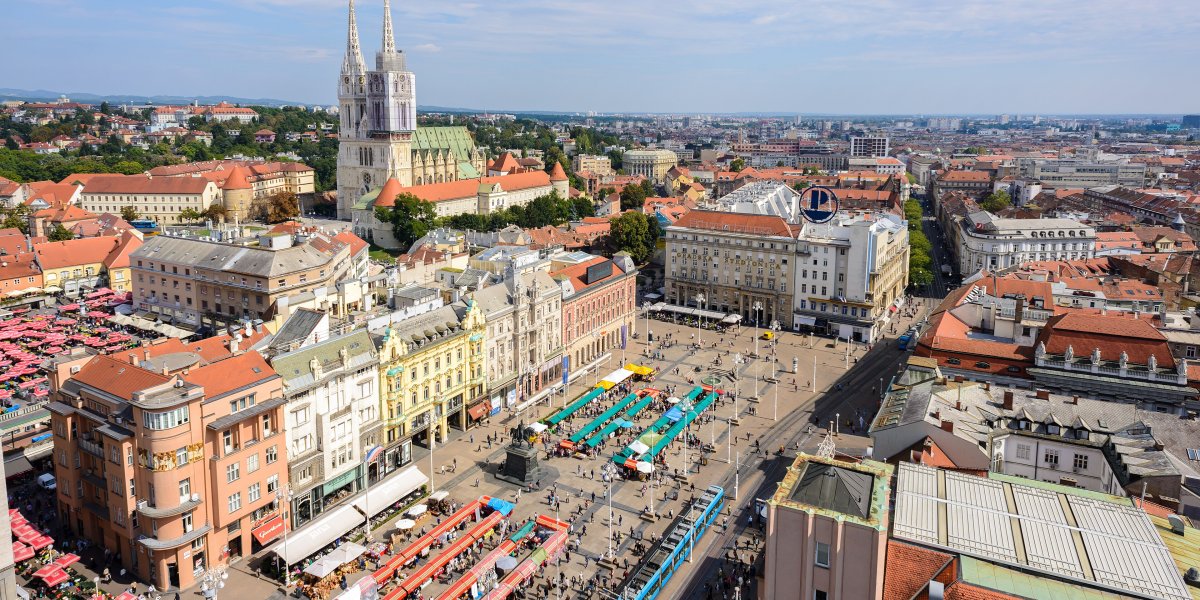
Step off the tram at the bronze horse of Ban Jelačić — the magnetic center of the city — and climb the staircase directly behind him. The red umbrellas of Dolac unfold in waves above crates of fresh figs, Pag sheep cheese, and seasonal greens; this is where every Zagreb housewife still shops, and where the city visibly wakes up. Catch it now, before the tour groups arrive: by 10:00 the produce terrace becomes a corridor and the best figs are gone.
Tip: Shoot the red umbrellas from the top of the northeast staircase looking down — that's the postcard angle, and the morning light rakes in from the right. Don't miss the hidden 'Riblja placa' (fish hall) tucked at ground level under the terrace; locals use the side stairs by the flower vendors and it closes at 14:00.
Open in Google Maps →10:30
Religious
From Dolac's fish hall, cross Kaptol street and walk two minutes east — the twin neo-Gothic spires rear up suddenly between the yellow houses. The 2020 earthquake tore the top off the south spire and the cathedral has been swathed in scaffolding ever since, but the scale is still staggering: 108 m of carved limestone above the old fortified bishop's citadel. This is an exterior-only stop — interior access has been restricted since the quake and isn't worth the queue.
Tip: Shoot from the Mary column fountain in Kaptol Square facing north — at this angle the functioning north spire hides most of the scaffolding, and you still get the full height. The defensive watchtowers to the right of the façade are the oldest surviving structure on the plaza and make a stronger photo than the front.
Open in Google Maps →11:30
Landmark
Cut back across Kaptol, down Bakačeva, then up the cobbled ramp of Radićeva — a 10-minute climb — until you pass through the wooden-vaulted tunnel of the Stone Gate, where Zagrebians still pause to light candles at the Marian shrine. Emerge onto the silent cobbles of Gornji Grad and walk straight to Zagreb's single most photographed object: the checkerboard tiled roof of St. Mark's Church, carrying the Croatian and Zagreb coats of arms. Continue past the Prime Minister's front door and the Museum of Broken Relationships' discreet façade to Lotrščak Tower — time your arrival for 11:55 sharp for the Grič cannon, the single thunderous shot that has marked midday here since 1877.
Tip: Stand on the open Strossmayer Promenade terrace behind Lotrščak (not inside the arcade) with the red-tiled Lower Town panorama in your viewfinder at 11:59 — the 12:00 blast sends pigeons erupting from every roof and that's the photo you want. For St. Mark's, shoot from the southwest corner of the square to catch both the tiled roof and the rose window in one frame; the interior is closed to tourists, so don't queue at the door.
Open in Google Maps →13:45
Food
Descend the covered stone staircase of Skalinska from the promenade — a 6-minute drop straight back into Lower Town's buzz — to a tiny hidden courtyard that serves exactly one thing, and does it like nowhere else. La Štruk's menu is only štrukli: paper-thin sheets of dough wrapped around fresh cottage cheese, either boiled in cream or baked until the edges blister gold. Order one savory baked (7 €) and one walnut-cinnamon sweet baked (6 €) with a glass of Graševina — this is the single dish every Zagreb grandmother is judged on.
Tip: The baked versions are objectively better than the classic boiled — the cream caramelizes at the edges. Arrive at 13:40, not 14:15: the courtyard has eight tables and they don't take reservations for under 4 people, and the post-Upper-Town crowd lands at a quarter past. Cards accepted, but keep a few euros cash for the tip.
Open in Google Maps →15:15
Landmark
From Skalinska, head north up the lower end of Tkalčićeva (you'll come back for dinner), pick up Ribnjak Park at the top, then follow Mirogojska Cesta uphill — a 30-minute climb past chestnut trees and quiet villas. Mirogoj is technically a cemetery, but that sells it short: Herman Bollé's 500-meter neo-Renaissance arcade, its ivy-clad domes receding in both directions, is one of the most photographed funerary sites in Europe and completely off the tour-bus circuit. Walk slowly — the graves here belong to Croatia's writers, footballers, and war heroes, and the whole arcade functions as an open-air national portrait gallery.
Tip: Enter through the main central arcade and walk the west (left) arcade first while the sun is still high, then reverse through the east arcade as the 17:30 golden hour hits the columns head-on — the light bounces off the ivy and turns the whole colonnade copper. If the uphill walk feels like too much after lunch, bus 106 from Kaptol Square takes 12 minutes and costs 0.80 € from the driver.
Open in Google Maps →19:30
Food
Descend the Mirogojska–Ribnjak spine back into the city — 25 minutes mostly downhill through the park — as the light drops, landing directly onto Tkalčićeva, Zagreb's pedestrian dining street, already glowing with string lights. Agava claims a tiered stone terrace carved into the hillside above the street, so every table looks down on the evening promenade and up at the medieval wall of Upper Town. Order the black cuttlefish risotto (22 €) and the slow-cooked veal peka (28 €, order 30 min ahead); for dessert, the fig cheesecake is the one Zagrebians actually recommend to visitors.
Tip: Reserve 48 hours ahead and specifically request the 'upper terrace' — the lower tier gets jostled by passing promenaders. Pitfall warning: the ground-floor restaurants further down Tkalčićeva with laminated English-only menus and hosts who physically intercept tourists are the classic Zagreb trap — prices run 30% higher and the 'Adriatic scampi' are frozen. Also decline the unprompted 'free welcome rakija' at any restaurant in this area: it is always followed by a surprise 8–10 € cover charge buried at the bottom of the bill.
Open in Google Maps →Zu Tag springen
09:00
Shopping
One minute up the covered steps from Ban Jelačić Square — Zagreb's open-air market is already alive by 9 am, a sea of red parasols where Istrian strawberries, Pag cheese, and spring onions change hands in quick Croatian bargaining. This is the hour the babice (elderly market women) are actually selling to locals; by 11 am the produce thins out and the aisles fill with tour groups. You are seeing the real engine of the city's breakfast table, not its souvenir version.
Tip: Duck into the covered fish hall (Ribarnica) at the market's northern edge — most visitors never find it and the morning catch from Rijeka lands here. Go Saturday morning for the full market (Sunday is fruit-only and half the size) and grab a still-warm slice of cheese burek from Pekarnica Dubravica at the square's lower corner for €2.50.
Open in Google Maps →10:00
Religious
Walk two minutes east out of Dolac across Kaptol Square — the twin 108-metre neo-Gothic spires appear framed by the gilded Virgin Mary column. One spire has been wrapped in scaffolding since the March 2020 earthquake cracked its tip; the cathedral is a building mid-resurrection and you will only see this transitional state for a few more years. Morning sun hits the western facade head-on at this hour, giving you the postcard photo without afternoon haze.
Tip: Stand on the small green area just beside the Virgin Mary fountain for the cleanest wide-angle shot of both spires. The nave is largely closed for restoration, but the entrance porch is open and worth five minutes for the gilded altar fragments displayed along the interior wall.
Open in Google Maps →11:00
Landmark
Follow Radićeva west from the cathedral and enter Upper Town through Kamenita Vrata (the Stone Gate) — the only surviving medieval gate has a candle-lit shrine inside where Zagreb grandmothers still pray in silence. Emerge onto Markov Trg for the checkerboard-tiled roof of St. Mark's Church, with the coats of arms of Croatia, Slavonia and Zagreb glazed directly onto the tiles in 1880. Then walk two minutes west to Lotrščak Tower, where the Grič Cannon has fired at 12:00 sharp every day since 1877 — time your arrival so you hear it.
Tip: For the St. Mark's roof photo, stand on the south side of the square — the north side is blocked by the Croatian Parliament building and scaffolding. Climb the 61 steps of Lotrščak just after the noon cannon fires; the entire red-tiled Lower Town unfolds below and the tower empties in ten minutes as the tour group leaves.
Open in Google Maps →13:00
Food
Descend the short Skalinska steps — five minutes down from Lotrščak, tucked onto a narrow terrace right beside Dolac. Štrukli is Zagreb's soul food: a pulled-dough pillow filled with fresh cottage cheese and either baked until the top cracks golden, or poached in cream. Order the baked štrukli with truffle (€11) plus a glass of graševina white (€4) — this is what every Zagreb grandmother used to cook for Sunday lunch, reduced to the one dish that got it right.
Tip: Stick to the baked version on your first visit — it is what made the place famous and the cheese-to-crust ratio is perfect. Arrive by 12:45 to claim a terrace table; by 13:15 there is a 30-minute queue down the steps.
Open in Google Maps →15:00
Museum
Walk back up Radićeva and left onto Ćirilometodska — ten minutes uphill from La Štruk, passing Lotrščak again on your right. A baroque palace now holds hundreds of objects people donated after breakups, each captioned with a one-paragraph story: the wedding dress used as a yoga mat, the axe that chopped an ex's furniture into firewood. It won European Museum of the Year in its first decade and you will walk out two hours later lighter than you came in.
Tip: Book the ticket online the night before — Saturday queues at the door run 40 minutes. In the gift shop, the notebook with 'I'll never forget' printed inside (€6) is Zagreb's most beloved museum souvenir and survives the suitcase better than the mug version.
Open in Google Maps →19:30
Food
Leave the museum, walk down Ćirilometodska, turn left onto Radićeva, then left again onto Tkalčićeva — eight minutes end to end, and the street is already strung with lanterns by the time you arrive. Agava has the best seats on the whole strip: two stacked terraces looking straight down the bar-lined pedestrian corridor. Order the black cuttlefish risotto (€18) or the Dalmatian lamb under the peka bell (€26) with a glass of Plavac Mali — this is where Zagreb residents take visiting friends to show off the city.
Tip: Reserve the upper terrace in advance — the lower level is street-side and noisier, and the upper one is where the view opens up. Avoid any restaurant on Tkalčićeva that displays photo menus in four languages at the door; those are the street's tourist traps, charging 40% more for the same dishes served ten metres away at Agava or Konoba Didov San.
Open in Google Maps →09:00
Park
Seven minutes south of Ban Jelačić Square along Praška — you enter the most beautiful of the eight squares that form Lenuci's Green Horseshoe, an elegant U-shaped chain of parks designed in the 1880s to out-elegant Vienna. At 9 am the park belongs to chess players and dog walkers; morning sun filters sideways through 130-year-old plane trees and the ornate iron music pavilion catches the light like gold leaf. The tourist crowds never arrive before 11.
Tip: Stop at the Andrija Štampar meteorological pillar in the centre of the park — it has shown temperature and humidity readings since 1884 and locals walk past it daily without noticing. Grab a Croatian espresso at the Kavana Zrinjevac kiosk on the south end for €1.80, exactly half what the same coffee costs on Ban Jelačić Square.
Open in Google Maps →10:00
Museum
Walk west along Masarykova for eight minutes, crossing Strossmayerov trg where the yellow Academy of Sciences sits behind chestnut trees. Mimara fills a neo-Renaissance palace with Ante Topić Mimara's private hoard: Velázquez, Raphael, Goya, Renoir, Flemish tapestry, ancient glass — 3,750 pieces across three floors. Some attributions remain scholarly debated, but the effect of walking through 3,000 years of art in a 19th-century palazzo, nearly empty of foreign tourists, is a quiet marvel arriving exactly at opening.
Tip: Head straight to the third-floor paintings wing first — guards begin closing those rooms 20 minutes before the museum shuts, and the top-floor Velázquez is the piece you won't forget. Mimara is closed Mondays and weekend hours end at 14:00, so arrive at 10:00 sharp if you are here Saturday or Sunday.
Open in Google Maps →12:30
Food
Walk six minutes north up Frankopanska and cut across onto Mesnička — a near-straight shot from Mimara. Stari Fijaker has been serving Zagreb's old bourgeois menu since 1900 in a dark-wood dining room that has not been redecorated in a generation. Order the Zagrebački odrezak (€15) — Zagreb's signature breaded veal stuffed with ham and cheese — with štruklovi u juhi (dumplings in clear beef broth, €5) to start. It is the lunch of a Zagreb civil servant on a Friday, and it tastes exactly as intended.
Tip: Ask for a table in the back dining room rather than the front terrace — the interior carries the smell of roasted meat and slow-cooked cabbage that makes the meal. The house-made apple štrudla (€4) is large enough to share and better than the dessert menu suggests.
Open in Google Maps →14:00
Landmark
Leave Stari Fijaker and walk ten minutes south down Frankopanska — the enormous yellow baroque-revival theatre (1895, by the Viennese duo Fellner & Helmer) rises in front of you at Republic of Croatia Square. Directly before the entrance crouches Ivan Meštrović's Well of Life (1905), a bronze ring of huddled figures peering into a pool of dark water — a sculpture most guidebooks mention in one line but which rewards a slow walk around all sides. Afternoon light cuts the bronze into sharp relief.
Tip: Walk the full circumference of the Well of Life — the sculpted figures change character from every angle, and the huddled old woman on the north side is the most photographed. If the theatre is open, step inside the entrance lobby (free) to catch the ceiling fresco before the evening performance arrives.
Open in Google Maps →15:00
Park
Walk ten minutes south from the theatre along Savska, then left onto Mihanovićeva, passing the Ethnographic Museum — you enter the green bottom of the Green Horseshoe. The Botanical Garden (founded 1889) is five hectares of landscaped ponds, a rockery, and 10,000 plant species including 1,800 exotic. Croatians come here on weekends to read on benches under the giant sequoia — afternoon light through the water-lily pond is the photo of the day.
Tip: Enter via the western Mihanovićeva gate rather than the main northern one — the western path leads directly to the water-lily pond, which is the garden's signature image. The garden is closed all day Monday and closes at 18:00 in summer, 14:30 in winter, so check the exact day before you go.
Open in Google Maps →19:30
Food
Walk fifteen minutes north from the garden along Preradovićeva, crossing Cvjetni trg's flower kiosks — or take one tram stop. Vinodol has anchored Zagreb dining since 1969 in a vaulted medieval hall around a vine-covered central courtyard open in summer. Order the lamb under the peka bell (€32, order 30 minutes ahead) — slow-roasted under a cast-iron lid over coals — or the octopus salad (€18), with a bottle of Krauthaker graševina. This is where Zagreb celebrates.
Tip: Reserve the courtyard — it is the heart of the restaurant in warm months and sells out first. One local warning for the square ahead: cafes directly on Ban Jelačić charge €4.50 for the same Croatian coffee that costs €1.80 three streets away, and the pizzerias on Bogovićeva with laminated English menus and pavement touts are the single most overpriced stretch in the city — walk five minutes to any side street for honest prices.
Open in Google Maps →
Trip builder
Plan this trip around Zagreb
Turn this guide into a bookable rail itinerary with FlipEarth.
Keep exploring
Related cities
More in the same country
FAQ
Frequently asked questions
How many days do you need in Zagreb?
Most travelers enjoy Zagreb in 1 days, with enough time for headline sights and a slower meal or museum stop.
What's the best time to visit Zagreb?
The easiest season for most travelers is Apr-Oct, especially if you want good weather and manageable crowds.
What's the daily budget for Zagreb?
A practical starting point is about €80 per person per day before hotels, then adjust based on museums, dining, and transport.
What are the must-see attractions in Zagreb?
A good first shortlist for Zagreb includes Upper Town — Stone Gate, St. Mark's Church & the Grič Cannon at Lotrščak Tower, Mirogoj Cemetery.