City Guide
Toulouse
Frankreich · Best time to visit: Apr-Oct.
Day-by-day plan
Choose your pace
Reisedauer
09:00
Religious
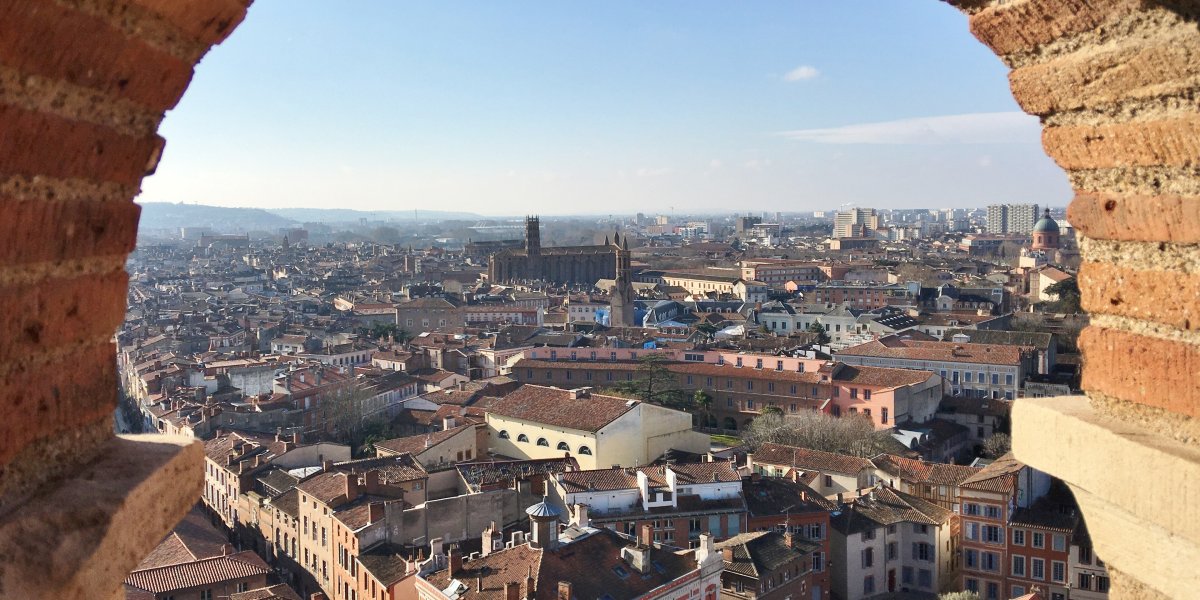
Head north from the city center — the five-tiered octagonal bell tower is visible blocks away, a pink beacon above the rooftops. The largest surviving Romanesque basilica in Europe and a UNESCO World Heritage stop on the Santiago de Compostela route. Circle the full exterior to watch morning sunlight turn the brick from rose to smoked salmon across the radiating chapels of the apse.
Tip: Best photo: northeast corner of Place Saint-Sernin, where the full tower and apse fit in one frame without distortion. Shoot before 10:00 — tour buses line the north side after that and selfie sticks crowd the clean angles. The interior is worth skipping; the exterior is the star.
Open in Google Maps →10:30
Landmark
Walk south along Rue du Taur for 10 minutes — a narrow medieval canyon of pink brick where you'll pass the Église Notre-Dame du Taur and its striking flat fortress-facade before the street opens dramatically into the square. The Capitole building stretches 128 meters across: neoclassical pink-and-white grandeur with eight columns honoring the city's historic magistrates. Look down at the enormous Occitan cross inlaid in the pavement, then step inside the ground-floor arcade (free, 90 seconds) for painted ceilings depicting Toulouse's history.
Tip: Stand at the southeast corner of the square around 10:30 — the sun fully illuminates the facade without shadows from surrounding buildings. The cross pattern on the pavement is best photographed from the second-floor gallery window inside the Capitole (free, take the main staircase just inside the entrance — 2-minute detour, not a museum).
Open in Google Maps →12:00
Food
Exit the square's south side and walk 3 minutes down to Place Victor Hugo — the market entrance is unassuming but the interior roars with life. This covered market has been Toulouse's food cathedral since 1892: wheels of aged cheese, ropes of saucisson, terrines of foie gras stacked beside the charcuterie counters. Grab a grilled saucisse de Toulouse sandwich (€6–8, coarser-ground and more garlicky than any sausage you've had) and a glass of local Fronton rouge (€3–4), or hit the oyster bar for a half-dozen Arcachon oysters with lemon (€10–12).
Tip: Closed Mondays. Eat standing at the counter like locals — don't look for a seat. The market empties hard after 13:00, so arrive right at noon for the full sensory chaos. If you want a taste of cassoulet without a sit-down dinner, some stalls sell it by the bowl to go (€8–10).
Open in Google Maps →13:30
Religious
Exit the market's north side and walk west for 6 minutes along Rue Gambetta — the monastery's massive brick walls appear suddenly above the low rooftops like a fortress without ornament. This 13th-century Dominican convent has no flying buttresses, no decoration, just sheer pink brick rising three stories in pure structural confidence. Step inside the church (free, 30 seconds) for the 'palm tree' — a single 22-meter column fanning into 22 stone ribs that support the entire vault, a structural miracle eight centuries old.
Tip: The best exterior shot is from Rue Lakanal facing east, where the bell tower and fortress wall fill the frame dramatically. The church interior is one room with one column — not a museum visit, just walk in and look up. Open 10:00–18:00 daily. The cloister (€4) is serene but skippable if time is tight.
Open in Google Maps →15:00
Landmark
Head south from the Jacobins along Rue de Metz — an elegant 8-minute walk past 17th-century hôtels particuliers with wrought-iron balconies and carved stone doorways. Despite meaning 'New Bridge,' this is Toulouse's oldest (1632), its seven asymmetric arches engineered to survive the Garonne's violent floods. Cross to the Saint-Cyprien bank and turn around — the pink city skyline reflected in the water, glowing amber in the late-afternoon sun, is the image that will stay with you long after you leave.
Tip: The money shot: cross to the west bank, walk 50 meters south, and photograph back toward the Hôtel-Dieu Saint-Jacques with Pont Neuf framing the skyline — this is the angle the tourism board uses. Best light 15:00–17:00 when the brick turns full amber. Warning: the quayside restaurants on Place Saint-Pierre are 30–40% overpriced with reheated menus — locals avoid them entirely, and so should you.
Open in Google Maps →19:30
Food
Walk northeast from Quai de la Daurade for 10 minutes through Toulouse's most charming medieval lanes — Rue des Changes and Rue Saint-Rome, lined with timber-framed buildings — until Place Saint-Georges opens up with its buzzing evening terraces. This longtime institution serves what many consider the definitive cassoulet toulousain: Toulouse sausage, duck confit, and pork belly slow-cooked in a clay casserole until the crust cracks golden (€26). Order it without a second thought — this is the dish Toulouse was built around.
Tip: Reserve or arrive at 19:15 — terrace tables facing the square fill by 19:45. Pair the cassoulet with a carafe of Marcillac (€6–8), a tangy red from nearby Aveyron that cuts through the richness perfectly. Budget €35–50 with wine. Skip the crème brûlée; order the violet ice cream instead — violets are Toulouse's signature flavor and this is the most elegant way to discover them.
Open in Google Maps →Zu Tag springen
09:00
Religious
Begin at Europe's largest surviving Romanesque basilica, a UNESCO World Heritage stop on the Camino de Santiago. Morning light streams through the ambulatory to reveal nine centuries of carved capitals in near-solitude — by 11:00, tour groups fill the nave. Descend into the crypt to see the gilded reliquaries of saints before its midday closure.
Tip: The crypt (€2.50) shuts at midday — visit it first. Stand at the center of the apse and look up for the best wide-angle shot of all five radiating chapels in a single frame.
Open in Google Maps →10:45
Landmark
Walk south along Rue du Taur for 8 minutes — this narrow medieval lane of pink brick, independent bookshops, and the tiny church of Notre-Dame du Taur is a film set unto itself. The Capitole's 128-meter neoclassical façade dominates Toulouse's main square; step inside to the Salle des Illustres, where ceiling frescoes by Jean-Paul Laurens depict the city's turbulent history with the drama of a Delacroix.
Tip: The Salle des Illustres is free and nearly empty before 11:00. On the square's pavement, find the brass Occitan cross inlaid in the stone — most visitors walk right over Toulouse's defining symbol without noticing.
Open in Google Maps →12:00
Food
Walk 5 minutes south through pedestrian streets to Place Victor Hugo. The ground floor is a sensory bombardment of the region's finest charcuterie and foie gras producers, but the real secret is upstairs: a ring of small restaurants cooking exclusively with the market's ingredients. Order saucisse de Toulouse grillée with white beans (€14) or duck confit with pommes sarladaises (€17), with a glass of local Fronton rouge (€4). Budget: €15–22.
Tip: Arrive at noon sharp — upstairs restaurants are first come, first served and packed by 12:30. Grab a bag of violettes de Toulouse (candied violets, the city's signature sweet) from the ground floor stalls on your way out. Closed Mondays.
Open in Google Maps →13:30
Landmark
Walk 7 minutes northwest through Rue Saint-Rome, one of Toulouse's oldest shopping streets. The Jacobins' plain brick exterior gives nothing away — then you step inside and look up. A single column at the apse fans into 22 stone ribs, a gravity-defying palm tree in stone that is one of the most astonishing feats of Gothic architecture in France. Thomas Aquinas's relics rest beneath this vault.
Tip: Walk all the way to the far east end of the nave before looking up — the 'palm tree' reveal is worth the buildup. The cloister (included in ticket) casts perfect geometric shadows for photos between 14:00 and 15:00 when the sun is directly overhead.
Open in Google Maps →15:30
Landmark
Walk 10 minutes south through Rue des Changes, where medieval timber-frame houses lean at improbable angles overhead. Despite its name, the Pont Neuf is Toulouse's oldest bridge, begun in 1544 — cross to the middle for the defining panorama of the pink skyline reflected in the Garonne. Then descend to the grassy bank of the Quai de la Daurade, where locals gather at sunset with wine as the city turns gold.
Tip: Golden hour light (roughly 18:00–19:30 in spring and summer) from the Quai de la Daurade facing Pont Neuf is the single best photograph in Toulouse. Sit on the grass with the locals, not the waterfront cafés — they charge €8 for a simple beer.
Open in Google Maps →19:00
Food
Walk 10 minutes north from the quay back to Place du Capitole. Le Bibent has occupied this corner since 1843, and its restored Belle Époque interior — gilded mirrors, painted ceilings, crystal chandeliers — is the most theatrical dining room in Toulouse. Order the cassoulet toulousain with Tarbais beans and local sausage (€28) or magret de canard with seasonal honey glaze (€26), and finish with crème brûlée à la violette (€12). Budget: €35–50.
Tip: Reserve a window table online for the illuminated Capitole view at night. Skip the tourist restaurants along Rue du Taur — they serve reheated cassoulet at double the price. If approached by 'survey' takers or bracelet sellers in the square, keep walking; this is Toulouse's most common scam zone.
Open in Google Maps →09:00
Landmark
Walk 15 minutes southeast from the center to Port Saint-Sauveur. Pierre-Paul Riquet's 17th-century engineering marvel — now a UNESCO World Heritage site — is at its most magical in the early morning, when the tunnel of centuries-old plane trees filters the light into dappled gold and the only sound is a narrowboat gliding through a lock. Walk northwest along the towpath toward the écluses near Boulevard de la Gare.
Tip: Narrowboats usually start operating by 09:30 — time your walk to catch one navigating the lock for the best photo. Shoot the plane tree tunnel with a longer lens from the towpath center for the iconic converging-lines perspective.
Open in Google Maps →10:30
Museum
Walk 15 minutes west through the university quarter back toward the Garonne. The Hôtel d'Assézat is Toulouse's most beautiful Renaissance palace, built in 1555 from the fortunes of the pastel (woad) trade that made the city fabulously rich. Inside, the Fondation Bemberg holds a collection that would be a destination anywhere: Cranach and Véronèse downstairs, a dazzling room of Bonnard, Monet, and Pissarro upstairs — seen in the intimate chambers of a 16th-century mansion, it feels like a private viewing.
Tip: Don't rush past the lower-floor Old Masters — the Cranach room is world-class. The inner courtyard with its twin Renaissance loggias is worth photographing before you enter the galleries. Closed Mondays.
Open in Google Maps →12:30
Food
Walk 3 minutes south to Rue Genty Magre, a quiet street tucked between the river and the Esquirol quarter. This no-fuss bistro is where Toulouse professionals eat lunch — you won't hear English at the next table. Start with salade de gésiers confits (warm duck gizzard salad with walnut oil, €12), then axoa de veau with espelette pepper (€16) or duck parmentier (€15), and a carafe of local Gaillac (€6). Budget: €16–24.
Tip: Arrive at 12:15 before the office crowd descends. Ask for the plat du jour — it's not always on the printed menu but it's always the freshest thing in the kitchen. The formule du midi (two-course set lunch) is the best value.
Open in Google Maps →14:00
Museum
Walk 10 minutes west, crossing the Garonne via Pont Neuf to the left bank's Saint-Cyprien quarter. The former 19th-century municipal slaughterhouse — brick vaults, iron trusses, the ghost of meat hooks — is now Toulouse's boldest art space. The collection pivots around a single masterpiece: Picasso's enormous 1936 stage curtain La Dépouille du Minotaure en costume d'Arlequin, a 13-meter canvas that fills an entire wall and stops you cold.
Tip: Head straight for the central nave to see the Picasso curtain first, then explore outward. The temporary exhibitions on the upper floors are often stronger than the permanent collection. Closed Mondays and Tuesdays.
Open in Google Maps →16:00
Park
Exit Les Abattoirs through the south garden and walk 3 minutes along the riverbank. Toulouse's most beloved green space slopes gently down to the Garonne's edge, unfolding a panorama of the right bank — Pont Neuf, the dome of the Hôtel-Dieu, the bell tower of La Grave — across the water. At this hour the afternoon sun lights the pink brick into deep rose and amber: the most quintessentially 'Pink City' view there is.
Tip: Sit on the grass at the river's edge directly across from the Hôtel-Dieu for the best pink-brick panorama. The Jardin Raymond VI just to the north has a modernist water garden worth a quick 5-minute detour.
Open in Google Maps →19:00
Food
Walk 15 minutes back across Pont Neuf and north through the old town to Place Saint-Georges, one of Toulouse's most charming squares. This institution has served canonical southwestern French cuisine for decades from a terrace shaded by plane trees — the perfect farewell to the Pink City. Start with foie gras de canard mi-cuit with fig chutney (€18), then pigeon rôti en croûte d'herbes (€26) or pavé de bœuf du Quercy (€28), and finish with pastis gascon — flaky pastry with Armagnac-soaked apples (€10). Budget: €35–50.
Tip: Reserve the terrace by phone that morning for the full Place Saint-Georges evening atmosphere. The square is a 10-minute walk to Gare Matabiau and 5 minutes to Jean Jaurès metro — ideal positioning for a last night. Beware of 'authentic cassoulet' signs near the station on your way out; those tourist-trap restaurants serve frozen reheats at triple the price.
Open in Google Maps →
Trip builder
Plan this trip around Toulouse
Turn this guide into a bookable rail itinerary with FlipEarth.
Keep exploring
Related cities
More in the same country
FAQ
Frequently asked questions
How many days do you need in Toulouse?
Most travelers enjoy Toulouse in 1 days, with enough time for headline sights and a slower meal or museum stop.
What's the best time to visit Toulouse?
The easiest season for most travelers is Apr-Oct, especially if you want good weather and manageable crowds.
What's the daily budget for Toulouse?
A practical starting point is about €80 per person per day before hotels, then adjust based on museums, dining, and transport.
What are the must-see attractions in Toulouse?
A good first shortlist for Toulouse includes Place du Capitole, Pont Neuf.