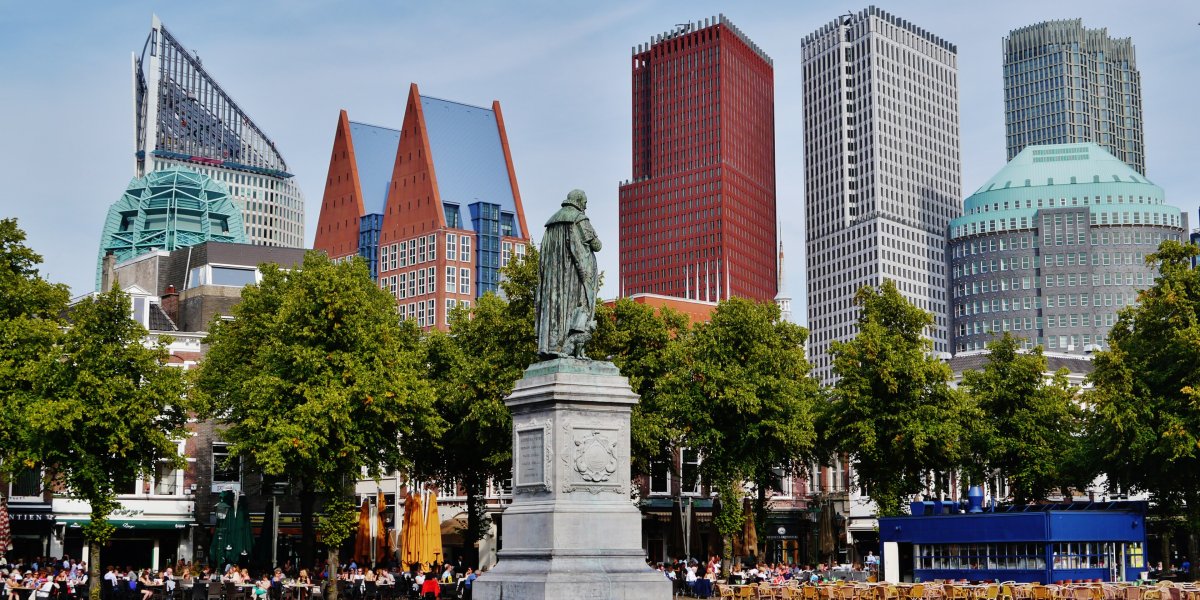
City Guide
The Hague
Niederlande · Best time to visit: May-Sep.
Day-by-day plan
Choose your pace
Reisedauer
09:00
Landmark
From Den Haag Centraal, walk southwest through the quiet streets of the Hofkwartier — 10 minutes to the palace gates. The working residence of King Willem-Alexander, where wrought-iron gates frame the Netherlands' most understated seat of power — no Versailles grandeur, just quiet Dutch authority with royal guards at the entrance. Walk the length of Noordeinde street itself, an elegant stretch of antique dealers and independent boutiques that feels a world away from Amsterdam's crowds.
Tip: Stand centered at the main gate for the cleanest shot of the façade and royal coat of arms. Around the corner on Hogewal, the Royal Stables (Koninklijke Stallen) are a stunning neoclassical building most visitors walk right past — worth a 2-minute detour.
Open in Google Maps →10:00
Landmark
Walk south along Noordeinde, ducking through De Passage — an 1885 glass-roofed shopping arcade with mosaic floors — to emerge at the Buitenhof gate in 10 minutes. Enter the inner courtyard to face the 13th-century Ridderzaal (Hall of Knights), then loop around to the Hofvijver pond for the city's defining image: the Binnenhof's silhouette reflected in still water, with the Mauritshuis — home to Vermeer's Girl with a Pearl Earring — anchoring the right edge. The Torentje, the Prime Minister's famously tiny tower office, perches on the north corner.
Tip: The reflection shot works best before 11:00 when the pond surface is calmest — stand on the east bank near the central fountain where the Ridderzaal tower centers perfectly. Parts of the Binnenhof are under renovation through 2028, but the Hofvijver view and Mauritshuis façade remain fully photogenic.
Open in Google Maps →12:00
Food
Exit the Binnenhof through the Buitenhof gate — Dudok's soaring windows on Hofweg are a 2-minute walk, impossible to miss. A grand café in a former electrical company building with cathedral ceilings and a devoted local crowd. Order the uitsmijter (three fried eggs on bread with ham and cheese, €13) — it arrives fast and fills the tank — then a slice of their legendary apple pie (€5.50), routinely voted the best in The Hague, with a crumble top and warm spiced filling that justifies every calorie. Budget: €15–20.
Tip: Skip the upstairs seating — the ground floor has better energy and faster service. Order the uitsmijter and apple pie together when you sit down and you'll be back on your feet in 30 minutes.
Open in Google Maps →13:15
Landmark
Walk northwest through Plein 1813 — the elegant square where Dutch independence was proclaimed — and along tree-lined streets for 25 minutes to Carnegieplein. Built with Andrew Carnegie's funds in 1913, this neo-Renaissance palace houses the International Court of Justice where nations settle disputes without guns. The façade incorporates gifts from countries worldwide — marble, mosaics, tapestries — and a clock tower that chimes on the quarter hour. The front gardens, the World Peace Flame, and the wrought-iron gates are freely accessible and arrestingly grand.
Tip: The best photo is from the iron gate at Carnegieplein where the full symmetry of the building frames perfectly. The visitor centre to the left of the main gate has a free exhibition and short film — worth 15 minutes if you want context and air conditioning.
Open in Google Maps →15:00
Landmark
Follow Scheveningseweg, a 17th-century boulevard connecting court and coast — 40 minutes on foot through a canopy of ancient trees, or hop on a tram for a 12-minute ride. The Dutch don't do beach towns like the Mediterranean: Scheveningen is wind-blown, democratic, and gloriously unpretentious. Walk from the grand Kurhaus hotel — a 19th-century palace anchoring the seafront — out to the pier stretching into the North Sea, with open horizon in every direction. On a clear day, the late-afternoon light over this water is what Vermeer was painting.
Tip: Walk to the end of the pier for the most dramatic photo — waves crash below and the city skyline recedes behind you. The Ferris wheel costs €10 and isn't worth it; the pier itself gives you the same view. Avoid eating along the boulevard between the Kurhaus and pier — tourist-trap restaurants with frozen fish and triple markups. Head to the harbour for dinner where the boats actually dock.
Open in Google Maps →19:00
Food
Walk south along the beach promenade to Scheveningen harbour — 15 minutes past surf schools and beach pavilions until the fishing boats come into view. A family-run Scheveningen institution on the quay where the day's catch comes in. Start with kibbeling (crispy fried cod bites, €10), then order the gebakken tong (pan-fried sole, €24) — the fish was swimming this morning. No fuss, just impeccably fresh North Sea seafood and a dining room that hums with regulars. Budget: €30–40.
Tip: No reservation needed — arrive by 18:45 and grab a window table facing the harbour. Order the kibbeling immediately as a starter while you study the menu. The house white wine at €4.50 a glass pairs better with the sole than anything expensive on the list.
Open in Google Maps →Zu Tag springen
09:00
Landmark
Start at Hofvijver, the rectangular court pond that mirrors the medieval Binnenhof parliament complex — the oldest parliamentary building in the world still in use. Walk along Lange Vijverberg on the north bank for the postcard-perfect reflection shot; morning light hits the facade head-on and the water is calmest before tour boats stir it. The Binnenhof is currently undergoing a major renovation (expected until 2028), but the Hofvijver panorama remains one of the most regal city views in Europe.
Tip: Stand at the centre of Lange Vijverberg for the symmetrical reflection shot — the small island fountain acts as a natural focal point. Early Saturday morning before 09:30 you'll share the pond with joggers and herons, not tour groups.
Open in Google Maps →10:00
Museum
Walk along the south side of the Hofvijver toward the corner — the elegant 17th-century mansion on your right is the Mauritshuis, one of the world's finest small museums. Arrive right at opening to stand alone with Vermeer's Girl with a Pearl Earring in Room 15 before the crowds thicken. Rembrandt's The Anatomy Lesson of Dr. Nicolaes Tulp and Carel Fabritius's The Goldfinch are in adjacent rooms — the entire collection fits a focused 90-minute visit because the building is beautifully compact.
Tip: Head straight upstairs to Room 15 for the Vermeer — most visitors linger on the ground floor first, giving you a few quiet minutes with the painting. On Thursdays the museum stays open until 20:00 with far fewer visitors, if your schedule is flexible.
Open in Google Maps →12:00
Food
Exit the Mauritshuis and walk through the Buitenhof square, then turn left onto Hofweg — Dudok is 3 minutes away, a soaring Art Deco–inspired brasserie popular with parliament staffers and Hague professionals on their lunch break. This is not a tourist café: the apple pie here is a genuine Hague institution, a thick slab with a buttery crumbly crust and a tangy filling that has been recipe-unchanged for decades.
Tip: Order the legendary apple pie (€7.50) — it arrives warm and enormous. For a full lunch, the club sandwich (€16.50) is reliable. Arrive before 12:15 on weekends to grab a window seat without waiting; after 12:30 the queue builds fast.
Open in Google Maps →13:30
Museum
Walk north up Noordeinde, past boutiques and the royal palace, then continue along Zeestraat — a pleasant 10-minute stroll through The Hague's most elegant streets. Inside this unassuming building is the world's largest cylindrical painting (1881): a 360-degree view of Scheveningen beach, the dunes, and the sea by Hendrik Willem Mesdag and his wife Sientje. You stand on a raised platform and the real sand floor blends seamlessly into the painted horizon — the trompe-l'oeil effect is genuinely startling, even in the age of VR.
Tip: Let your eyes adjust for a full minute before walking around the platform — the illusion deepens dramatically once your brain stops searching for the canvas edge. The upstairs gallery has Mesdag's original preparatory sketches, which most visitors skip entirely.
Open in Google Maps →15:00
Neighborhood
Retrace your steps 5 minutes south along Zeestraat back to Noordeinde — the working palace of King Willem-Alexander sits at the top of this stately tree-lined street. The palace interior is closed, but the neoclassical façade and the ceremonial guard are worth a stop. Stroll down the Noordeinde shopping street — the city's most refined — then duck into De Passage, a gorgeous 1885 glass-roofed shopping arcade modelled after the Galleria in Milan. The afternoon light filtering through the glass ceiling is at its warmest around 15:30.
Tip: In De Passage, look up — the ornate ceiling, iron arches, and original tilework are the real attraction, not the shops. For a treat, stop at Huize van Wely on Noordeinde 36 for handmade bonbons; the sea-salt caramel is unreasonably good.
Open in Google Maps →19:00
Food
Walk 3 minutes south from Noordeinde to Kneuterdijk — Garoeda has been serving The Hague's Indonesian community and diplomatic elite since 1949. The Hague has the best Indonesian food in the Netherlands thanks to deep colonial ties, and this is where locals go for a proper rijsttafel: a parade of 12–20 small dishes served simultaneously, from peanut-sauced satay to slow-braised rendang to coconut-laced sayur lodeh.
Tip: Order the rijsttafel (€38–45 per person) — it is non-negotiable. Reserve at least 2 days ahead for weekend evenings. Ask the staff which sambal level suits you; 'medium' here is genuinely spicy by European standards. Avoid the tourist-oriented Indonesian restaurants on Lange Poten nearby — they serve reheated versions at the same price.
Open in Google Maps →09:00
Landmark
Take tram 1 from the city centre to the Vredespaleis stop (10 minutes), or walk 20 minutes west through leafy embassy-lined streets. The Peace Palace, funded by Andrew Carnegie in 1913, houses the International Court of Justice and the Permanent Court of Arbitration — this is where nations come to resolve disputes without war. The building is a cathedral of diplomacy: red brick, granite, and ornamental ironwork donated by dozens of countries. The free Visitor Centre explains the court's work through interactive exhibits.
Tip: The best photo angle is from the Carnegieplein fountain looking northeast, capturing the full façade and the clock tower. Guided tours of the palace interior run on select weekends — check vredespaleis.nl and book at least a week in advance if available.
Open in Google Maps →10:30
Park
Walk 10 minutes northwest from the Peace Palace through quiet residential streets lined with grand embassy villas — the architecture of this wealthy neighbourhood is worth the stroll on its own. Westbroekpark is The Hague's most beautiful green space, home to the International Rose Garden with over 20,000 roses in 350 varieties. Even outside peak bloom, the Japanese garden, the swan-filled pond, and the rolling lawns make this a perfect mid-morning pause before the coast.
Tip: The roses peak from mid-June to early September, but the park is lovely year-round. Walk to the south-facing terrace of the park café for a coffee with a view over the pond — it's where Hague residents spend weekend mornings, and it feels nothing like a tourist attraction.
Open in Google Maps →12:00
Food
Continue north 15 minutes on foot from the park through residential Scheveningen streets until you hit the harbour — the forest of masts and the smell of frying fish tell you you've arrived. Simonis has been a Scheveningen institution since 1896, and the harbour-side location lets you eat fresh North Sea fish while watching the boats come in. This is not refined dining — it is a working harbour canteen beloved by locals, and the fish was swimming this morning.
Tip: Order the kibbeling (€9) — crispy battered cod nuggets with remoulade — and a broodje haring (€4.50), raw herring with onions and pickles in a soft bun. Eat at the outdoor tables overlooking the harbour. Skip the tourist fish stalls along the boulevard further north; Simonis is where the fishermen eat.
Open in Google Maps →13:30
Landmark
Walk 15 minutes north from the harbour along the coastal path — the full sweep of the North Sea opens up ahead and the grand Kurhaus hotel rises like a white wedding cake from the beachfront. This 1885 Grand Hotel is Scheveningen's architectural centrepiece; even if you don't go inside, the domed façade against the sea is a sight. Walk the wide sandy beach, breathe the salt air, and stroll out onto De Pier, which extends into the sea with a Ferris wheel offering panoramic views of the entire coastline.
Tip: Walk past the Kurhaus to the quieter stretch of beach south of the pier — the sand is the same, the crowds are half. For the best Kurhaus photo, shoot from the beach looking landward in the afternoon when the white façade catches the westerly sun.
Open in Google Maps →15:30
Museum
Walk 5 minutes south along the boulevard from the Kurhaus — the museum entrance is hidden behind the dunes, easy to miss if you don't know it's there. Beelden aan Zee is built into the dunes themselves: whitewashed underground galleries flooded with natural light showcase contemporary figurative sculpture. The rooftop terrace offers a panoramic sea view with open-air sculptures silhouetted against the sky — one of the most architecturally surprising museums in the Netherlands.
Tip: Don't skip the rooftop terrace — the sculptures framed against the sea horizon are the museum's signature image. The permanent Tom Otterness bronze figures are playful and photogenic. Allow 10 minutes just to sit on the terrace with the wind in your hair before heading back.
Open in Google Maps →19:00
Food
Take tram 1 from Scheveningen back to the centre (20 minutes) and walk to Het Plein — the grand square flanked by government ministries where Hague professionals unwind after work. Luden occupies a prime corner with a sprawling terrace and an interior that mixes old-world brasserie warmth with modern Dutch ease. It is a locals' institution: buzzy, unpretentious, and the ideal farewell dinner after a salt-air afternoon.
Tip: Start with bitterballen (€10) — the definitive Dutch bar snack, crunchy outside and molten ragout inside. For mains, the steak or catch of the day (€22–28) are reliable. Grab a terrace table facing the square if the weather allows. Avoid the overpriced restaurants around Plein 1813 nearby — they charge double for half the atmosphere. Den Haag Centraal station is an 8-minute walk east if you're catching a train.
Open in Google Maps →
Trip builder
Plan this trip around The Hague
Turn this guide into a bookable rail itinerary with FlipEarth.
Keep exploring
Related cities
More in the same country
FAQ
Frequently asked questions
How many days do you need in The Hague?
Most travelers enjoy The Hague in 1 days, with enough time for headline sights and a slower meal or museum stop.
What's the best time to visit The Hague?
The easiest season for most travelers is May-Sep, especially if you want good weather and manageable crowds.
What's the daily budget for The Hague?
A practical starting point is about €75 per person per day before hotels, then adjust based on museums, dining, and transport.
What are the must-see attractions in The Hague?
A good first shortlist for The Hague includes Noordeinde Palace, Binnenhof & Hofvijver, Peace Palace.