City Guide
Saint-Malo
Frankreich · Best time to visit: May-Sep.
Day-by-day plan
Choose your pace
Reisedauer
09:00
Landmark
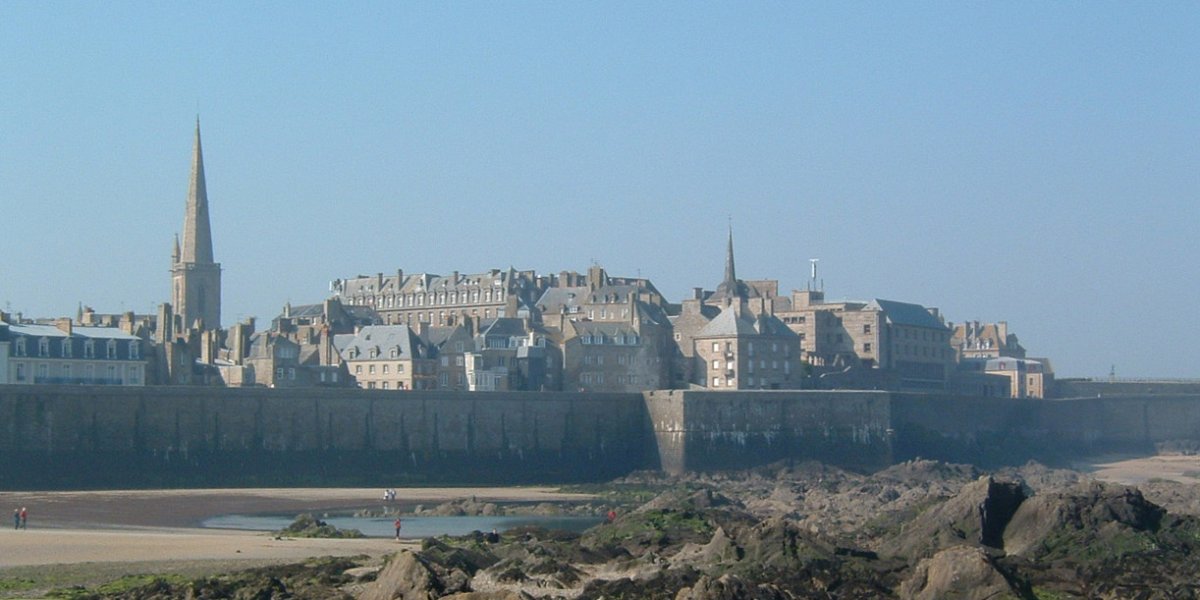
From Porte Saint-Vincent climb the stone staircase straight onto the ramparts — at this hour the walls are empty and low eastern light rakes across the granite. Walk clockwise: the harbour side first, then the Atlantic opens up and Fort National, Grand Bé, and Petit Bé appear floating in the bay. The full circuit is just under 2 km and delivers the entire old town, the port, and the open sea from one unbroken walkway above the rooftops.
Tip: Go clockwise from Porte Saint-Vincent, not counter-clockwise — this puts the morning sun behind you when you reach Tour Bidouane, where Fort National and Grand Bé are picture-perfect. Coach groups start arriving around 10:30, so aim to clear the Atlantic stretch before then.
Open in Google Maps →11:00
Landmark
Descend the ramp beside Tour Bidouane — three minutes down and you're standing on Plage de Bon-Secours directly under the walls. At low tide a causeway of wet sand appears and you can walk out to Grand Bé, where Chateaubriand's tomb faces the open sea, or toward the squat granite cube of Fort National. The tide here is among the largest in Europe — up to 13 metres — and what is walkable now may be fully submerged in four hours, which is exactly the point of coming at this moment.
Tip: Before leaving the hotel, google 'marée Saint-Malo' and note the day's marée basse (low tide) time — if low tide is before noon, swap this stop with the ramparts. Never cross if water is already lapping the causeway; the incoming tide moves faster than walking pace here and people get stranded on Grand Bé every summer.
Open in Google Maps →12:30
Food
Climb back up to the ramparts at Bastion de la Hollande — the crêperie occupies a former guard post built into the wall itself, with a terrace staring straight at Grand Bé. Order the galette Complète (buckwheat, ham, egg, emmental, ~11€) with a bowl of Breton cider (~4€), or the Saint-Malo with local andouille sausage and caramelised onion (~13€). This is the only restaurant in the old town with a proper rampart terrace — you come for the view first, the food (which is honest and regional) second.
Tip: Arrive at 12:00 sharp, not 12:30 — the terrace has about twelve tables, no reservations, and fills fast. If every outdoor seat is taken, skip the indoor room and walk three minutes to La Brigantine on Rue de Dinan, which serves a better galette without the panorama. Budget 15-22€ per person with cider.
Open in Google Maps →14:00
Religious
Step off the ramparts at Porte Saint-Pierre and dive into the grid of narrow granite streets — in three minutes you emerge at Cathédrale Saint-Vincent, its unassuming facade hiding a soaring medieval nave inside. The originals were pulverised in 1944 and the modern stained glass is by Jean Le Moal, its deep blues saturating the stone. Afterwards wander Rue Saint-Vincent, Place Chateaubriand, and the alleys around Place aux Herbes — the entire old town was rebuilt stone-by-stone after WWII bombing, and it feels centuries older than it actually is.
Tip: Enter the cathedral through the side door on Rue Saint-Benoît — the main west front collects tour groups, the side is almost always empty. Look for the cobblestone slab set into the floor of the nave: this is where Jacques Cartier received his blessing in 1535 before sailing west and 'discovering' Canada. Most visitors walk straight over it without noticing.
Open in Google Maps →16:00
Park
Walk out through Porte Saint-Thomas — five minutes and you're on the esplanade with three kilometres of open Atlantic sand curving northeast, punctuated by the weathered wooden brise-lames (storm stakes). Head out along the beach past the line of belle-époque villas; the old town shrinks behind you and the true scale of the Saint-Malo tide becomes obvious on the empty sand flats. Turn back around 18:00 for the golden hour — the granite walls of Intra-Muros catch the low sun from across the beach and glow amber, the single best photograph of the day.
Tip: Walk as far as the Thermes Marins hotel (about 1.5 km out) then turn around — that's the precise spot where the walled city frames cleanly against the horizon; closer and the angle flattens. If the tide is coming in, stay well above the line of washed-up seaweed; rising water here covers 100 metres of beach in minutes.
Open in Google Maps →19:30
Food
Walk back along the sea wall to Porte Saint-Thomas and three minutes into Intra-Muros — Le Chalut sits on a quiet lane behind the cathedral. One Michelin star, no theatrics: just whatever the Saint-Malo trawlers landed that morning, cooked by a chef who has been doing this here for over twenty years. Start with half a dozen Cancale oysters (~18€), then the Saint-Pierre (John Dory) with beurre blanc (~38€) or the whole grilled turbot for two (~80€). Mains run 32-42€; budget 75-90€ per person with a glass of Muscadet.
Tip: Reserve 2-3 days ahead — the dining room seats only 28 and every serious Brittany food traveler knows about it. Pitfall warning: avoid every seafood restaurant fronting Place Chateaubriand or the main ramparts gates — they live off tourist turnover, charge 45€ for a frozen plateau de fruits de mer, and the locals laugh about them. All the real tables in Saint-Malo are on the side streets, never the main squares.
Open in Google Maps →Zu Tag springen
09:00
Landmark
Start at Porte Saint-Vincent, the main gate where every visit to Intra-Muros begins. The complete 2 km rampart walk takes 90 minutes with photo stops, and morning light slants down the ochre granite while tour buses are still on the autoroute. From the western Bastion de la Hollande the eye sweeps across Grand Bé, Petit Bé and Fort National all at once — the single most defining view of the city.
Tip: Walk clockwise from Porte Saint-Vincent so the sea stays on your right and the rising sun lights the walls; almost everyone else circles counter-clockwise, so you will pass them rather than walk into their backs of cameras.
Open in Google Maps →11:00
Religious
Descend the ramparts at Porte Saint-Vincent and follow Rue Saint-Vincent inward — 4 minutes through narrow granite lanes that smell of bakeries pulling out their second batch. The cathedral was gutted in the 1944 bombing and rebuilt with extraordinary modernist stained glass by Jean Le Moal, the only place in Brittany where Romanesque stone meets pure 1960s color. Jacques Cartier, the navigator who claimed Canada for France in 1534, lies in the north transept.
Tip: Stand under the rose window between 11:30 and noon — that is when the southern sun pours through Le Moal's deep blue glass and turns the entire nave underwater. Do not skip the choir floor: a bronze plaque marks the spot where Cartier knelt before sailing to the New World.
Open in Google Maps →12:30
Food
From the cathedral, cut west along Rue Sainte-Anne to the western ramparts at Bastion de la Hollande — 7 minutes through quiet boutique-lined lanes. This is the only restaurant built into the city walls themselves; the terrace hangs in open air directly over the sea, looking straight at Grand Bé. Order a traditional galette complète (egg, ham, Emmental — €10) or the Saint-Malo with scallops and leeks (€16), washed with a bowl of brut cider (€5). Budget €22–28.
Tip: Reserve the day before for a terrace table, or walk in at 12:00 sharp — by 12:30 the terrace is locked and no walk-ins are taken. The andouille de Vire galette (smoked tripe sausage) is what local fishermen actually order; tourists never try it and miss the most Breton thing on the menu.
Open in Google Maps →14:30
Museum
Exit the créperie and walk east along the northern ramparts back to Porte Saint-Vincent and the château at the eastern corner — 12 minutes with the Channel always on your left. Inside the 15th-century duchess Anne donjon, four floors trace the city's corsair captains, its uncomfortable role in the slave trade (the museum tells it honestly, not glossed), and the August 1944 bombing that flattened 80 percent of Intra-Muros. Climb to the top of the keep last for the only vantage that frames the whole walled town and Fort National together.
Tip: The narrow window in the donjon's top room facing northwest is the city's best free panoramic frame — wait three minutes for the school tour to clear out and you will have it alone. The English audioguide (€2) is essential; the French wall cards skip half the corsair stories.
Open in Google Maps →17:00
Landmark
Exit the château through Porte Saint-Thomas onto Plage de l'Éventail and walk west along the wet sand past Fort National to the stone causeway — 10 minutes with the city walls towering on your left. This rocky islet is reachable only six hours a day at low tide; the writer François-René de Chateaubriand chose to be buried here facing the open Atlantic with no name on the cross, wanting to hear only wind and sea. A 30-minute climb leads through ruined fort walls to a 360° platform that takes in the entire coast.
Tip: Check today's low-tide window the night before on the free 'Marées France' app — if you mistime by 30 minutes the rising sea will strand you on the rock for six hours. The tomb is on the seaward side, not the side facing the city: a plain black cross on bare granite, easy to walk past if you don't loop the whole islet.
Open in Google Maps →19:30
Food
Cross back over the causeway before the tide returns, re-enter Intra-Muros at Porte Saint-Thomas and walk south to Rue de Boyer — 12 minutes through lamp-lit cobbled lanes. This 24-seat bistro is run by a chef-couple who write the chalkboard menu around the morning's catch off Cancale. Signature dishes: tartare of John Dory with green apple and dulse seaweed (€22), and Saint-Pierre fillet with beurre blanc (€28). Three courses run €45–55 with a glass of Muscadet.
Tip: Book a month ahead — there are no walk-in seats and the dining room fills the day reservations open. Avoid the chain crêperies plastered along Rue de la Pie and Rue Jacques Cartier with photographed menus and English signs; they reheat frozen galettes and charge double — the giveaway is any place advertising 'galette + cider + dessert €12.90'.
Open in Google Maps →09:00
Museum
From Intra-Muros walk south along Quai Saint-Vincent and Esplanade Commandant Menguy — 25 minutes along the marina with the towers of Saint-Servan rising ahead (or take bus #2 from Saint-Vincent for a 10-minute ride). Three linked granite towers built in 1382 to guard the Rance estuary, today housing the Cap-Horniers museum: the personal logs, scrimshaw and storm-shredded sails of the 19th-century French sailors who rounded Cape Horn under canvas. The spiral stair to the top opens to the widest harbor view in the city.
Tip: Climb to the very top first, then descend through the museum floors — the curators built the narrative top-down, and the light through the medieval arrow-slits shifts the mood deliberately as you go. Sailors' tattoos are documented on the second floor down; few visitors notice the small sliding drawer beneath the central case.
Open in Google Maps →10:45
Landmark
From Tour Solidor walk north through Rue de la Maison Neuve and up the wooded coastal path to the Cité d'Aleth promontory — 15 minutes uphill through pines opening to cliff views back across the bay at the walled city. This was the original Roman city before Saint-Malo moved onto its island; today a circular cliff path circles the headland, and a massive German bunker complex burrowed into the rock houses the Mémorial 39-45, where 400 German troops held out against Patton's army for two weeks in August 1944.
Tip: The bunker is visitable only by guided tour at fixed times (typically 10:15 / 11:30 / 14:30 / 16:00 — confirm at the kiosk before climbing); aim for the 11:30 slot, the only one with reliable English narration and the least crowded. The cliff path on the north side gives the single best long-lens shot of Intra-Muros' silhouette across the bay — much better than from the city itself.
Open in Google Maps →12:45
Food
Descend the southern path of Cité d'Aleth back toward Tour Solidor — 12 minutes down through the steep lanes of old Saint-Servan past garden walls dripping with hydrangea. A warm bistro 50 m from Tour Solidor, where dock workers and museum staff queue at noon. A dozen Cancale oysters on the half-shell run €14 (the beds are 12 km east — you will never eat fresher); grilled line-caught bar with samphire €24; the two-course lunch formule is just €18. Budget €25–35.
Tip: Order specifically the Cancale n°3 oysters — the medium size, peak salinity, the gauge locals always choose over the showy n°1. Ask for a glass of dry Muscadet sur Lie (€4); it is the only wine an oyster from this estuary actually wants — Sauvignon Blanc tastes wrong with this salt level.
Open in Google Maps →14:30
Park
From the bistro walk north along the harbor, re-enter Intra-Muros at Porte de Dinan and exit again through the Bastion de la Hollande gate down to Bon-Secours beach — 20 minutes. This is the most photographed beach in Brittany: a granite-walled tidal swimming pool built into the rocks that fills at high tide and stays full as the sea retreats, three high diving boards rising above it. Grand Bé and Petit Bé float just offshore — at low tide you can walk to both straight from the sand.
Tip: The pool is most photogenic at half-tide on the falling cycle, when the seaward wall is just visible above the waves and the inner water mirrors the sky — at full high tide the walls submerge and the shot disappears. Wedge yourself on the south rocks above the diving boards for the iconic angle that has the pool, the divers and Petit Bé all in one frame.
Open in Google Maps →16:30
Park
Leave Bon-Secours, walk east along the inner ramparts to Porte Saint-Vincent, exit and turn left onto Chaussée du Sillon — 12 minutes; the city walls drop away on your right and the wide Sillon opens ahead. A 3 km arc of straight Atlantic beach with a soldier's row of weather-blackened oak storm-breakers (brise-lames) marching into the sea — the most defining 'northern France' photograph you will bring home. Walk as far as Pointe de Rochebonne if your legs allow, with the wind and the marching pilings the whole way.
Tip: Time the walk to a falling tide so the wet sand turns into a mirror beneath the wooden pilings — that is the postcard everyone tries to copy. Skip this stop entirely on a 'grandes marées' (vives-eaux) day: waves vault the seawall, the promenade closes, and the police whistle you back — the tide table is posted at every Intra-Muros bus stop.
Open in Google Maps →19:30
Food
From the Sillon promenade re-enter Intra-Muros at Porte Saint-Vincent and turn into Rue de Toulouse — 10 minutes through the lamp-lit old town as the granite warms gold. A convivial neighborhood bistro literally named 'elbow to elbow' for its long shared wooden tables packed with locals; no English menu, no concession to tourism. Bavette à l'échalote (flank steak, shallots) €18, fish of the day €22, half-bottle of Quincy €14. Budget €30–40.
Tip: Walk in at 19:15 sharp or call earlier in the day for one of the eight reservable seats — by 19:45 the line spills out the door and the kitchen turns away walk-ins. Avoid the oyster bars on Rue Jacques Cartier with English-language sandwich boards and platters in chalk outside; they buy industrial Normandy oysters and double the Cancale price — the real local ones are sold from the back of the Halle au Blé fish stalls each morning.
Open in Google Maps →
Trip builder
Plan this trip around Saint-Malo
Turn this guide into a bookable rail itinerary with FlipEarth.
Keep exploring
Related cities
More in the same country
FAQ
Frequently asked questions
How many days do you need in Saint-Malo?
Most travelers enjoy Saint-Malo in 1 days, with enough time for headline sights and a slower meal or museum stop.
What's the best time to visit Saint-Malo?
The easiest season for most travelers is May-Sep, especially if you want good weather and manageable crowds.
What's the daily budget for Saint-Malo?
A practical starting point is about €120 per person per day before hotels, then adjust based on museums, dining, and transport.
What are the must-see attractions in Saint-Malo?
A good first shortlist for Saint-Malo includes Ramparts of Saint-Malo (Remparts de Saint-Malo), Fort National & Grand Bé from Plage de Bon-Secours.