City Guide
Pula
Kroatien · Best time to visit: May-Sep.
Day-by-day plan
Choose your pace
Reisedauer
09:00
Landmark
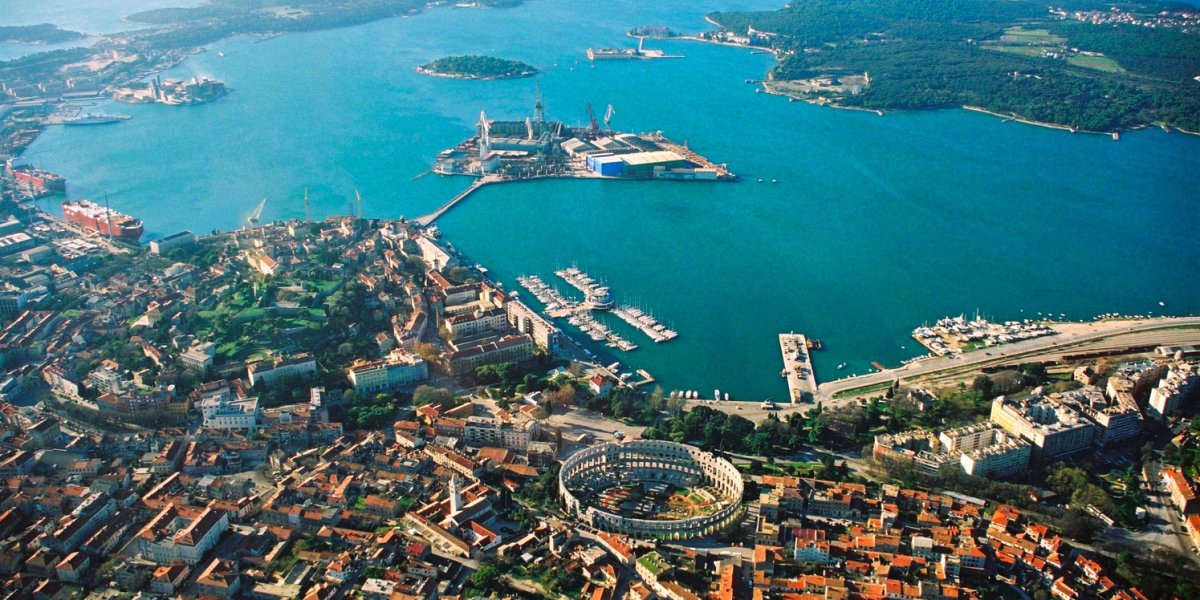
Whether you've come in on the morning ferry, the night bus from Zagreb, or a cruise tender, head five minutes north along Istarska and let the limestone hit you cold — Pula Arena rises whole and unrepaired, one of only six surviving Roman amphitheatres with all four side towers still standing. At 09:00 the rising eastern sun lights the seaward facade gold while the cruise groups are still on the buffet line; walk the outer perimeter counter-clockwise to circle two thousand years of stone in twenty minutes. From the gravel verge on the harbour side, the four towers frame against the open Adriatic — this is the angle no one shoots from inside the ticket gate.
Tip: Skip the interior — the entry ticket only buys you a view of bare oval floor and a small underground display. The true postcard is from outside, specifically the narrow path between the Arena and Flavijevska where nothing breaks the silhouette. Bring a wide lens or step back to the harbour wall to catch all four towers in one frame; by 10:30 the first cruise coaches arrive and the spot fills with selfie sticks.
Open in Google Maps →11:00
Landmark
Exit the Arena's south side and cross the green Giardini park — a 12-minute walk past surviving stretches of medieval city wall lands you in front of the Arch of the Sergii, the 1st-century BC triumphal arch that Michelangelo sketched in his notebook on his way to Rome. Stand directly underneath and look up: the carved eagles, Pegasi and grape vines on the inner soffit are still the originals, blackened but sharp. Then walk through and into Sergijevaca, the marble-paved spine of the old town, polished to a mirror by two millennia of footsteps.
Tip: Approach from the Giardini (southern) side first — the reverse angle is uncrowded and the Roman inscription reads correctly in a photo. Then duck through the arch, take 20 paces down Sergijevaca, and turn back: the framing with the cobblestone perspective is the shot you've seen on every Pula postcard, and it works best before noon when the eastern sun lights the carved face.
Open in Google Maps →12:15
Food
Turn off Sergijevaca and climb Castropola for two short blocks — Jupiter has been Pula's pizzeria of record since 1986, family-run, packed at noon with municipal workers and harbour pilots, not tour groups. Order the house 'Jupiter' (prosciutto, mushrooms, egg, ~9€) or the boškarin-and-truffle pizza (~13€), wood-fired on a paper-thin Istrian base. A full lunch with a glass of local Malvazija lands around 14€ per person — the fastest, most local meal you'll find within the walls.
Tip: Arrive at 12:15 sharp — by 12:30 the office wave breaks and you'll wait twenty minutes for a table indoors. They don't take lunch reservations; the small terrace turns over fastest. Cash gets a small discount, and the chilled house Malvazija is half the price of bottled water elsewhere in town.
Open in Google Maps →13:30
Landmark
Descend Castropola and rejoin Sergijevaca — three minutes west and the street opens onto the Forum, Pula's main square for two thousand years running. The Temple of Augustus stands intact at the north end, the same Corinthian columns the emperor saw when it was dedicated in 2 BC; beside it, the medieval city hall is built directly into the spine of the temple's vanished twin (Diana), one of Europe's strangest stacked ruins — read the seams between Roman ashlar and Venetian brick. After 14:00 the school groups thin out and the square belongs to a handful of locals nursing espressos.
Tip: Sit on the city hall steps, not the café terrace — that's the only angle where the temple's pediment lines up cleanly against the modern square without parasols cutting the columns. Look for the cat that lives in the niches behind the temple; she'll be napping in shade by early afternoon and is half the locals' Instagram feed.
Open in Google Maps →15:30
Landmark
Climb the stone staircase behind the city hall — five flights and ten cypress-lined minutes lift you onto the Kaštel, the four-pointed Venetian fortress crowning Pula's central hill. Skip the historical museum inside; the prize is the free outer rampart walk, where the Arena, the harbour cranes, the bell towers of the old town, and the green smudge of the Brijuni Islands all sit inside one 360° frame. Stay until late afternoon when the western light swings around to flood the Arena gold; then descend the harbour-side path past the bronze James Joyce, who sits at his café table outside Uliks (he taught English in this very building, 1904–05).
Tip: The corner of the rampart facing north-west is the only spot where the Arena, harbour, and shipyard all line up — be there between 17:00 and 17:45 for direct golden light on the amphitheatre. On the way down, the worn left knee of the James Joyce statue is the local good-luck rub; the café behind him pours an honest €3 espresso, half the harbour price.
Open in Google Maps →19:30
Food
Walk eight minutes south through the cobbled lanes off Sergijevaca to Flanatička, where a stone stairway drops you into Kantina, a 16th-century vaulted cellar where Pula's locals genuinely book for anniversaries. Order the hand-rolled fuži with black truffle (~17€) and the boškarin (Istrian ox) carpaccio with aged Pag cheese (~15€), washed down with a glass of Teran, the inky red of the Istrian interior. Three courses and wine land around 40–45€ a head — proper sit-down Istrian cooking with no concession to the cruise menu.
Tip: Reserve 24 hours ahead in summer — Kantina has maybe fourteen tables and turns once a night; ask for the back vault where the original limestone ceiling is intact, not the front room near the door. Pitfall warning: skip every restaurant along the harbour strip between the Arena and the cruise pier — they charge 40% more for frozen Adriatic fish to a captive audience of day-trippers, and the 'fresh catch' boards are repainted the same prices every morning. Kantina is where Pulesi themselves eat.
Open in Google Maps →Zu Tag springen
08:30
Landmark
Walk five minutes downhill from the old town's eastern edge along Istarska — the limestone giant rises ahead with the Adriatic behind it. Arrive at opening to walk the inner oval almost alone; the first cruise groups don't pour in until after 10. Morning light strikes the eastern arches first, and the four corner towers — found on no other surviving Roman amphitheatre — glow honey-coloured against the sea.
Tip: Descend to the underground passages where gladiators once waited — most tour groups skip the stairs and you'll have the lit stone vaults to yourself. The amphorae exhibit down there is the only place in Croatia displaying ancient Roman olive-oil presses in situ.
Open in Google Maps →11:00
Landmark
Exit the Arena's south gate and follow Sergijevaca — the old Roman cardo — for eight minutes through café tables spilling onto polished limestone. The arch appears suddenly at the street's end, white columns framed by ochre facades. A widow had it built in 27 BC to honour her dead family; James Joyce passed beneath it daily on his way to teach English at the naval school.
Tip: Stand 20 metres back on the cobbles to fit the full arch with Hotel Scaletta's ochre facade behind. Touch the wall to your left where the arch meets the row of houses — that's the original Roman city gate masonry, embedded where the wall once attached.
Open in Google Maps →11:45
Landmark
From the arch, continue west along Sergijevaca for four minutes; the street curves slightly and opens onto an enormous square. The Temple of Augustus stands at the far end — six Corinthian columns from the 1st century BC, somehow still intact after a direct WWII bomb hit that flattened it (the Allies rebuilt it stone by stone in 1947). The town hall to its right was built directly into a second Roman temple — Roman, Renaissance and modern Croatia layered into one wall.
Tip: Step inside the temple at noon when sun strikes through the front colonnade — the shadow lattice on the marble floor has been falling at this angle for two thousand years. The single sculpture exhibit takes ten minutes and is usually empty.
Open in Google Maps →13:00
Food
Climb the short stone stairway behind the Forum — three minutes up Castropola — and Jupiter reveals itself in a vaulted cellar carved into the hill. This is where Pula's residents actually eat; locals defend it as fiercely as Neapolitans defend their pizzerias. Wood-fired oven, paper-thin crusts, queues out the door by 13:30.
Tip: Order the Istra pizza (€9) with house-cured pršut and truffle oil — they shave fresh Motovun winter truffle at the table, not the bottled stuff. Arrive at 12:50 or after 14:00 to skip the lunch surge; the cellar seats fill in under ten minutes once the bell rings.
Open in Google Maps →15:00
Museum
Walk five minutes uphill through the narrow alleys behind Jupiter — the route loops past quiet courtyards and laundry lines no tour bus reaches. The 17th-century Venetian fortress crowns Pula's central hill, and the museum inside traces three thousand years from the Histri tribes through Habsburg naval days. Even for museum sceptics, the rampart walk alone is worth the climb.
Tip: Move quickly through the indoor exhibits and head straight to the bastion walk — the highest free panorama in Pula, with the Arena, the harbour cranes and the Brijuni islands all in one frame. Time it for 16:30 when the light turns molten gold on the Arena's east face.
Open in Google Maps →19:30
Food
From the fortress, descend the eastern stairs for ten minutes through Flanaticka — lit shopfronts and the Arena rising at the street's end. Stari Toranj sits a single block from the amphitheatre walls. A white-tablecloth konoba with a wood-beamed dining room serving whatever the morning's fishing boat delivered, plus boškarin — the native Istrian ox the EU brought back from near-extinction.
Tip: Order the fuži with boškarin ragù (€18) — it's the dish that proves the breed is worth saving. Reserve a day ahead for the small terrace facing the Arena. Avoid the seafood places along Sergijevaca with photo menus and English-speaking touts outside — their prices run 40% higher and the fish is frozen.
Open in Google Maps →09:00
Landmark
Start at the Kaštel's western foot, five minutes from the Forum down a small marked lane. Zerostrasse — Zero Street — is a network of WWI tunnels hollowed into the hill by the Austro-Hungarian navy to shelter 50,000 civilians from naval bombardment. Cool concrete corridors at a steady 15°C, lit through original ventilation shafts that punch up to the city above.
Tip: Climb the spiral staircase at the western exit up to the Austro-Hungarian observation tower — it's included with the ticket but unmarked at the entrance, so almost no one realises it exists. The 360° view over the harbour cranes and the Arena is the best free panorama you'll find without paying museum admission.
Open in Google Maps →10:30
Landmark
Exit Zerostrasse and walk north along Carrarina for six minutes — the Twin Gates (Porta Gemina) rise abruptly beside an unassuming park, two 2nd-century arches that are all that remain of Pula's defensive walls. Double back south through a narrow alley off Sergijevaca to the Roman Floor Mosaic — a near-intact 3rd-century floor depicting the Punishment of Dirce, glass-covered, free, hidden in a residential courtyard behind a 1960s apartment block.
Tip: The mosaic is signed from one direction only — coming from Sergijevaca, look for a small green arrow on the wall opposite Banca Popolare. Bring a phone torch and shine it at a low angle across the surface; the bound figure of Dirce only emerges in raking light.
Open in Google Maps →12:30
Religious
From the mosaic courtyard, follow the alley three minutes north — the cathedral's bell tower appears framed between two leaning houses. The interior is shockingly austere: a 5th-century early-Christian floor mosaic beside the altar, Byzantine reliefs, and a Roman sarcophagus serving as the high altar itself. Fewer than thirty visitors most days; you'll often be alone with stones older than France.
Tip: Walk to the left of the altar and look down at the floor — the original 5th-century mosaic is exposed beneath a glass panel set into the stone. Most visitors miss it entirely because they approach the altar straight up the centre aisle.
Open in Google Maps →13:30
Food
Walk six minutes south — out through the old town's southern edge, across the Giardini square, into the unassuming Vitezića residential street. Vodnjanka has no English sign, no English menu, fewer than twenty seats. This is where Pula's tradesmen and lawyers queue at noon: a handwritten daily menu of Istrian peasant cooking — bean-and-sauerkraut soup, manestra, fuži with chicken sugo.
Tip: Order the maneštra od bobići (corn-and-bean stew, €6) and the fuži with cuttlefish ink (€10) — both are village-of-Vodnjan recipes you won't find on urban tourist menus. Cash only, no cards. Arrive at 13:30 sharp; the kitchen closes at 14:30 and the signature dishes sell out by 14:00.
Open in Google Maps →15:30
Neighborhood
Walk eight minutes north from Vodnjanka along Giardini — Joyce sits cross-legged on a bronze café chair outside Uliks (he lived in the building above in 1904-05, teaching English to Austro-Hungarian naval officers and hating every minute of it). Pat his knee for luck, then continue ten minutes west along the harbour promenade to the disused Uljanik shipyard. Its eight 1930s gantry cranes were converted by Croatian lighting designer Dean Skira into kinetic sculptures that change colour every evening — the afternoon walk takes you past working dry-docks where the cranes reveal themselves slowly.
Tip: Time your arrival at the cranes for sunset minus thirty minutes — the lighting sequence cycles through nine programmed colours in thirty-second intervals starting at official sundown. The western end of Riva is the only spot where all eight cranes line up in frame. Order coffee at Café Mozart one block inland; the seafront cafés directly opposite charge 40% more for an identical espresso.
Open in Google Maps →19:30
Food
From the waterfront, ten minutes gently uphill west into the Šijana neighbourhood — a quiet residential pocket where tourist menus end and locals walk their dogs. Farabuto is one of Istria's most respected small restaurants: twenty-four seats, white walls, open kitchen, a tasting menu that rewrites itself weekly around whatever the morning's Adriatic boats delivered.
Tip: Order the four-course chef's tasting (€42) over à la carte — it includes the off-menu sea-urchin tagliolini that's the kitchen's quiet signature. Reserve two days ahead for weekends. Final warning for the trip: skip the seafood places ringing the Arena with multilingual photo menus and 'live lobster' tanks outside — they serve frozen catch at €60 for cuttlefish risotto, and no Pula local has ever set foot inside one.
Open in Google Maps →
Trip builder
Plan this trip around Pula
Turn this guide into a bookable rail itinerary with FlipEarth.
Keep exploring
Related cities
More in the same country
FAQ
Frequently asked questions
How many days do you need in Pula?
Most travelers enjoy Pula in 1 days, with enough time for headline sights and a slower meal or museum stop.
What's the best time to visit Pula?
The easiest season for most travelers is May-Sep, especially if you want good weather and manageable crowds.
What's the daily budget for Pula?
A practical starting point is about €95 per person per day before hotels, then adjust based on museums, dining, and transport.
What are the must-see attractions in Pula?
A good first shortlist for Pula includes Pula Arena (Roman Amphitheatre), Arch of the Sergii, Forum of Pula and Temple of Augustus.