City Guide
Limoges
Frankreich · Best time to visit: May-Sep.
Day-by-day plan
Choose your pace
Reisedauer
09:00
Landmark
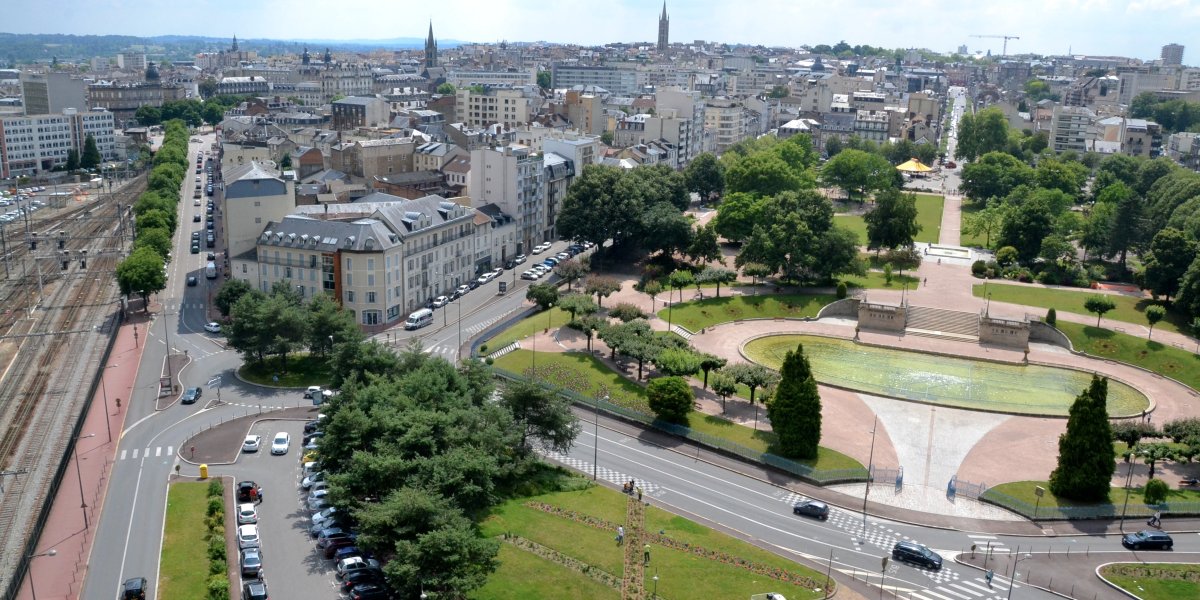
Step off your train onto the platform and walk straight out to the parvis — then turn around. Built in 1929 by Roger Gonthier, Limoges-Bénédictins is consistently voted the most beautiful railway station in France: a copper-green dome rising over four allegorical figures of the cities it links, a 60-meter campanile, and Francis Chigot stained glass inside the dome. The 9 AM eastern sun hits the facade at the perfect raking angle — by noon the light flattens and the carvings vanish.
Tip: Cross Avenue du Général de Gaulle into the Champ de Juillet park and shoot from the upper steps near the reflecting pool — the only viewpoint that aligns the dome, campanile, and the four sculpted city figures in one frame. The plaza directly in front of the station fills with tour buses by 10:00 and blocks the angle entirely.
Open in Google Maps →10:15
Museum
Cut west through Champ de Juillet's plane-tree allée and continue 8 minutes along Boulevard Carnot — the museum facade appears across Place Winston Churchill. Even without entering, this square is the spiritual heart of porcelain Limoges: the bronze of Adrien Dubouché himself, the pale Périgord-stone facade in the slanting late-morning light, and the Bernardaud flagship two blocks south where unfired white biscuit gleams through the showroom windows. Walk a slow loop through the surrounding streets — every other doorway carries a maker's mark above the lintel, the city's quiet signature.
Tip: Step inside the Bernardaud showroom on Avenue Garibaldi (free, no obligation) — the back wall holds their seconds shelf, where minor-flaw espresso cups go for 12 euros instead of 45. The shop closes 12:30-14:00 for lunch; visit before noon or skip it.
Open in Google Maps →12:30
Food
Walk 10 minutes southeast down Rue Jean Jaurès to Place de la Motte — the wrought-iron-and-glass market hall, built in 1900, sits dead center. Skip the sit-down restaurants and head to the stalls: order a galetou (the buckwheat crêpe of the Limousin, folded around ham and Cantal cheese) from the crêperie near the eastern doors, 6 euros, with a glass of local cidre fermier for 3 euros. Eat standing at the chest-high counters — this is how Limousins lunch on a Tuesday.
Tip: Pascal Beillevaire's cheese stall on the central aisle sells Boutons de Culotte — thumb-sized aged goat cheeses unique to this region — three for 3 euros, vacuum-packed for travel. Avoid the named brasseries inside the hall: their lunch queues eat 30 minutes and they charge tourist rates for the same regional dishes the stalls do better.
Open in Google Maps →14:00
Neighborhood
Exit Les Halles south, cross Rue Haute-Vienne, and Rue de la Boucherie begins immediately — a single sloping cobbled street, 200 meters long. For eight centuries, until 1980, this was the closed guild quarter of Limoges' 100+ butcher families: the half-timbered houses still carry meat-hook hardware on the lintels, and No. 36 has an octagonal corner turret that overhangs the cobbles. Slip into the Chapelle Saint-Aurélien halfway down — the butchers' private chapel, three meters wide, gilded ceiling, almost no signage, and almost no visitors.
Tip: The chapel's saint reliquary is still maintained by the Confrérie des Bouchers — drop a 1-euro coin in the wooden slot inside the door and the spotlights flick on for 60 seconds, revealing the gilt altar. Photos welcome, flash forbidden. The Confraternity locks the chapel at 17:00 sharp.
Open in Google Maps →15:45
Religious
From the bottom of Rue de la Boucherie, walk 6 minutes south down Rue Saint-Pierre — the cathedral spire pierces above the rooftops before the full mass comes into view. Saint-Étienne is the only French Gothic cathedral built entirely in granite — 600 years of work, 1273 to 1888 — and its rose-tinted west portal catches the southwestern afternoon sun. Drift down through the terraced Jardin de l'Évêché toward the Vienne, then cross the 13th-century Pont Saint-Étienne; from the far towpath at 18:30, the cathedral spire mirrors in the river — the single iconic image of the city.
Tip: Don't shoot from the Pont Saint-Étienne itself — cross fully to the south bank and walk 50 meters east along the towpath beneath the willows; that's where the spire-and-reflection composition lines up. From mid-September the sun drops behind the apse by 19:30, so time your crossing for 18:15 in summer, 17:45 in autumn.
Open in Google Maps →19:30
Food
Walk back north through the Boucherie quarter, 8 minutes uphill, lanterns on the cobbles guiding you up to Place de la Motte. Chez Alphonse at No. 5 is the unmoved Limoges institution: red-checked tablecloths, daily blackboard menu, run by the same family since 1992, packed with locals on a Wednesday. Order the tête de veau sauce gribiche (22 euros — the regional braised-veal classic, served sliced and warm) and the clafoutis aux cerises (8 euros — the Limousin's gift to French desserts). Two courses with a glass of Bergerac red runs about 38 euros.
Tip: Phone-reserve the morning of (+33 5 55 34 34 14) — no online booking, no walk-ins seated after 19:45. Ask for 'une carafe d'eau' (tap water, free) — the surrounding Place de la Motte terraces are the city's classic tourist trap, pouring 6-euro bottled water and overpricing rillettes plates by 40%; Chez Alphonse is the one address on the square that prices like a neighborhood place.
Open in Google Maps →
Trip builder
Plan this trip around Limoges
Turn this guide into a bookable rail itinerary with FlipEarth.
Keep exploring
Related cities
More in the same country
FAQ
Frequently asked questions
How many days do you need in Limoges?
Most travelers enjoy Limoges in 1 days, with enough time for headline sights and a slower meal or museum stop.
What's the best time to visit Limoges?
The easiest season for most travelers is May-Sep, especially if you want good weather and manageable crowds.
What's the daily budget for Limoges?
A practical starting point is about €110 per person per day before hotels, then adjust based on museums, dining, and transport.
What are the must-see attractions in Limoges?
A good first shortlist for Limoges includes Gare de Limoges-Bénédictins.