City Guide
Lille
Frankreich · Best time to visit: Apr-Oct.
Day-by-day plan
Choose your pace
Reisedauer
09:00
Landmark
From Lille-Flandres station, walk 10 minutes south down Rue de Paris — the streets are still quiet and the boulangeries are just opening. You arrive at Porte de Paris, a 17th-century triumphal arch built to celebrate Louis XIV's capture of the city from the Spanish Netherlands, flanked by sculpted angels of Victory. Rising directly behind it is the 104-metre Beffroi de l'Hôtel de Ville, a UNESCO-listed Art Deco belfry in red brick.
Tip: Shoot the arch from the south side between 9:00-9:30 — the low morning sun backlights the eastern façade and the belfry together in one frame. Skip climbing the belfry interior: the 100-step spiral eats an hour, and the best angle on Lille's skyline is actually from this square looking up, not from the top looking down.
Open in Google Maps →10:15
Landmark
Walk 12 minutes northwest through the quiet 19th-century Paris district, past red-brick townhouses with wrought-iron balconies. You emerge onto Place de la République, where a grand Belle Époque colonnaded façade commands the entire square — this is the Palais des Beaux-Arts, the second-largest art museum in France after the Louvre. Cross to the opposite side and walk the length of the rectangular reflecting pool for the classic symmetrical shot.
Tip: Stand on the Rue de Valmy side with the pool in the foreground — at 10:30 the sun is still east enough that the sandstone façade glows warm without direct glare on the glass. The interior holds Goya, Rubens and Delacroix, but it's a full day's visit; save it for a proper return trip.
Open in Google Maps →11:15
Landmark
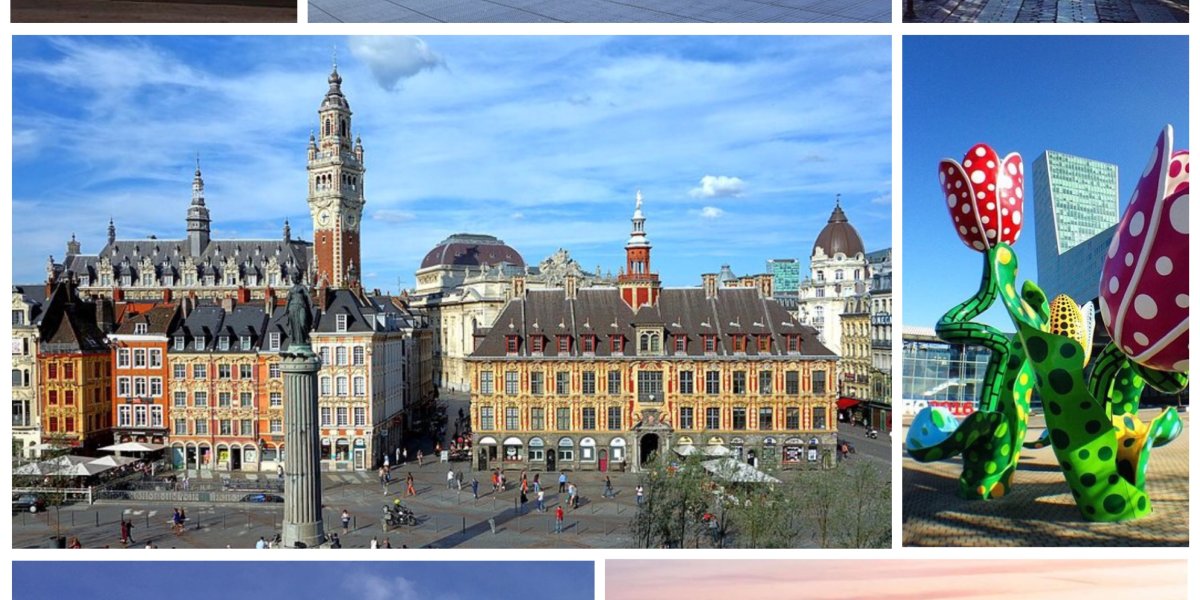
Head 12 minutes north along Rue de Paris — the cafés are busy with mid-morning coffees and the smell of chicory drifts out of doorways. You arrive at Place du Général de Gaulle, which every local calls the Grand Place. At its centre rises the Column of the Goddess, and on the east side stands Lille's masterpiece: the Vieille Bourse, 24 identical red-brick merchant houses built in 1653 around an enclosed inner courtyard. Step through the arched entrance — the carved wooden galleries and stone medallions of fruits and flowers are stunning.
Tip: The inner courtyard hosts a used-book and flower market Tuesday-Sunday 13:00-19:00, plus informal chess matches on fold-out tables — swing back past on your way into Vieux-Lille after lunch to catch it in full swing. For the best façade photo of the Grand Place, stand in front of La Voix du Nord building (the one with gilded statues on the roof) and shoot south toward the Column.
Open in Google Maps →12:45
Food
Walk 3 minutes north from the Vieille Bourse into Rue Esquermoise — the bustling square gives way to a narrower boutique-lined street, the unofficial threshold of Vieux-Lille. At number 27, the 1761 gilded façade of Méert with its caryatids and painted arches is impossible to miss. This is Lille's most legendary patisserie, and Charles de Gaulle's personal favourite. Grab a savoury quiche Ch'ti or a beef-and-beer pâté en croûte at the counter, plus their signature gaufre fourrée à la vanille de Madagascar — a thin oval waffle filled with Bourbon vanilla cream.
Tip: The tea room at the back has a 20-minute wait after 13:15 — skip it. Order at the patisserie counter (waffle 3.60€, savoury tart 9€, a small salad 7€) and eat standing at the wooden ledge or two minutes away on Place du Lion d'Or. Buy a second waffle to go: they stay good 48 hours and are the perfect train snack.
Open in Google Maps →14:00
Neighborhood
Leaving Méert, turn right onto Rue de la Monnaie — the single most photogenic cobbled street in northern France, lined unbroken with 17th-century Flemish townhouses in red brick, pale stone and tall chimneyed gables. The street curves and opens onto Parvis Notre-Dame, where the cathedral's astonishing 1999 façade — a wall of translucent white marble held in a steel frame — confronts you head-on. Then loop the neighbourhood: Rue de la Clef, the tiny Place aux Oignons with its ivy-draped bistros, Rue Royale with its aristocratic hôtels particuliers, Rue Basse, and back through Rue Esquermoise. This is the 6-km heart of your power walk.
Tip: Step inside Notre-Dame de la Treille around 17:00 — the late-afternoon western sun passes through the marble façade and turns the entire nave into a glowing amber cavern. It lasts only 30-40 minutes. Most guidebooks dismiss the cathedral because the exterior is polarising; they miss that the real spectacle is entirely from the inside, and only at this hour.
Open in Google Maps →19:30
Food
From Notre-Dame, walk 8 minutes southeast via Rue des Vieux Murs and Rue de la Halle, then turn onto Rue de Gand — a single 300-metre street holding half of Lille's surviving old estaminets (Flemish taverns). At number 25, T'Rijsel (Flemish for 'Lille') spills warm light and chatter onto the cobbles. Inside: enamel advertising signs, red-and-white checked tablecloths, dried hop vines hanging from beams, and regulars greeting the owner by name. Order carbonade flamande (beef braised for six hours in Grimbergen brown ale with gingerbread, 17€) and a pint of cold Goudale blonde on draught (5.50€).
Tip: Reserve 24-48 hours ahead by phone or arrive exactly at 19:00 when they open — walk-ins after 19:45 wait 45+ minutes and get the bad tables near the door. Ask for the potjevleesch as a starter (cold terrine of four white meats in jelly, 9€) — it's the dish every Lillois grandmother made. Final warning: avoid every moules-frites restaurant along Rue de Béthune and Place Rihour — those are the tourist-trap strip aimed at weekend visitors from Paris and Brussels, serving frozen mussels at double price, and the 'street performers' around the Column of the Goddess at night are a well-known distraction-theft team.
Open in Google Maps →Zu Tag springen
09:30
Religious
Begin at Place Gilleson where Lille's strangest church meets you head-on: a half-finished neo-Gothic shell capped with a translucent marble facade completed only in 1999. Step inside for ten quiet minutes — at this hour the morning sun pushes through the alabaster panels and the rose window glows from within, an effect that vanishes by mid-morning.
Tip: Walk in, then turn around and look back at the facade from inside — the marble flares orange-pink only between 09:00 and 10:30 when the eastern sun hits it. After that the magic dies. Free to enter, no queue before 10:00.
Open in Google Maps →10:45
Museum
Exit the cathedral and walk five minutes west on Rue du Cirque, threading the cobbled lanes of Vieux-Lille past artisan chocolatiers and the pocket-sized Place aux Oignons. The general's birth house on Rue Princesse is preserved as a comfortable 1890 bourgeois home; the upstairs nursery is unexpectedly moving even without French. Allow time for the modest interactive exhibit downstairs.
Tip: Pay the extra €2 for the audio guide — without it the rooms read as just antique furniture. Skip the on-site shop and walk to Méert's bookshop on Rue Esquermoise instead for better de Gaulle titles.
Open in Google Maps →12:30
Food
Walk ten minutes east through Rue de la Monnaie, Vieux-Lille's prettiest stretch of red-brick mansions and boutiques, onto Rue de Gand. T'Rijsel is the most authentic estaminet inside the historic centre — long communal tables, tobacco-warm walls, locals reading the paper. Order the carbonade flamande (€18, beef braised in Goudale beer) or potjevleesch (€15, cold meat terrine in jelly — the dish nobody warns you about and everyone remembers).
Tip: Reserve a day ahead by phone — weekends fill by 12:30 and they'll turn walk-ins away. Pair the carbonade with a half-pint of Ch'ti Brune; the waitress will nod approvingly. Cash and French cards only.
Open in Google Maps →14:30
Landmark
Walk eight minutes southwest down Rue Esquermoise. The square opens suddenly: the Déesse column at its centre, the Vieille Bourse's stepped Flemish gables on the east side, the gold-lettered La Voix du Nord facade to the north. Afternoon light strikes the bourse square-on — this is the postcard hour of the day.
Tip: Stand at the foot of the Déesse column and frame the Vieille Bourse over your right shoulder — that single shot is the one image of Lille every traveler needs. Avoid the carousel-side angle: it crops awkwardly into every frame and dates the photograph instantly.
Open in Google Maps →16:00
Landmark
Step into the arcaded courtyard immediately behind you — twenty-four Flemish merchant houses built around a single square in 1653, now hosting daily second-hand book stalls and chess tables where retirees play in deep silence. Then loop north through Rue de la Monnaie, Rue de la Grande Chaussée and Place du Lion d'Or, the boutique heart of Vieux-Lille, past Méert's pastel-blue patisserie and the tiny galleries the guided tours never enter.
Tip: Stop at Méert (27 Rue Esquermoise) for a single vanilla waffle (€3.50) at the back takeaway counter — zero wait, while the sit-down tea room queue stretches outside. The bourse courtyard empties around 18:00 when stalls pack up — golden hour without the crowds.
Open in Google Maps →19:30
Food
Walk two minutes south on Rue Saint-Étienne — you'll smell the kitchen before you arrive. Le Barbue d'Anvers is a true Flemish estaminet: dark wood, candle stubs, hop garlands looped from the beams. Order the welsh complet (€19, melted cheddar over ham on toast, drowned in Goudale beer) or the carbonade flamande (€21), and finish with a small génépi if the host offers.
Tip: Pitfall warning: avoid the touristy crêperies and pizzerias clustered along the north end of Rue de la Monnaie — they mark up 30% and use pre-made batter. Real estaminets only show handwritten chalkboards; if there's a laminated photo menu out front in four languages, walk away.
Open in Google Maps →09:00
Neighborhood
Take metro line 1 from Rihour to Gambetta (4 minutes), then walk three minutes south on Rue Léon Gambetta. Sunday morning is when Wazemmes erupts: Maghrebi spice traders, Senegalese fabric stalls, oyster shuckers, and a chicken-rotisserie line where locals queue with foil trays. Walk the outdoor stretch first, then duck inside the 19th-century brick halle for cheese, charcuterie and hot mint tea.
Tip: Arrive before 10:30 — by 11:30 the lanes are shoulder-to-shoulder. The €12 rotisserie chicken at the central indoor counter is the local Sunday breakfast; eat it standing at the small bar with a €3 glass of white. Tuesday and Thursday markets exist but are half the size — Sunday is the only day worth planning around.
Open in Google Maps →11:00
Museum
Walk ten minutes northeast through Rue d'Iéna and Rue Inkermann to Place de la République — the museum is the grand neoclassical block facing the square. France's second-largest fine arts collection after the Louvre, and at this hour you'll have rooms to yourself. Don't miss Goya's Old Women, Rubens' Descent from the Cross, and the eerie 16th-century relief plans of fortified Flemish cities tucked away in the basement.
Tip: Buy tickets online to skip the counter line. Head straight to the basement plans-reliefs first — they are the museum's secret weapon and most groups never descend there. Closed Tuesdays. Allow exactly two hours for a focused visit; the full collection needs four.
Open in Google Maps →13:30
Food
Walk eight minutes north along Rue Nationale to Rue de Béthune. Aux Moules has served moules-frites since 1930 — red leather banquettes, brass coat hooks, waiters in floor-length white aprons who've worked here for decades. Order the moules marinière (€19 for a full kilo with fries) or, for the local move, the moules au Maroilles (€23, drowned in Lille's stinkiest cheese).
Tip: Arrive at 13:00 or after 14:15 — the 13:30–14:00 window is when nearby office workers swamp every table. Mussels are at peak quality September through April; in summer ask the waiter directly what came in fresh that morning rather than ordering blind.
Open in Google Maps →15:00
Landmark
Walk thirteen minutes southeast along Rue de Paris, the city's main pedestrian shopping spine, to Place Augustin Laurent. The 104-metre belfry is UNESCO-listed and the tallest civil belfry in France — a hundred steps then a small lift to the top. From the platform you'll see the Flemish plain stretching flat to the horizon, the Citadel star-fort to the west, and on a clear day the spires of Tournai across the Belgian border.
Tip: Last entry is 16:30 — do not arrive at 16:25 hoping to slip in. Closed Monday and Tuesday. Stand on the southwest corner of the platform: it frames the Porte de Paris triumphal arch directly below with Vieux-Lille's red rooftops behind — the only photo from up here that doesn't look generic.
Open in Google Maps →17:00
Landmark
Descend and walk two minutes west — the arch is already in view from the belfry doorway. Built between 1685 and 1692 by Vauban to celebrate Louis XIV's capture of the city, with sculpted Hercules figures below and gilded angels of victory blowing trumpets above. Late afternoon sun lights the south face and the gold figures genuinely glow; walk around to the rear too, where almost no tourist bothers and the lesser-photographed angle is the better one.
Tip: Skip the tired carousel at the centre of the square — overpriced and the ponies look depressed. The grass slope on the east side of the arch is a good five-minute pause before walking back for dinner. Behind you the 1932 Art Deco Hôtel de Ville facade is worth a glance; locals either love it or hate it, never neutral.
Open in Google Maps →19:30
Food
Walk thirteen minutes northwest along Rue de Paris back to Place Rihour. La Paix is a 1920s belle époque brasserie with mosaic tile floors, mirrored walls and wicker café chairs — the place where Lille businessmen still close deals over choucroute. Order the choucroute alsacienne (€26) or the sole meunière (€28, fileted at your table); the house Riesling at €5 a glass holds up surprisingly well.
Tip: Pitfall warning: avoid the chain pizzerias and kebab counters ringing the Place Rihour metro exit — they prey on travelers who think they're saving money and the food is uniformly bad. Reserve La Paix for 19:30 sharp; after 20:30 the after-work crowd makes conversation hard. The €32 three-course formula is one of central Lille's best-value sit-down meals.
Open in Google Maps →
Trip builder
Plan this trip around Lille
Turn this guide into a bookable rail itinerary with FlipEarth.
Keep exploring
Related cities
More in the same country




FAQ
Frequently asked questions
How many days do you need in Lille?
Most travelers enjoy Lille in 1 days, with enough time for headline sights and a slower meal or museum stop.
What's the best time to visit Lille?
The easiest season for most travelers is Apr-Oct, especially if you want good weather and manageable crowds.
What's the daily budget for Lille?
A practical starting point is about €90 per person per day before hotels, then adjust based on museums, dining, and transport.
What are the must-see attractions in Lille?
A good first shortlist for Lille includes Porte de Paris & Beffroi de l'Hôtel de Ville, Palais des Beaux-Arts (Exterior) & Place de la République, Grand Place & Vieille Bourse.