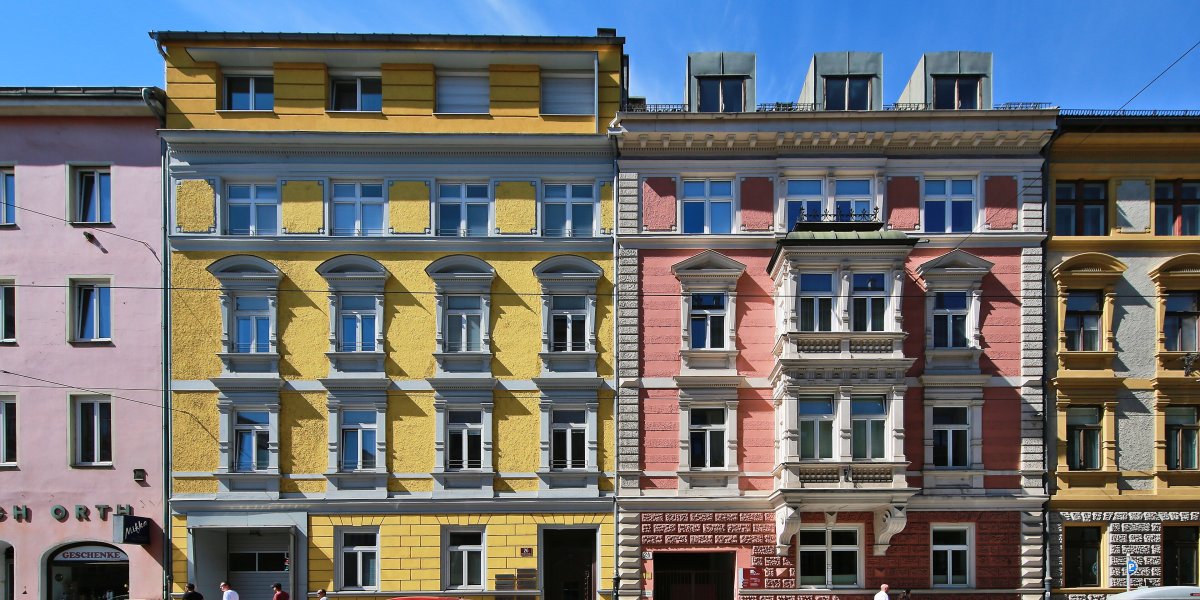
City Guide
Innsbruck
Österreich · Best time to visit: Jun-Sep, Dec-Mar.
Day-by-day plan
Choose your pace
Reisedauer
09:00
Landmark
The morning sun hits the 2,657 fire-gilded copper tiles at a low angle, turning Emperor Maximilian's balcony into a blaze of gold against the shadowed medieval facades. Walk the length of Herzog-Friedrich-Straße — barely 200 metres — but every building has a painted fresco or a Gothic oriel window worth stopping for. At nine o'clock the square belongs to you; by ten it fills with tour groups.
Tip: Stand directly beneath the roof and shoot upward for the most dramatic photo — the foreshortened angle exaggerates the gold. The best wide-angle framing of the roof plus the painted Helblinghaus next door is from the southeast corner of the square.
Open in Google Maps →10:00
Landmark
Walk north from the Golden Roof through the Marktgraben passage toward the river — 8 minutes to the Hungerburgbahn Congress station, a Zaha Hadid-designed glass shell that looks like it arrived from another century. Three cable-car stages carry you from 574 m to the Hafelekar summit at 2,334 m in twenty minutes. Step off at the top and the Inn Valley stretches east and west like a geological cross-section, the city a toy model 1,760 metres below your feet.
Tip: Buy the round-trip ticket online the night before — slightly cheaper and you skip the queue. Morning ascents have the clearest panoramas; Alpine thermals build clouds after 13:00. If Hafelekar is too windy, stop at Seegrube (middle station) where a panoramic terrace serves coffee with the same view.
Open in Google Maps →12:30
Food
Ride back down to Congress and walk south past the Hofburg — 10 minutes to Innsbruck's glass-roofed food market on Innrain. Locals queue at the Tyrolean stand for Kiachl, a disc of fried dough topped with sauerkraut and sour cream (€5), or grab a warm Kasspressknödel — cheese dumpling in broth (€7). No reservation, no fuss — in and out in half an hour with change from a ten-euro note.
Tip: The cheese stall on the ground floor sells vacuum-packed Graukäse (Tyrolean grey cheese) — sharp, pungent, and an edible souvenir that survives a day in your bag. Skip the Asian fusion stalls if you're short on time; they're fine but not why you're here.
Open in Google Maps →13:30
Neighborhood
Exit the Markthalle and walk north along Innrain toward the river — 5 minutes to the Innbrücke. Step onto the bridge and face north: the row of pastel-coloured houses along Mariahilf-Straße, backed by the snow-dusted Nordkette you were standing on an hour ago — this is the most photographed view in Innsbruck. Cross to the north bank and stroll the full length of Mariahilf at street level, where the painted facades reveal their detail up close.
Tip: The postcard shot is from the middle of the Innbrücke, facing north with the mountains behind the coloured houses. In early afternoon the sun lights the facades directly — no shadow, no backlight. Walk 50 metres east along the north bank for a quieter angle with fewer selfie sticks in your frame.
Open in Google Maps →14:30
Landmark
Cross back to the south bank, walk through the Altstadt, and emerge onto the wide boulevard of Maria-Theresien-Straße — 10 minutes. Halfway down, the Annasäule (St. Anne's Column) stands in the pedestrian zone; turn north here for the iconic shot — the baroque column in the foreground, the Nordkette filling the sky above the Old Town rooftops. Continue south to the Triumphpforte, a triumphal arch built in 1765 for a Habsburg wedding that doubled as a funeral — one side celebrates, the other mourns.
Tip: The Annasäule looking north is the shot — afternoon light warms the mountains behind the column. The arch itself is a two-minute stop; don't linger. If you want chocolate, Café Munding at Kiebachgasse 16 is Innsbruck's oldest pastry shop (since 1803), a one-minute detour east from the column. Avoid the souvenir shops along the east side of the street — they charge triple for the same Swarovski keychains you'll find at the airport.
Open in Google Maps →18:00
Food
Walk north back up Maria-Theresien-Straße into the Old Town — 8 minutes. The Ottoburg's medieval tower is visible from Herzog-Friedrich-Straße, steps from the Golden Roof where your day began. A restaurant since 1745 in a 1494 Gothic tower, with vaulted stone ceilings and candlelight that earns its five centuries. Order the Tiroler Gröstl — pan-fried potatoes with speck and a runny egg (€17) — or the Wiener Schnitzel pounded thin and fried in clarified butter (€23). Budget €30–40 per person with a beer.
Tip: Ask for a table on the first floor — the vaulted Gothic room is the most atmospheric. Walk-ins work before 18:30 on weekdays; reserve ahead on weekends. Order a Starkenberger draught instead of the tourist-trap Jägertee cocktail they push at every table. One area warning: ignore the Swarovski Crystal Worlds shuttle sellers near the Golden Roof — the attraction is 20 km out of town, eats half your day, and the gift shop is the real exhibit.
Open in Google Maps →Zu Tag springen
09:00
Landmark
From the Congress station at the edge of Old Town, step into Zaha Hadid's glacier-like Hungerburgbahn funicular — the first of three stages that carry you straight to Hafelekar at 2,334 meters in just twenty minutes. At the summit, the Karwendel range unfolds in every direction: jagged limestone peaks to the north, the Inn Valley and Innsbruck's pastel rooftops far below to the south. Spend time at both the Seegrube terrace (1,905 m) and the Hafelekar viewing platform before descending.
Tip: Buy the roundtrip ticket for all three stages at the Congress station machine to skip the window queue. Morning before 10:00 gives the clearest visibility — afternoon clouds regularly build against the north face and can erase the panorama entirely. Stand on the left side of the Hungerburgbahn going up for the best framing of the valley.
Open in Google Maps →12:00
Food
Ride the Hungerburgbahn back down to Congress station and walk three minutes south across the Marktgraben to reach the glass-roofed Markthalle on the Inn riverbank. This covered market is where Innsbruck locals grab lunch — stalls sell everything from Tyrolean cheese to South Tyrolean speck. Head to the Tyrolean counter for a bowl of Kaspressknödelsuppe (cheese dumpling soup, ~€6) or a plate of Tiroler Gröstl (pan-fried potato and beef hash, ~€11). Eat at the communal tables by the windows overlooking the river.
Tip: The lunch crowd peaks at 12:30 and the best counter seats facing the Inn fill first — arrive right at noon. Skip the international food stalls and go straight to the back-left Tyrolean stall for the most authentic bites. The market closes at 18:00 on weekdays and 13:00 on Saturdays; closed Sundays.
Open in Google Maps →13:00
Landmark
Walk north from the Markthalle across the Inn River via the Innbrücke — look left for a postcard view of the Nordkette towering above the coloured facades — then continue straight up Herzog-Friedrich-Straße, the pedestrianised spine of Old Town, directly to the Goldenes Dachl. The 2,657 fire-gilded copper tiles were commissioned by Emperor Maximilian I in 1500 to mark his wedding balcony. After admiring it from below, buy a combined ticket and climb the 148 steps of the adjacent Stadtturm for a 360-degree panorama: the Golden Roof directly below, the Nordkette to the north, and the Patscherkofel to the south.
Tip: The south-facing roof catches direct sunlight from roughly 11:00 to 15:00 — shoot from directly across the street at first-floor height for the sharpest angle on the gilded tiles. Climb the Stadtturm first while your legs are fresh; the narrow spiral staircase gets congested after 14:00 when tour groups arrive.
Open in Google Maps →14:30
Museum
Walk two minutes east along Rennweg — you'll pass under a Baroque archway and the white palace façade appears on your right. Empress Maria Theresa transformed this medieval fortress into a Rococo showpiece in the 1750s. The Giant's Hall (Riesensaal) is the centrepiece: a 31-metre-long ballroom with ceiling frescoes, crystal chandeliers, and life-sized Habsburg portraits lining every wall. The state apartments reveal imperial daily life with original furnishings, porcelain stoves, and the chapel where royal marriages were sealed.
Tip: The Giant's Hall photographs best from the doorway entrance — stand centred and shoot straight down the hall to capture its full 31-metre length in one frame. Audio guides are included in the ticket and worth using for the Maria Theresa rooms. The palace is one of the few Innsbruck sights open on Mondays.
Open in Google Maps →16:15
Religious
Exit the Hofburg's east wing and walk one minute through the courtyard to the Hofkirche entrance next door. This is Emperor Maximilian I's grand mausoleum — though his body was never placed here. Twenty-eight larger-than-life bronze statues, the famous 'Schwarze Mander' (Black Men), line the nave, standing eternal guard around his empty marble cenotaph. Each figure represents a historical or mythical ancestor of the Habsburg dynasty. Upstairs, the Silver Chapel holds the tomb of Archduke Ferdinand II and his wife Philippine Welser.
Tip: Study the face of King Arthur among the 28 bronzes — it was sculpted by Albrecht Dürer's workshop and is the most artistically refined figure of the group. Late afternoon light through the side windows creates dramatic shadows across the statues, making 16:00–17:00 the best hour for photography. The combined ticket with the adjacent Volkskunstmuseum saves €3, but skip the folk museum today — save your energy for tomorrow.
Open in Google Maps →19:00
Food
Stroll west back down the full length of Herzog-Friedrich-Straße — the evening light turns the painted facades gold — until you reach the medieval tower at the northern end where the street meets the Inn bridge. The Ottoburg has occupied this five-storey tower since 1494 and remains one of Innsbruck's finest traditional kitchens. Request a table on the second floor for exposed timber beams and candlelit atmosphere. Order the Wiener Schnitzel pounded thin and pan-fried golden (~€22) or the Zillertaler Krapfen, stuffed pasta parcels with cheese and potato (~€16). Pair with a glass of Austrian Grüner Veltliner.
Tip: Reserve for 19:00 by calling ahead — the second floor fills by 19:30 and walk-ins get sent to the less atmospheric ground level. Avoid the restaurants with outdoor barkers along Maria-Theresien-Straße south of Old Town: they target tourists, charge 30% more for reheated food, and have no soul. Ottoburg is where Innsbruck locals bring their own visitors.
Open in Google Maps →09:00
Landmark
Take Tram 1 southbound from Museumstraße for ten minutes to the Bergisel stop, then walk up the wooded hillside path. Zaha Hadid's sweeping concrete-and-glass tower replaced the old Olympic jump in 2003 and has become Innsbruck's most dramatic silhouette. Ride the funicular up the slope, then take the elevator to the observation deck at the summit. You'll stand exactly where Olympic ski jumpers launch — the 50-metre-high platform offers a vertigo-inducing view straight down the in-run and out across the entire Inn Valley with the Nordkette behind the city.
Tip: The best photo angle is from the outdoor café terrace rather than through the glass observation deck — no reflections, unobstructed panorama. Morning light hits the valley from the east, making 09:00–10:30 optimal for shots toward the city. The panorama sign on the platform identifies every visible peak. On clear days you can see straight down toward the Brenner Pass and Italy.
Open in Google Maps →10:45
Religious
Walk down from Bergisel along Bergiselweg and turn right — the twin yellow towers of the Wiltener Basilika appear after five minutes through the quiet residential Wilten neighbourhood. Step inside and the explosion of Rococo ornamentation will stop you mid-stride: every surface covered in gold stuccowork, pastel ceiling frescoes by Matthäus Günther, and intricate altarpieces. This 18th-century church is considered one of the finest Rococo interiors in the entire Tyrol, yet it sees a fraction of the visitors the Old Town churches receive.
Tip: Between 10:00 and 11:00, morning light pours through the east-facing windows and the gold stucco practically glows — this is the single best hour to experience the interior. Look up at the ceiling fresco above the main altar: it depicts the legendary founding of Wilten Abbey by the giant Haymon after he slew the dragon Thyrsus. Photography is permitted but tripods are not.
Open in Google Maps →12:00
Food
Exit the Basilica and walk three minutes east along Klostergasse, past the sandstone walls of Stift Wilten abbey, to reach the Bierstindl — a traditional Tyrolean Gasthaus that has fed the Wilten neighbourhood for generations. This is a working-class lunch spot, not a tourist restaurant, and the dining room fills with locals from noon. Order the Speckknödel with sauerkraut (bacon dumpling served in broth, ~€10) or a pan of Kasnocken baked golden with mountain cheese (~€12). A half-litre of draft Märzen beer rounds out the meal.
Tip: If the weather is good, sit in the courtyard garden where tables face the old abbey walls. Service is Tyrolean-paced — flag down your server early and order promptly. The daily special (Tagesmenü, usually around €10) is always the best value and changes every day; ask for it even if it's not on the printed menu.
Open in Google Maps →13:30
Museum
From Klostergasse, walk five minutes to the Stubaitalbahnhof tram stop and ride Tram 6 eastbound for ten minutes to Schloss Ambras, then stroll five minutes uphill through the castle's English landscape park. Archduke Ferdinand II transformed this medieval fortress into a Renaissance pleasure palace in the 1570s. The ground-floor Chamber of Art and Curiosities is one of the world's oldest museum collections — coral sculptures, suits of armour for giants and children, scientific instruments, and portraits of human 'wonders.' Upstairs, the Spanish Hall features an extraordinary coffered ceiling and twenty-seven full-length portraits of Tyrolean rulers.
Tip: Start with the Curiosity Cabinet on the ground floor — it is the most extraordinary room and gets crowded after 14:00 when bus tours arrive. The Habsburg Portrait Gallery on the upper floor has over 200 paintings, including the famous portrait of Petrus Gonsalvus, the 'hairy man' who was the real-life inspiration behind Beauty and the Beast. The castle gardens are free to enter even without a museum ticket.
Open in Google Maps →16:00
Religious
Ride Tram 6 back westbound, exit at Museumstraße, and walk five minutes north through the university quarter into Old Town. The twin-towered Baroque cathedral sits on the Domplatz, its modest sandstone exterior hiding one of the most spectacular painted ceilings in Austria. Cosmas Damian Asam's massive ceiling fresco draws your eye upward the moment you enter, and above the high altar hangs the Mariahilf — one of Lucas Cranach the Elder's most venerated Madonna paintings, a destination of pilgrimage for centuries. After visiting, walk south to Maria-Theresien-Straße for a farewell stroll past the Annasäule column with the Nordkette framed behind it.
Tip: A €2 lighting donation activates the altar illumination — absolutely worth it to see the Cranach painting properly lit. Late afternoon light from the western windows fills the nave with warm amber tones, making 16:00–17:00 the most atmospheric time to visit. Sit in a rear pew and look straight up for the best vantage of the Asam ceiling without neck strain.
Open in Google Maps →19:00
Food
Walk three minutes south from the Dom through the narrow Seilergasse to reach Die Wilderin, a farm-to-table restaurant that is the current darling of Innsbruck's food scene. The menu changes weekly based on what Tyrolean farmers and foragers deliver — expect dishes like venison tartare with mountain herbs (~€16) or slow-braised beef cheeks with root vegetables (~€24). The interior is stripped-back alpine: raw wood, open kitchen, and a deliberately small dining room that creates an intimate, buzzing atmosphere. This is your farewell meal — make it count.
Tip: Reservations are essential — book at least two days ahead via phone or their website and request a window table. The wine list focuses on Austrian and South Tyrolean natural wines; ask the server to pair by the glass rather than committing to a bottle. Avoid the generic pizza-and-pasta restaurants lining nearby Maria-Theresien-Straße — they survive on foot traffic and serve nothing you would remember. Die Wilderin is where Innsbruck's chefs eat on their nights off.
Open in Google Maps →
Trip builder
Plan this trip around Innsbruck
Turn this guide into a bookable rail itinerary with FlipEarth.
Keep exploring
Related cities
More in the same country
FAQ
Frequently asked questions
How many days do you need in Innsbruck?
Most travelers enjoy Innsbruck in 1 days, with enough time for headline sights and a slower meal or museum stop.
What's the best time to visit Innsbruck?
The easiest season for most travelers is Jun-Sep, Dec-Mar, especially if you want good weather and manageable crowds.
What's the daily budget for Innsbruck?
A practical starting point is about €100 per person per day before hotels, then adjust based on museums, dining, and transport.
What are the must-see attractions in Innsbruck?
A good first shortlist for Innsbruck includes Goldenes Dachl (Golden Roof), Nordkette Cable Car (Hungerburgbahn to Hafelekar), Maria-Theresien-Straße and Triumphpforte.