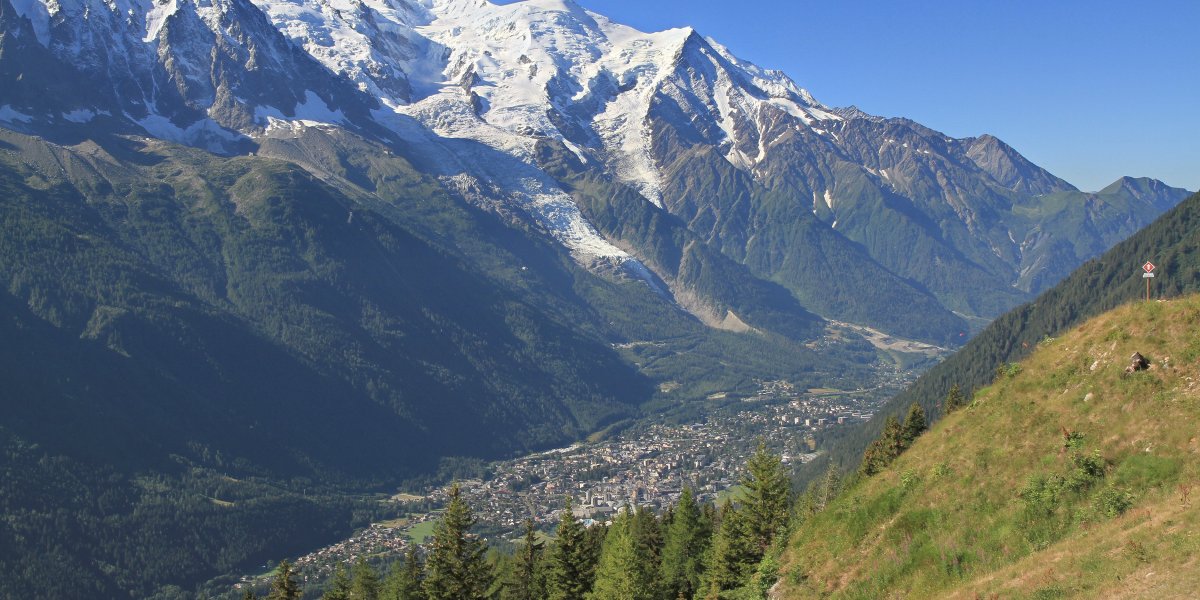
City Guide
Chamonix
Frankreich · Best time to visit: Jun-Sep, Dec-Mar.
Day-by-day plan
Choose your pace
Reisedauer
08:10
Landmark
Arrive at the téléphérique base station fifteen minutes before your 08:10 booked slot — the first ride goes up in clear pre-thermal air before cloud builds. Two cable cars lift you from 1035 m to 3842 m in twenty minutes, ending on a summit terrace that stares straight down the Bossons Glacier and across to the Mont Blanc dome. The Step Into the Void glass box lets you stand on nothing above a 1000 m drop — ten seconds of the most honest vertigo you will ever feel.
Tip: Book the 08:10 slot online the night before — by 11:00 cloud typically swallows the summit and your €75 buys you fog. On the top terrace, take the free interior elevator to the 3842 m piton FIRST, then queue on the LEFT side of Step Into the Void (the right line is always twice as long). The 'Pipe' tunnel on the south-facing terrace has the cleanest Mont Blanc backdrop; locals shoot from inside it looking out.
Open in Google Maps →12:00
Food
From the téléphérique base, walk five minutes north along Rue Joseph Vallot into the old centre. Poco Loco is the town's climber-fuel burger counter — order the Pocoloco double with Beaufort cheese and raclette-grilled onion (€14), wrapped in paper, eaten standing. Calories engineered for the afternoon's glacier staircase, in and out in fifteen minutes.
Tip: The Beaufort blend is why climbers come here and tourists miss it — ask for it 'avec oignons raclette' at the window. Skip the combo fries if you're heading to Montenvers; you want light legs for the 580-step glacier descent. Takeaway wrapper travels fine to the bench by the Arve footbridge if indoor seats are full.
Open in Google Maps →13:30
Landmark
From Poco Loco, cross Place du Mont Blanc and follow the signed path east for eight minutes to Gare du Montenvers, tucked behind the SNCF platforms. The red rack-and-pinion train climbs 870 m in twenty minutes through pine forest, ending directly above what is left of France's longest glacier. The Mer de Glace has retreated more than 1.5 km in a generation — descending the staircase to the ice cave is both a photograph and a climate reckoning.
Tip: Buy the combined Aiguille + Montenvers pass online in advance — it's €15 cheaper than two separate tickets. Skip the télécabine down to the ice cave and take the 580-step staircase instead: you pass year markers showing where the glacier surface used to be, and the cabin queue wastes forty minutes. Catch the 16:30 return train before the last-slot crush; afternoon light on the Drus spires is sharper than morning.
Open in Google Maps →16:45
Landmark
Ride the train back down and walk three minutes south along Avenue Michel Croz into Place Balmat, the pedestrian heart of town. The bronze statue of Horace-Bénédict de Saussure and Jacques Balmat is frozen mid-gesture — Balmat's outstretched arm points at Mont Blanc's summit, which they co-pioneered in 1786. Late-afternoon sun catches the bronze and the mountain behind it in a single frame.
Tip: Stand on the downhill (east) side of the statue and crouch slightly — Balmat's raised finger lines up exactly with the Mont Blanc dome from this one angle alone. After 17:00 the granite warms into gold; wait through a single tour-group pulse and the square clears for about thirty seconds — shoot then.
Open in Google Maps →17:30
Religious
Walk forty metres south from the statue — Saint-Michel's onion-domed spire is already in view. This Savoyard parish church has watched Chamonix evolve from a farming valley into Europe's climbing capital, and its churchyard holds the graves of alpinists who never came down. A quiet counterweight to the day's conquest narrative, and a chance to wander pedestrian Rue du Docteur Paccard before dinner.
Tip: Enter the cemetery through the narrow side alley to the left of the church — Edward Whymper's grave and several Everest-era British climbers lie in plots most visitors walk past without noticing. A five-minute detour that reframes the entire day, and the low 18:00 light through the cypresses is the day's quietest photograph.
Open in Google Maps →19:30
Food
From the church, walk two minutes west down Rue du Lyret to Le Monchu — timber façade, cowbells hanging from the beams, a menu that has never chased trends. Order the fondue moitié-moitié (€28 per person, minimum two) blending Beaufort d'été and Comté, or the croziflette au reblochon (€22) made with buckwheat crozets grown in the next valley. With a glass of local Mondeuse wine (€6) you'll spend €45 for a meal that teaches you what Savoyard food is actually supposed to taste like.
Tip: Reserve by phone the same morning — they hold walk-in tables only after 20:30 and the 19:00 seating fills by 18:30. Ask for the mezzanine near the back window; the main floor gets loud with ski groups. PITFALL: on Rue du Docteur Paccard and around Place Balmat, any restaurant with laminated photo menus and a hawker stationed outside is pure tourist-trap — microwaved fondue at a 40% premium. Skip the Aiguille du Midi summit gift shop too: the same Savoie honey and Génépi sell for a third of the price at Chamonix's Saturday morning market on Place du Mont Blanc.
Open in Google Maps →Zu Tag springen
08:30
Landmark
From your hotel in central Chamonix, walk 5 minutes south down Rue de l'Aiguille du Midi — you'll see the gondolas already swinging skyward before you reach the base station. Take the first lift of the morning to 3842 m, when the massif is still painted pink by alpenglow and before the afternoon clouds close the summit; then step onto the glass box Step Into the Void with the Vallée Blanche spread 1000 m below your shoes. This is the single most astonishing half-day in the French Alps — do it first, and every other view of the trip becomes a variation on the theme.
Tip: Book the exact time slot online the night before — walk-up tickets sell out by 09:00 in summer at the same price. Bring a warm layer (it's -5°C up top even in July) and skip the €8 summit ice cream bar; the free panorama terrace on the north side gives a wider view of the Grandes Jorasses than the paid Pipe Observation Room.
Open in Google Maps →12:30
Food
Descend the cable car and walk 4 minutes northeast down Rue du Lyret — you'll smell the melted Reblochon before you see the door. This wood-panelled Savoyard canteen is where locals take their grandmother for her birthday, and the tartiflette (€18) arrives bubbling in a cast-iron pan with the potatoes crisping at the edges. Pair it with a 25 cl pitcher of Apremont white (€7) and skip dessert — the portions assume you just came down from 3842 m, which you did.
Tip: Order the tartiflette, not the fondue — fondue is a dinner dish for two, tartiflette is the one-person Savoyard specialty. Arrive right at 12:30 opening to skip the 13:00 queue; no reservations taken for lunch service.
Open in Google Maps →14:00
Museum
Walk 3 minutes northwest up Avenue Michel Croz and look for the old Chamonix Palace — a 19th-century grand hotel now housing the museum. Inside you'll find the actual rope Balmat and Paccard used on the first Mont Blanc ascent in 1786, hand-drawn maps from the golden age of mountaineering, and a recreated Victorian alpine salon that smells faintly of cedar. Go straight to the Whymper-era ice axes on the second floor — they're the objects every climber in the valley makes a pilgrimage to see.
Tip: Skip the intro film (dated and in French only) and head to the second-floor mountaineering gallery. The window at the far end frames Mont Blanc itself — the best free photo in Chamonix after the cable car, and unknown to most tourists who enter by the ground floor shop.
Open in Google Maps →16:00
Religious
From the museum, walk 4 minutes south down Rue du Dr Paccard to the cobbled square — you'll spot the bronze statue of Balmat pointing up at Mont Blanc, with Saussure beside him, the man who funded the first ascent. The adjoining 18th-century Église Saint-Michel is plain on the outside but holds a rare ex-voto collection: wooden tablets left by climbers' families over two centuries thanking the mountain for returning their sons alive. Sit on the bench at the back for five minutes — the late-afternoon light through the stained glass falls on the valley-side wall at exactly this hour.
Tip: Balmat's pointing finger aligns perfectly with the true summit of Mont Blanc — stand behind the statue and line up your shot through his outstretched hand for the town's most iconic photo. Ninety percent of visitors shoot it head-on and miss this.
Open in Google Maps →17:30
Landmark
Walk 10 minutes northeast up Chemin du Cimetière, climbing gently away from the tourist streets until the noise drops to birdsong. This small hillside cemetery holds some of the greatest names in mountaineering — Jacques Balmat himself, Edward Whymper, many of the guides lost on the Grandes Jorasses and Eiger — each headstone carved with a peak or an ice axe. Come at this exact hour: the late sun slants across the crosses, the Aiguilles glow orange above the wall, and you will almost certainly be the only visitor there.
Tip: Find Balmat's grave in the upper row just left of the central path — the cross still carries iron-pendant tributes left by modern climbers before big routes. The cemetery gate closes at sunset and the guardian doesn't wait, so don't stay past the first shadow on the back wall.
Open in Google Maps →19:30
Food
Walk 12 minutes back down to Place Balmat, then across the Arve footbridge to the river-terrace side — Atmosphère's tables face straight at the illuminated Aiguille du Midi you rode up this morning. Order the diots aux crozets (Savoyard sausages with buckwheat pasta, €24) and the tarte myrtille (€9), made with blueberries foraged from the valley that same week. It's the single dinner reservation every serious alpinist in town makes on their last night; make yours too.
Tip: Reserve 48 hours ahead and ask specifically for a river-terrace table — it's where the view is; the interior room is ordinary. Pitfall warning: on the walk back ignore the touts offering 'last-minute paragliding' and 'valley tours' on Rue du Dr Paccard — Chamonix's legitimate operators work only from fixed offices on Place Balmat and never solicit on the street. The square-front restaurants with laminated photo menus charge €28 for microwaved tartiflette; all real eating is one street back.
Open in Google Maps →08:30
Landmark
From the Chamonix SNCF station, walk 2 minutes east to the small red cogwheel platform of the Gare du Montenvers — the 1908 rack railway still climbs the same rails through spruce forest up to 1913 m. At the top, the glacier sprawls below you like a frozen highway; a short gondola then drops you to a metal stair onto the ice and into the blue Grotte de Glace, re-carved fresh every spring. Go in the morning: the east-facing glacier catches full sun until 11:00, the ice glows turquoise, and the Italian and Geneva day-trippers don't arrive until noon.
Tip: Buy the combined train + gondola + ice-cave ticket at the Montenvers base desk rather than online — the clerk prints the next available slot and saves you the €5 online booking fee. Descend the 400 metal steps to the ice slowly; they are steeper than they look, and the return climb is the hardest 15 minutes of the whole trip.
Open in Google Maps →12:00
Food
Walk 4 minutes west from the station down pedestrianised Rue du Dr Paccard — look for the small stone arch set back from the street. This 12-table bistro is where Chamonix guides eat on their day off, and the daily slate lists two mains only: usually a valley trout with crozets and a slow-braised Beaufort-cheese beef cheek. Three courses runs €32; the house pear tart with génépi sorbet is the single best dessert in the valley.
Tip: Reservations essential — call by 11:00 or you won't get in. If they're full, ask to sit at the bar counter for the 13:30 second seating; they keep exactly two stools unreserved for walk-ins who know to ask.
Open in Google Maps →13:45
Landmark
Walk 10 minutes northwest up Route Henriette d'Angeville — the road switchbacks uphill and the cable station appears at the top of the rise. The téléphérique lifts you first to Planpraz, then to the Brévent summit at 2525 m, and for the first time the whole Mont Blanc massif — Aiguille du Midi, the Drus, the Grandes Jorasses — lines up across the valley like a single painting. This is the balcony opposite: yesterday you stood over there, today you finally see what you were standing on.
Tip: Get off at Planpraz mid-station on the way up and spend 20 minutes there before riding on — the summer flower meadows and the bench row facing Mont Blanc are where local photographers camp, and the view rivals the summit with a fraction of the wind. The summit café serves an honest tarte aux noix for €6, but bring your own water; up there it's €5 a bottle.
Open in Google Maps →16:45
Museum
Ride back down and walk 10 minutes east along Rue de la Mollard to Place du Triangle de l'Amitié — the modern glass-fronted building on the square. The ground-floor Musée des Cristaux holds the finest quartz and smoky-crystal specimens ever pulled from the massif by the cristalliers, some bigger than your head, each labelled with the exact couloir it came from. Upstairs, the climbing museum traces alpinism from hemp ropes to Messner across a single immersive floor — small but surgical, perfect for the last tired hour of a long day.
Tip: Come now, after 16:30 — the museum is nearly empty once day-trippers have left the valley, and the angled glass roof throws late sunset light directly onto the crystal display cases, which is when the quartz actually sparkles the way the cristalliers intended.
Open in Google Maps →18:30
Park
Walk 15 minutes south along Route des Pèlerins, leaving the shops behind and entering quiet chalet streets — you'll hear the lake before you see it. This small glacier-fed pond at the base of the Gaillands cliff is where Chamonix's first climbers trained in the 1890s; today locals come to swim, dogs come to chase ducks, and the entire Mont Blanc range mirrors in the water on a still evening. Walk the 400 m loop slowly — the reflection shifts with every step.
Tip: Stand on the small wooden jetty on the north shore for the postcard shot — Mont Blanc reflects dead centre, with a climber occasionally silhouetted high on the cliff face behind you. Avoid the bench area on the south side in July and August; mosquitoes come off the water at dusk and it's savage.
Open in Google Maps →19:45
Food
Walk 8 minutes further south down Route du Bouchet to the cluster of old wooden chalets — Maison Carrier occupies a reconstructed 18th-century farmhouse beside the Hameau Albert 1er. The menu is pure Chamoniard: farçon (spiced potato-and-prune cake, €16), diots aux crapiaux (€26), and a mountain-cheese board served with honey from the same ridge you looked down on this afternoon. It is the most complete farewell dinner the valley offers — a one-table apology for leaving.
Tip: Reserve a week ahead for Saturday night, 48 hours midweek. Ask for a table by the fireplace in winter or on the garden terrace in summer — the central dining room is fine but the two flanking rooms are where the atmosphere is. Pitfall warning: after dinner don't wait for a street taxi back into town — Chamonix cabs don't cruise. Have the restaurant call one when you ask for the bill (15 min wait), or walk back along the riverside path, which is lit and safer than the unlit Route du Bouchet at night.
Open in Google Maps →Zu Tag springen
08:10
Landmark
From the center of Chamonix, walk 6 minutes south along Rue de l'Aiguille du Midi to the téléphérique station. The world's steepest cable car climbs from 1035m to 3842m in under twenty minutes; the 08:10 tram catches Mont Blanc in its clearest light, before the afternoon convection clouds veil the summit. Cross the suspended steel bridge between the two granite peaks and step onto Le Pas dans le Vide — a glass cube hanging over a 1000-metre drop — with the Vallée Blanche spilling away below.
Tip: Book the 08:10 tram online 48h ahead — it is the only slot that guarantees unobstructed views. On arrival, ride the inner summit elevator straight up before its queue builds to 25 minutes by 10:00; save the photo terraces for the descent. The summit is -5°C even in August, so pack a warm layer in a daypack.
Open in Google Maps →13:00
Food
Back at the cable car lower station, walk 3 minutes north along Rue du Docteur Paccard — the timber façade with geranium boxes is on your right. A 140-year-old chalet serving the most honest Savoyard fondue in the valley. The signature Fondue Montagnarde (€28) melts emmental, beaufort, and comté with white Apremont wine, and the Tartiflette au Reblochon (€22) is a potato-bacon-cheese gratin first invented in these mountains. A glass of Mondeuse (€7) cuts the cheese beautifully.
Tip: Order the fondue for two even if you are four — it arrives with bread, cured ham, and pickles in quantities that feed twice as many. Reserve 24h ahead for any seating after 12:30; the dining room turns over once per service and walk-ins wait 40 minutes.
Open in Google Maps →15:30
Museum
Exit La Calèche, cross Place Balmat and follow Allée du Recteur Payot 4 minutes south — the modern glass-and-wood building sits at the edge of the Arve river. Two floors of alpine crystals pulled from inside Mont Blanc itself: smoky quartz, pink fluorite, and metre-wide rock-crystal clusters collected by the cristalliers, a tiny guild of Chamonix crystal hunters who still dig geodes from 4000m crevasses. The upper floor hosts a mountaineering collection with Balmat's original 18th-century ice axes.
Tip: Visit the darkened crystal room around 16:00 — that is when the afternoon skylight angles through the quartz and the smoky specimens glow amber for ten minutes. Most visitors skip the upper floor; do not — the 1865 Matterhorn disaster display, with the frayed climbing rope, is the quiet heart of the museum.
Open in Google Maps →16:45
Park
Exit the museum, cross the wooden footbridge, and the park meadow is 2 minutes on the right bank of the torrent. A quiet riverside lawn where Chamonix families picnic after school. Follow the gravel path 500m south along the Arve — the water is the loudest sound in town — toward the entrance of the Bois du Bouchet forest. Mont Blanc stands directly above, framed between two rows of spruce without a single cable car cable in the view.
Tip: At 17:15 in summer, and 15:45 in winter, the alpenglow hits Mont Blanc's north face dead-on from the footbridge at the park's south end — this is the one angle in town where you frame the entire summit without wires in the shot. Locals call it l'heure d'or du pont.
Open in Google Maps →19:30
Food
From the park, retrace the Arve footpath 8 minutes north. The restaurant's terrace hangs over Place Balmat beside the Paccard bronze. Chamonix's most consistently starred table, run by the Farinet family for four decades. Order the Filet de Boeuf aux Cèpes (€36) — beef tenderloin with Savoyard porcini — or the Omble Chevalier (€32), an arctic char fished from Lac Léman. The Mont Blanc dessert (€12), a spiral of chestnut cream on meringue, is a homage to the mountain that sets it beside you.
Tip: Request a window seat facing the torrent when booking — the sound of the Arve under the floor is part of the meal; book 3+ days ahead in July-August. Avoid the English-language 'Chamonix fondue' pubs between the cable car station and Place Balmat — they sell mass-produced cheese over pre-sliced bread for €35 per head, while the real fondue is only in chalets that hand-mix it tableside in a clove-rubbed pot.
Open in Google Maps →08:30
Landmark
Walk 4 minutes north from Chamonix town center along Avenue de la Plage; the red Montenvers train departs from its own station behind the SNCF platform. The 1908 cog railway climbs 870m through pine forest to Montenvers at 1913m in just twenty minutes. Step off and the Mer de Glace opens below you — a 7-kilometre river of grooved, sky-blue ice fed from the Aiguille du Géant, the longest glacier in France. The Victorian-era Grand Hôtel de Montenvers still anchors the platform, unchanged since Queen Victoria stayed here in 1856.
Tip: Sit on the LEFT side of the train going up for glimpses of the Aiguille du Dru between the spruce. The 08:30 departure reaches the viewing platform 45 minutes before the first coach tours arrive — you will have the glacier edge almost to yourself, the cleanest photography window of the day.
Open in Google Maps →11:00
Landmark
From the Montenvers platform, follow signs to 'Grotte' — take the small gondola 3 minutes down to the glacier level, then descend the 100 metal steps carved onto the ice surface. The markers along the descent show the glacier's height each decade since 1990 — a sobering 30-metre retreat per decade. Inside, a tunnel is carved fresh every spring directly into the living ice: sculpted chambers, illuminated blue corridors, and an ice throne at the far end. The tunnel migrates 40m downhill every year as the glacier flows, so the caverns are re-dug from scratch each April.
Tip: Carry a light fleece inside — the cave stays at -2°C year-round even when Chamonix reads +25°C. Do not attempt to walk back up the 580-step staircase that was used before the gondola; take the lift back up (included) and save your legs for the afternoon.
Open in Google Maps →13:00
Food
Ride the gondola back to Montenvers and the restaurant terrace is 40 paces from the station, perched directly over the glacier. The only full-service restaurant on the mountain, housed in the stone Grand Hôtel built in 1880 for Victorian alpinists. Order the Fondue Savoyarde (€28) melted tableside, or the Diots au Vin Blanc (€24), grilled Savoyard sausages simmered in white wine. Pair with a glass of local Apremont (€6) on the railing terrace with the ice river two hundred metres below.
Tip: The terrace fills by 12:45 — arrive at 13:00 and the first wave is already leaving, railing tables open up at exactly that moment. Skip the coffee up here; it is €5 for a filter cup. Better coffee waits in town at Annapurna.
Open in Google Maps →15:30
Park
Take the Montenvers train down to Chamonix, then walk 15 minutes south along the Arve through Les Pèlerins — the lake appears on your right at the base of a 60-metre limestone climbing crag. A mirror pond where local guides train beginner climbers on the rock face; on still afternoons Mont Blanc reflects perfectly in the water, the single most photographed angle of the summit from valley level. Bring a picnic bench seat and watch the climbers chalk up while the mountain doubles itself below.
Tip: The reflection is cleanest before 17:00 — after that the northerly valley wind rises and ripples the surface. Stand at the small gravel spit on the northwest corner for the full summit-to-water frame; the wooden pier on the east side looks closer but has a fence in the foreground.
Open in Google Maps →19:30
Food
From Les Gaillands, take the free Bus 1 town shuttle (8 minutes) back to Chamonix center — the restaurant's steep wooden staircase is 3 minutes from the Place du Mont Blanc stop. An old chalet reimagined as a maritime-themed bistro by a family of alpinists and sailors: warm wood, thick rope rails, and brass portholes salvaged from decommissioned ships. The menu is classic French mountain cuisine — Magret de Canard (€29) with honey-rosemary glaze, and Filet de Perche (€32), lake perch from Léman in a beurre blanc.
Tip: Request table 12 or 14 on the upper floor — two-top alcoves with a view of the Saint-Michel church spire. The house Chartreuse-green ice cream (€9) is made on-site with the monastery's 132-proof liqueur. Skip the 'Menu Savoyard' sidewalk boards around Chamonix Sud — those are tourist packages (fondue + soft drink + tiramisu for €45) using cheese blends that never see a Beaufort wheel.
Open in Google Maps →09:30
Landmark
From Chamonix center, walk 8 minutes north up Route Henriette d'Angeville to the Planpraz gondola; one gondola and one second cable car carry you in 20 minutes to the 2525m summit of Le Brévent — the opposite valley wall from Mont Blanc. This is the only viewpoint in the range where the entire south face of the massif lies before you in one sweep: Aiguille Verte, Dru, Aiguille du Midi, Mont Blanc du Tacul, Maudit, and Dôme du Goûter, perfectly ranked from left to right.
Tip: Morning light paints the Mont Blanc face between 09:30 and 11:00 — after that the summit backlights and flattens in photographs. The short trail from the upper cable car to the summit cross takes 5 minutes and clears the cable car machinery from your frame; walk the extra hundred metres.
Open in Google Maps →12:30
Food
From the Brévent base station, walk 8 minutes down Rue Joseph Vallot into the pedestrian heart of town — the restaurant is on Rue du Lyret, right beside the Saint-Michel church. A true Savoyard kitchen feeding guides since 1975 — low wooden ceiling, cowbells on the wall, a stone hearth active in winter. Order the Raclette Traditionnelle (€27) — a half-wheel of cheese melted tableside and scraped hot over potatoes — or the Croûte au Beaufort (€19), a slab of alpine cheese gratinéed over bread soaked in Apremont white wine.
Tip: No reservations here — arrive by 12:30 or wait 40 minutes. A raclette for two is ample for three; pair one raclette with one salade montagnarde to share. Ask for the house génépi digestif at the end — the flower liqueur is free for regulars, €6 for visitors, and asking politely in French is usually enough to land in the first category.
Open in Google Maps →14:30
Museum
From Le Monchu, turn right on Rue du Lyret, cross Place Balmat, and the museum is a 4-minute walk inside the old Chamonix-Palace hotel — the grand belle-époque building with the painted timber eaves. Three floors chronicling the first ascent of Mont Blanc by Jacques Balmat and Michel Paccard in 1786: original ice axes, hemp ropes, Paccard's handwritten summit account, and the oil paintings early alpinists commissioned on their return. The top floor is devoted to the 1924 Chamonix Winter Olympics — the very first Winter Games ever held.
Tip: The 1786 first-ascent room is the sole reason to visit — spend 45 minutes there and skim the rest. The English audio guide (€3) adds real context to the Paccard manuscripts most French-only labels leave opaque; the 1924 Olympic ski pole at the end weighs almost 2kg — lift it, you will understand why no one medalled twice.
Open in Google Maps →16:45
Neighborhood
Exit the museum, cross Avenue Michel Croz, and you emerge in 2 minutes directly onto Place Balmat — the square with the bronze of Jacques Balmat pointing Horace-Bénédict de Saussure up to the summit of Mont Blanc. The 1709 Saint-Michel church sits across the square; step inside for the carved wooden altarpiece and the memorial plaques to guides lost on the mountain. Then wander Rue du Docteur Paccard, the original main street, past the traditional guide-shop windows, and finish on the stone footbridge over the Arve torrent.
Tip: At 17:30 in summer the alpenglow strikes Mont Blanc from the stone bridge — this is the farewell view locals come for, not a postcard spot but a living one. If you want the perfect last espresso, Annapurna on Place Balmat is where off-duty guides drink, 20 metres from the Balmat statue.
Open in Google Maps →19:30
Food
From Place Balmat, walk 5 minutes south along Rue du Lyret, cross the Arve on the footbridge, and the restaurant is immediately on Avenue de l'Aiguille du Midi. Chamonix's one Michelin-starred table, run by chef Mickey Bourdillat in a refined 28-seat room of reclaimed larch and slate. The menu threads Mont Blanc terroir: roasted Savoie lamb with wild thyme (€38), Léman perch in vin jaune emulsion (€34), and a deconstructed Mont Blanc dessert with fresh chestnut and Chartreuse rum cream (€14).
Tip: Book 10 days ahead in high season — the 20:00 seating is the only slot that allows 2.5 unhurried hours. Ask for the wine pairing; the sommelier is regionally famous for Savoie cuvées that never leave the valley. One final pitfall: do not be tempted by the 'panoramic' restaurant marketing photos you may have seen on the Brévent summit deck — mountain-top lunch prices are roughly double valley prices for identical Savoyard plates, and the wind sweeps most terraces unusable by 15:00.
Open in Google Maps →
Trip builder
Plan this trip around Chamonix
Turn this guide into a bookable rail itinerary with FlipEarth.
Keep exploring
Related cities
More in the same country
FAQ
Frequently asked questions
How many days do you need in Chamonix?
Most travelers enjoy Chamonix in 1 days, with enough time for headline sights and a slower meal or museum stop.
What's the best time to visit Chamonix?
The easiest season for most travelers is Jun-Sep, Dec-Mar, especially if you want good weather and manageable crowds.
What's the daily budget for Chamonix?
A practical starting point is about €180 per person per day before hotels, then adjust based on museums, dining, and transport.
What are the must-see attractions in Chamonix?
A good first shortlist for Chamonix includes Aiguille du Midi Cable Car, Mer de Glace & Montenvers Railway, Place Balmat & Saussure–Balmat Statue.