City Guide
Beaune
Frankreich · Best time to visit: Apr-Oct.
Day-by-day plan
Choose your pace
Reisedauer
09:00
Landmark
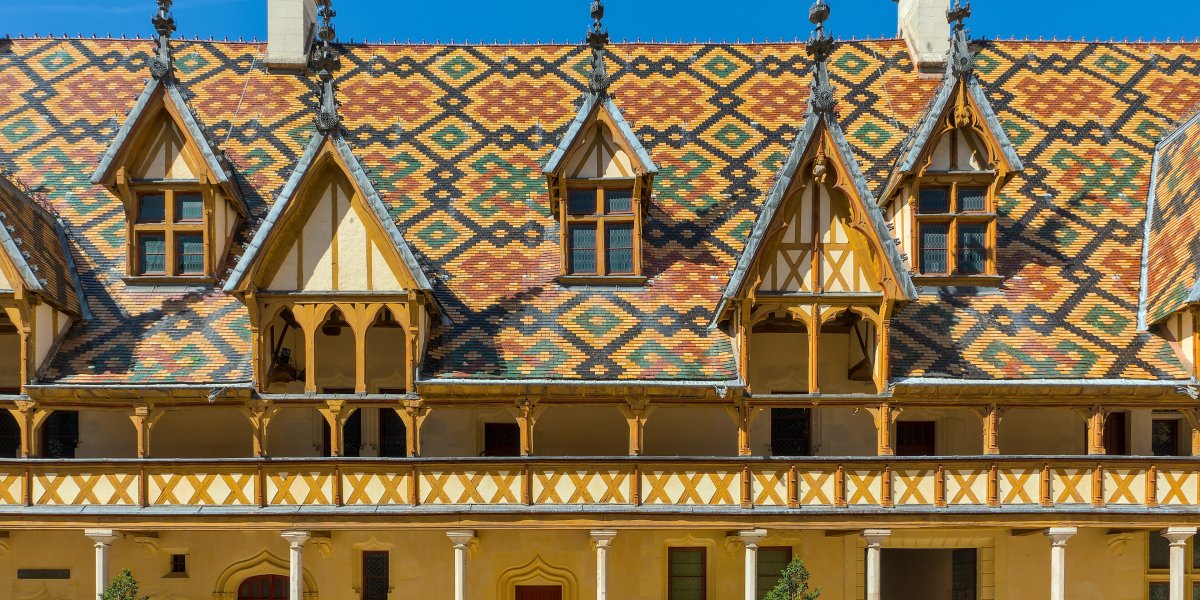
Begin at Place de la Halle, the cobbled square directly opposite the famous polychrome tile roof. At 9 AM the east-facing glazed tiles — yellow, green, ochre, terracotta — catch the first slanted light and the whole facade glows like stained glass. The street-side facade on Rue de l'Hotel-Dieu is deliberately plain (a 15th-century almshouse for the poor should not flaunt wealth), so circle the building clockwise: through the arch into Place de la Madeleine, where the chapel spire and a long stretch of patterned roof rise above the rear wall.
Tip: The Instagram shot every guidebook prints (the full Cour d'Honneur courtyard) requires a €13 ticket. For free: stand at the Place de la Madeleine roundabout 80 m south of the building — the chapel turret and three full bays of polychrome tiles rise above the perimeter wall, and at 9:15 AM the backlight makes the glaze translucent. Better photo than the paid courtyard angle, which is usually crowded with tour groups by 10.
Open in Google Maps →10:00
Entertainment
Cross Place de la Halle diagonally — the entrance is the unmarked arched doorway of the 14th-century Eglise des Cordeliers, 60 seconds from the Hospices. You descend into candlelit stone vaults that have stored wine since the Black Death, and taste 15 Burgundy wines at your own pace from numbered barrels: starting with crisp Aligote and Chablis, building through village-level Cote de Beaune, ending with a 1er Cru Pommard or Volnay. The engraved tasting glass is yours to keep.
Tip: Follow the order strictly — whites first, reds from light (Bourgogne Rouge) to powerful (Pommard 1er Cru). Real local trick: ask the cellar master for the spittoon (crachoir) and actually use it. You have a 10 km vineyard walk ahead this afternoon, and the final Pommard pour is generous enough to derail it. Must-try: stop number 14, the Volnay — it's the wine that justifies the whole exercise.
Open in Google Maps →11:45
Food
Exit the cellars, turn left on Rue Maufoux, then right onto Rue Monge — a 4-minute walk past the 16th-century mansions of the wine merchants. This narrow bistrot has eight tables, a chalk-scrawled menu of three plates, and a wine list that punches three categories above its price range. The lunch formula is fast: oeufs en meurette (poached eggs in red-wine sauce, €14) or a plat du jour like andouillette grillee with mustard cream (€16), plus a glass of village Burgundy (€6).
Tip: Arrive at 11:45 sharp — at 12:15 the local notaries and wine-shop owners pour in and the kitchen slows. Order the oeufs en meurette over the andouillette if you have not eaten Burgundian food before; it is the dish that locals judge a bistrot by, and theirs is among the three best in town. Skip dessert — you need to leave by 13:00 for the ramparts.
Open in Google Maps →13:00
Landmark
Walk south on Rue Maufoux for 3 minutes and climb onto the ramparts at Bastion Saint-Jean. You are now walking on top of the 15th-century city walls — massive earth bulwarks fortified to repel the armies of Louis XI. The full circuit is 2.1 km and passes the rear of the Hospices, the Romanesque facade of Collegiale Notre-Dame, and four surviving bastions with crossbow loopholes intact. Beneath your feet lie the cellars of Bouchard Pere et Fils, Joseph Drouhin, and Patriarche — three of the most famous wine houses in the world, all hidden underground.
Tip: Drop off the ramparts at Bastion Notre-Dame (north side) and detour 80 m to the front of Collegiale Notre-Dame de Beaune — at 13:45 the sun is square on the Burgundian-Romanesque facade and the tympanum sculpture (Coronation of the Virgin) reads cleanly in the light. Free entrance; the interior tapestries are worth a 10-minute glance but you can skip them today. Photo angle: from the steps of the Wednesday market hall opposite.
Open in Google Maps →14:30
Park
Cut west across Place Carnot and exit the old town through Porte Marie de Bourgogne — 8 minutes of urban walking puts you on the D973 ring road. Cross at the roundabout and pick up the green-and-white Voie des Vignes signpost behind the Parc de la Bouzaize. This is a paved former rail line that cuts dead-straight through Pommard and Volnay — 5 km one way to Volnay's church, 10 km return. Every stone wall you pass is a named 'climat' inscribed on UNESCO's World Heritage list; every row of Pinot Noir produces wine that sells for €80 to €800 a bottle.
Tip: Stop at the stone marker on the right just past Pommard village — it reads 'Clos des Epeneaux,' a 5.2-hectare monopole owned by Domaine du Comte Armand and one of the most photographed parcels in all of Burgundy. The Pinot vines here are 60+ years old and visibly gnarled. Fill water bottles before leaving Beaune — there is one drinking fountain in Pommard square and nothing else until you return. The walk is flat but exposed; in July-August carry a hat.
Open in Google Maps →19:30
Food
Walk back into town via Faubourg Madeleine — the restaurant sits in a narrow storefront opposite the parish church of La Madeleine, almost invisible behind two olive trees in planters. Inside: communal oak tables, an open kitchen the size of a closet, and a 1,000-bottle wine list scrawled on chalkboards above the bar. Two daily mains change with the market — typically a slow-cooked boeuf bourguignon (€26) and a poached chicken in vin jaune sauce with morels (€28). The cheese cart from Alain Hess across town is wheeled in at 21:00.
Tip: Reserve 3 weeks ahead by phone only — they refuse online bookings and the dining room seats 28. Skip the wine list and ask the owner Laurent for 'un verre du moment' (€8-12 per glass) — he will pour something from a tiny producer that never appears in print, often a generous taste of the bottle a regular has open. PITFALL: do not eat dinner on Place Carnot or Place de la Halle — every restaurant facing those squares has identical €35 tourist menus serving microwaved boeuf bourguignon and pre-portioned escargot. The locals eat one street back, and the price difference per plate is €10 in your favor.
Open in Google Maps →
Trip builder
Plan this trip around Beaune
Turn this guide into a bookable rail itinerary with FlipEarth.
Keep exploring
Related cities
More in the same country
FAQ
Frequently asked questions
How many days do you need in Beaune?
Most travelers enjoy Beaune in 1 days, with enough time for headline sights and a slower meal or museum stop.
What's the best time to visit Beaune?
The easiest season for most travelers is Apr-Oct, especially if you want good weather and manageable crowds.
What's the daily budget for Beaune?
A practical starting point is about €120 per person per day before hotels, then adjust based on museums, dining, and transport.
What are the must-see attractions in Beaune?
A good first shortlist for Beaune includes Hospices de Beaune (Hotel-Dieu) — Exterior Tour, Beaune Ramparts Walk.