City Guide
Basel
Schweiz · Best time to visit: Apr-Oct.
Day-by-day plan
Choose your pace
Reisedauer
09:00
Landmark
From Basel SBB, walk north through Steinenvorstadt and across Barfüsserplatz, then turn left onto Spalenvorstadt — 15 minutes through Basel's quietly elegant old town. The most imposing medieval city gate in Switzerland, built around 1400, with storybook round towers and a pointed tile roof adorned with painted coats of arms. In the morning, soft eastern light warms the ornate inner facade — this is when the red stone looks its best.
Tip: Stand centered on Spalenvorstadt at street level for the classic postcard shot — the small fountain in front makes a natural foreground element. From the outer west side the gate looks more fortress-like and less photogenic; save your shots for the eastern approach.
Open in Google Maps →10:00
Landmark
Walk east along Spalenvorstadt into Freie Strasse — 10 minutes through Basel's oldest shopping corridor, lined with guild-era facades. Basel's Town Hall erupts in a blaze of crimson across Marktplatz: vivid red-painted walls, gold-leaf coats of arms, and Renaissance murals that make it one of the most arresting civic buildings in Europe. Step through the main arch to find an inner courtyard with even more intricate frescoes, then linger in the square as the daily market fills it with flower stalls and fresh bread.
Tip: Walk into the inner courtyard — it's free, and most visitors miss the elaborate painted frescoes inside. The best photo of the full red facade is from the southeast corner of the square, where the clock tower and main entrance align perfectly.
Open in Google Maps →12:00
Food
No walking needed — the food is right here at the stalls spread across Marktplatz. Eat standing like the locals: a charcoal-grilled St. Johann Bratwurst mit Bürli (CHF 8.50) from the grill stand at the north end of the square, or a wedge of aged Gruyère with a warm pretzel from the cheese vendor. The market runs Monday to Saturday until roughly 14:00 — fifteen minutes here and you're fueled for the afternoon.
Tip: Skip the sit-down restaurants ringing the square — they charge nearly double for a view seat and serve reheated tourist-menu food. The market stalls are fresher, cheaper, and exactly how Basel has eaten for centuries.
Open in Google Maps →13:30
Religious
Walk south from Marktplatz past the ornate Fischmarktbrunnen fountain and down narrow Augustinergasse — a medieval lane that opens suddenly onto Münsterplatz after 5 minutes. The twin towers and diamond-patterned tile roof have anchored Basel's skyline since the 12th century, but the reason to come is behind the cathedral: the Pfalz terrace, an elevated stone platform delivering the single best panorama in the city — the Rhine curving below, Kleinbasel stretching to the horizon, and on clear days the Black Forest and the Vosges framing the distance. In the early afternoon the sunlight falls directly onto the far bank, making Kleinbasel glow.
Tip: Walk to the far western end of the Pfalz terrace for the widest composition — Rhine bend, Mittlere Brücke, and both Münster towers in a single frame. Before leaving, find the Galluspforte on the north transept: the oldest Romanesque figural portal in German-speaking lands, and almost everyone walks right past it.
Open in Google Maps →15:00
Landmark
Take the stone steps down from the Pfalz terrace to the river — a steep but quick 3-minute descent to the small wooden dock. A tiny open boat crosses the Rhine powered entirely by the river's current: no engine, no oars, just a steel cable and the force of water — a Basel tradition since 1854. After the silent 4-minute crossing, turn right along the Oberer Rheinweg promenade and walk east — in the late afternoon the entire Grossbasel skyline glows golden off the water, and this stretch delivers the photograph you came to Basel for.
Tip: Have CHF 1.60 in coins ready — the ferryman often cannot break large bills. After crossing, continue east past Wettsteinbrücke for the definitive Basel shot: the Münster and old town mirrored in the Rhine. On warm afternoons locals line the stone steps with their feet in the water — join them for five minutes and the city reveals its most unguarded side.
Open in Google Maps →19:00
Food
Walk north from the Rhine promenade into Kleinbasel's residential grid, turning left on Rebgasse — 10 minutes through a neighborhood of bakeries and corner bars that feels nothing like the tourist old town. Volkshaus is a Basel institution in a breathtaking 1925 Art Nouveau building with chandeliers, mosaics, and ornate ceilings that alone justify the visit. Order the plate-sized Wiener Schnitzel with warm potato salad (CHF 36) or start with the Flammkuchen with crème fraîche and caramelized onions (CHF 18), paired with a local Ueli Bier — budget CHF 40-60 per person.
Tip: No reservation needed for the ground-floor brasserie — arrive by 19:00 for a table in the main hall under the Art Nouveau ceiling. Avoid the Rhine-front restaurants near Mittlere Brücke: they charge CHF 45 for mediocre pasta because the view does the selling. For a nightcap, walk south to Rheingasse — Kleinbasel's bar street, local and unpretentious.
Open in Google Maps →Zu Tag springen
09:00
Religious
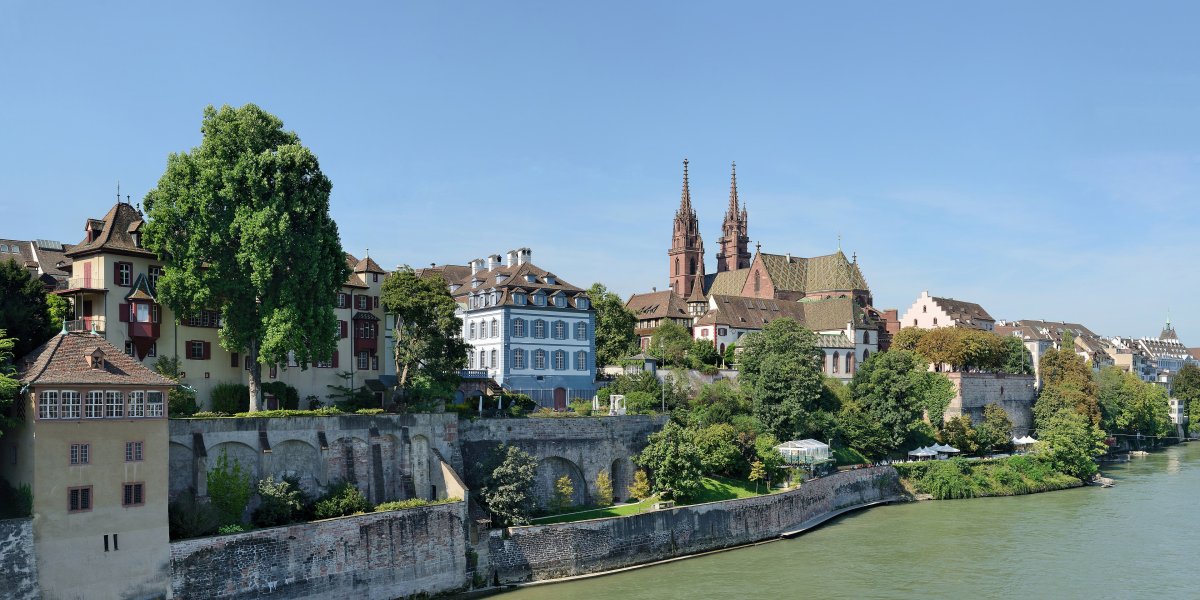
Begin your Basel story at its highest point. The red sandstone cathedral rises above the Rhine on the Münsterhügel, its twin towers visible from every corner of the city. Step inside to see the tomb of Erasmus, then walk through the cloister to the Pfalz — the cathedral's rear terrace, where the Rhine bends below you and the Black Forest stretches to the horizon. At 9 AM the morning sun hits the Kleinbasel rooftops across the water, and you will have this breathtaking terrace nearly to yourself.
Tip: Skip the interior first and go straight through the cloister to the Pfalz terrace — the Rhine panorama from the center railing, where the river bends, is Basel's single best photograph. The tower climb (CHF 5) is not worth it on a short trip; the Pfalz view is wider and better. Return inside afterward for the Romanesque crypt and Erasmus's tomb near the choir.
Open in Google Maps →10:45
Landmark
Walk downhill from the Münster through narrow Augustinergasse, lined with antiquarian bookshops and print galleries — a 5-minute stroll that feels like stepping into the 16th century. The Rathaus erupts in crimson and gold on Marktplatz, impossible to miss. Its vivid red facade was painted in the early 1600s to celebrate Basel joining the Swiss Confederation; step through the main archway into the courtyard to discover the frescoed arcades and ornate clock tower that most visitors walk right past.
Tip: The inner courtyard frescoes — depicting allegorical figures and cantonal coats of arms — are the real showpiece, yet most tourists only photograph the exterior and leave. Walk through the main arch and look up. The daily morning market fills Marktplatz until noon with flower and vegetable stalls; grab a warm Bretzel (pretzel, CHF 2.50) from any stand for the walk.
Open in Google Maps →12:00
Food
Duck from Marktplatz into Schneidergasse, a narrow medieval alley just steps south of the Rathaus — the timber-framed Gifthüttli is 2 minutes on foot. This centuries-old guild house restaurant is where Basel's old town workers still take their midday meal. Low ceilings, dark oak paneling, and a menu that hasn't needed reinvention. Start with Basler Mehlsuppe — Basel's iconic roasted-flour soup, dark, smoky, and rich, a dish you will not find done properly outside this city — then follow with a golden Käseschnitte, Switzerland's answer to the croque-monsieur, baked until bubbling.
Tip: Arrive at noon sharp — by 12:20 every table is taken and you will wait 20 minutes. Order the Basler Mehlsuppe (CHF 14) and Käseschnitte (CHF 24). Ask for Hahnenwasser (tap water) instead of bottled — Swiss tap water is pristine and it is free. Skip the rösti here; save that dish for a mountain town where they do it justice.
Open in Google Maps →13:30
Museum
Walk south from Gifthüttli along Freie Strasse — Basel's elegant shopping boulevard lined with watchmakers and chocolate shops — then turn left onto St. Alban-Graben. A pleasant 10-minute stroll. The Kunstmuseum holds the oldest public art collection in the world, and in 1967 Basel's citizens voted at referendum to purchase two Picassos at auction, making it the first city where the public collectively bought modern art. The collection spans from Holbein's haunting 'Dead Christ in the Tomb' through Monet, Cézanne, and Picasso to Richter and Kiefer in the contemporary wing across the street.
Tip: Head straight to the second floor of the main building for the Holbein room — his 'Dead Christ in the Tomb' is the painting Dostoevsky stood before, so shaken it inspired a pivotal scene in 'The Idiot.' Then cross through the underground passage to the Neubau (new building) for the contemporary collection. Closed Mondays. The post-lunch slot means thinner crowds than morning; by 14:00 the tour groups have moved on.
Open in Google Maps →16:00
Neighborhood
Exit the Kunstmuseum and walk west along Steinenberg, through Barfüsserplatz where buskers often play beneath the plane trees, then continue uphill — 10 minutes total. The Spalentor appears suddenly: a towering medieval city gate with twin round towers and a steep pointed roof, the best-preserved gate in Switzerland. Pass through it, then turn around and walk DOWN Spalenberg and Nadelberg. The lanes twist and narrow between half-timbered houses, independent boutiques, vintage bookshops, and artisan chocolate makers. Late afternoon light catches the upper facades at a warm angle that makes every doorway glow.
Tip: Photograph the Spalentor from outside the gate looking in — the twin towers frame the lane perfectly. Walk DOWN Spalenberg, not up; each bend reveals another photogenic corner as the street narrows. Stop at Beschle (Spalenberg 2) for a box of Basler Läckerli — the city's signature spiced honey biscuit (CHF 8). Avoid the overpriced tourist shops on Freie Strasse; Spalenberg's boutiques are where locals actually browse.
Open in Google Maps →19:00
Food
Descend from Spalenberg through Nadelberg and Heuberg toward the Rhine — a scenic 10-minute downhill walk past painted facades and hidden courtyards that open and close as you pass. The Grand Hotel Les Trois Rois has occupied this bend of the Rhine since 1681, hosting Napoleon, Queen Victoria, and Picasso. Its brasserie serves refined Swiss-French cuisine in a dining room that opens directly onto the river. The atmosphere is elegant but not stiff — Basel's business crowd unwinds here, and in summer the terrace tables overlooking the moonlit Rhine are simply unforgettable.
Tip: Reserve a terrace table — the Rhine view at dusk with Kleinbasel's lights reflecting on the water is the finest dinner panorama in the city. Order the Felchen, Lake Constance whitefish pan-fried with brown butter (~CHF 48), or the Entrecôte café de Paris (~CHF 56). Budget CHF 65-85 per person with a glass of wine. Book at least 2 days ahead for weekend evenings; weeknights are easier.
Open in Google Maps →09:00
Landmark
Start your second morning in Basel's most picturesque and least-visited corner. Walk south from the old town along St. Alban-Vorstadt to the medieval St. Alban Gate — one of the last surviving city gates on Basel's southern flank. Step through it into St. Alban-Tal, where a canal from the old paper mills still flows between half-timbered houses draped in ivy. This is Basel's 'Little Venice': cobblestones, wooden water wheels, and barely a soul in sight before 10 AM. Morning light filters through the chestnut trees and turns the canal path golden.
Tip: Stand on the small stone bridge over the canal just past the gate — the reflection of the timbered houses in the still water is the most 'secret Basel' photograph you will take. This lane is nearly empty before 10 AM; by afternoon joggers and cyclists fill the path and the stillness is gone.
Open in Google Maps →10:00
Museum
Continue 2 minutes down St. Alban-Tal along the canal — the museum occupies the very medieval mill complex you have been admiring. The Basler Papiermühle is a working museum inside a 15th-century paper mill where you make paper by hand, set lead type on a Gutenberg-era press, and print your own page to carry home. It is hands-on in a way most museums never attempt: you will leave with ink stains on your fingers and a sheet of handmade paper in your bag that is worth more than any souvenir shop trinket.
Tip: Do not rush the letterpress station on the ground floor — the staff will help you compose and print a custom line of text using antique lead type. It takes 10 minutes and produces the best souvenir in Basel, for free with your ticket. Closed Mondays. The museum is intimate; 1.5 hours is enough to complete every hands-on station without hurrying.
Open in Google Maps →12:00
Food
Walk north from the Paper Mill along St. Alban-Rheinweg toward the Rhine — a quiet 5-minute riverside path shaded by chestnut trees, with the sound of the current beside you. Restaurant zum Goldenen Sternen, documented since 1421, claims to be the oldest restaurant in Switzerland. It sits directly on the Rhine with a summer terrace that catches the midday sun. White tablecloths, river views, and a seasonal menu of Swiss classics — this is a proper, unhurried Basel lunch, the kind of meal where you forget you are a tourist.
Tip: Sit on the Rhine terrace if the weather allows. The daily lunch set menu (Tagesmenu, CHF 28-35) is outstanding value for Basel and changes with the season. For à la carte, the Kalbsgeschnetzeltes — sliced veal in white wine cream sauce served over rösti (~CHF 42) — is their signature and worth every franc. Skip dessert; you will want coffee later by the river.
Open in Google Maps →13:30
Landmark
Walk 3 minutes east along St. Alban-Rheinweg to the ferry landing, marked by a small green wooden cabin on the bank. Basel's four Rhine ferries are unlike anything else in Europe: small open boats attached to an overhead cable, propelled entirely by the river's current — no engine, no fuel, just the silent force of the Rhine angling against the hull. The St. Alban-Fähre, affectionately called 'Wilde Maa,' glides you across in 4 minutes. Stand at the railing and watch the Münster towers rise behind you as Kleinbasel's colorful facades draw closer ahead.
Tip: Pay the ferryman CHF 1.60 in coins (exact change appreciated; no cards). Stand on the downstream side of the boat for the best view of the old town skyline and Münster receding behind you. The ferry runs every 10-15 minutes with no fixed schedule — just walk up and wait. This is not a tourist attraction; it is how Basel locals actually commute.
Open in Google Maps →14:30
Museum
From the Kleinbasel landing, turn right and walk east along Oberer Rheinweg — a wide, leafy promenade where locals sunbathe on the stone steps and swimmers drift past in the current below. After a 15-minute riverside stroll you will see the Solitudepark and Mario Botta's elegant museum facade. Museum Tinguely houses the world's largest collection of Jean Tinguely's kinetic sculptures: clanking, whirring, rattling machines built from scrap metal, bicycle wheels, and found objects. Visitors press buttons to bring them to life. Every piece moves, surprises, and makes you laugh — it is joyful, anarchic art that turns the whole room into a playground.
Tip: Press every button you see — the sculptures are designed to be activated and the staff encourages it. The large 'Méta-Harmonie' pieces on the ground floor produce hauntingly beautiful sounds from salvaged piano keys and metal chimes. Do not miss the outdoor sculpture garden behind the museum overlooking the Rhine. Closed Mondays. The museum café terrace is a perfect post-visit stop for an espresso above the water.
Open in Google Maps →19:00
Food
Walk west from Museum Tinguely along the Rhine promenade, then turn into Kleinbasel's lively grid of streets toward Claraplatz — about 20 minutes on foot through Basel's most multicultural neighborhood, where Turkish bakeries and Lebanese grills sit next to Swiss wine bars. The Volkshaus is a grand Art Deco hall redesigned by Basel's own Pritzker Prize architects Herzog & de Meuron. The brasserie serves hearty, modern Swiss-European cooking beneath soaring ceilings with original 1920s terrazzo floors, brass fixtures, and tall arched windows that glow amber by evening.
Tip: The Wiener Schnitzel (~CHF 38) is legendary — hand-pounded, pan-fried, and larger than the plate. Pair it with a glass of Gutedel from the Markgräflerland across the German border (~CHF 9). Budget CHF 50-65 per person with wine. No reservation needed on weeknights; book ahead for Friday or Saturday. On your walk back toward the station, avoid the cluster of overpriced restaurants around Barfüsserplatz — they survive on tourist foot traffic and locals know to skip them entirely.
Open in Google Maps →
Trip builder
Plan this trip around Basel
Turn this guide into a bookable rail itinerary with FlipEarth.
Keep exploring
Related cities
More in the same country

FAQ
Frequently asked questions
How many days do you need in Basel?
Most travelers enjoy Basel in 1 days, with enough time for headline sights and a slower meal or museum stop.
What's the best time to visit Basel?
The easiest season for most travelers is Apr-Oct, especially if you want good weather and manageable crowds.
What's the daily budget for Basel?
A practical starting point is about €90 per person per day before hotels, then adjust based on museums, dining, and transport.
What are the must-see attractions in Basel?
A good first shortlist for Basel includes Spalentor, Basel Rathaus & Marktplatz, Münsterfähre Rhine Ferry.